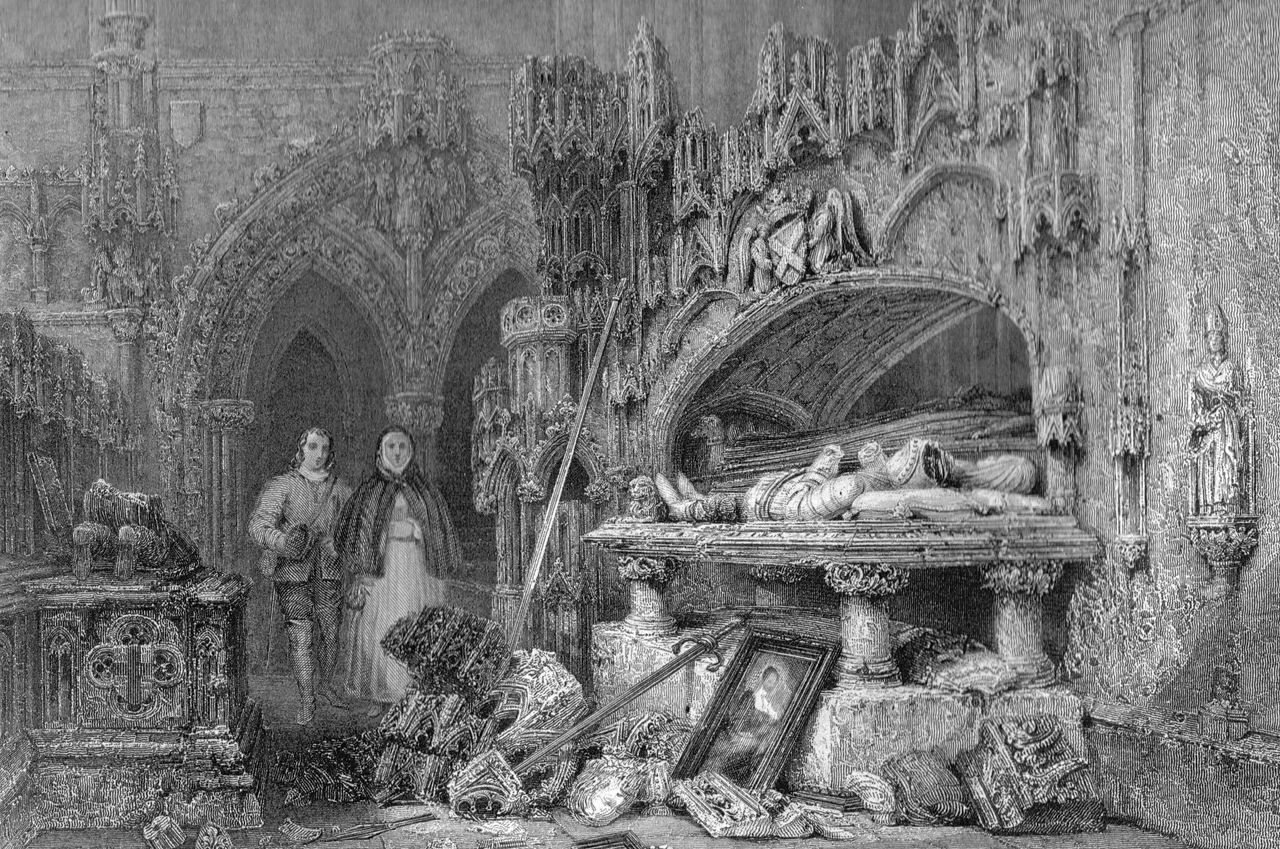

Melrose Abbey
Robert the Bruce, the king who won Scottish independence at Bannockburn, asked on his deathbed that his heart be cut from his body and carried to the Holy Land on crusade. The mission ended in disaster in Spain. The heart returned, wrapped in lead, and was buried at Melrose Abbey - the great Cistercian house that Bruce had ordered rebuilt after the English burned it in 1322. In 1921 and again in 1998, archaeologists found a lead container in exactly the place the medieval records said the heart was buried. The Bruce's heart still lies under the ruined chapter house, between the chestnut trees, where he wanted it to be.
Cistercians and a King's Patronage
Melrose Abbey was founded in 1136 by Cistercian monks at the request of King David I of Scotland - the first Cistercian house in the country. David was deliberately importing the most rigorous and self-sufficient monastic order he knew, transplanting them into the wool-rich grasslands of the Borders. The east end of the church was completed in 1146; the rest of the complex was built over the following half-century. The Cistercians did with sheep what David had hoped: they pioneered new farming techniques and made Melrose wool a brand recognised in the great trading ports of northern Europe. The abbey was the chief Cistercian house in Scotland until the Reformation. One of the earliest surviving accounts of the Magna Carta agreement at Runnymede in 1215 is found in the Chronicle of Melrose Abbey - a monk's contemporary record made far from the field at Runnymede but transmitted along the international networks the white monks ran.
The Burning and the Bruce
Melrose sat on the main road from Edinburgh to England, which made it dangerously exposed. In 1322 Edward II's army, retreating from Scotland, attacked the town and much of the abbey was destroyed. Robert the Bruce ordered it rebuilt, with Sir James Douglas - his great commander, known to the English as the Black Douglas - serving as the principal auditor of finance for the reconstruction. Bruce died in 1329 and asked Douglas to carry his heart on crusade to Jerusalem; Douglas was killed in 1330 fighting the Moors in Spain, but the heart was recovered from his body and brought home. The medieval records say it was buried at Melrose. In 1921 a lead container was found below the chapter house site, opened, photographed, and re-buried. In 1998 archaeologists found it again and confirmed the location. It remains there now, marked by a small carved stone in the grass.
The Mason's Inscription
Look at the right places on the abbey walls and you will see John Morow's signature. He was the master mason who supervised the late-fourteenth-century rebuilding after Richard II of England burned Melrose again in 1385. On one of the abbey's stairways he carved an inscription that is half prayer, half craftsman's confession: "Be halde to ye hende" - "Keep in mind, the end, your salvation." The phrase became the motto of the town of Melrose. Morow's other carved decorations cover the abbey: saints, dragons, gargoyles, and plants. There is a famous gargoyle on the south wall that depicts a pig playing bagpipes - a small, irreverent joke in stone that has now stared down over the ruins for more than six hundred years.
Cromwell and the Last Monk
From 1541 the abbey was held by commendators - secular nobles awarded the income without the religious duties - and its life as a working monastery declined. The last abbot, James Stuart, an illegitimate son of James V, died in 1557. In 1590 the abbey's last monk died, and the long Cistercian presence at Melrose ended. The walls were bombarded one final time by Oliver Cromwell's troops during the Wars of the Three Kingdoms, and some of the masonry still shows cannon damage. In 1618 part of the church was converted into a parish church for the town and used until 1810. Sir Walter Scott, as Sheriff-Depute of Roxburghshire in the early nineteenth century, oversaw the restoration that preserved what stands today, with funding from the Duke of Buccleuch. In 1918 the duke gave the ruins to the state. In 2019 the abbey received 61,325 visitors. The Bruce's heart still lies where the medieval records placed it, and the carved inscription on the stairway still asks pilgrims to remember the end.
From the Air
Melrose Abbey lies in the small town of Melrose on the south bank of the River Tweed at 55.60N, 2.72W. From the air the most striking visual marker is the triple-peaked silhouette of the Eildon Hills immediately south - three distinct conical summits that local legend says were split into three by the wizard Michael Scot. The abbey ruins sit at the foot of the Eildons in a bend of the Tweed. Best viewed at 1,500-3,000 ft AGL. Nearest ICAO: EGPH (Edinburgh, 30nm northwest), EGNT (Newcastle, 56nm south). The Eildons are a reliable visual fix from up to 30nm in clear conditions.
Nearby Stories
- Peebles 2.5 km away
- Edinburgh South 3.2 km away
- Eyemouth Disaster 5 km away
- Gifford, East Lothian 6.8 km away
- Battle of Homildon Hill 9.2 km away
- Simonside Hills 14 km away
- Kielder Observatory 16 km away
- Lockerbie 30 km away