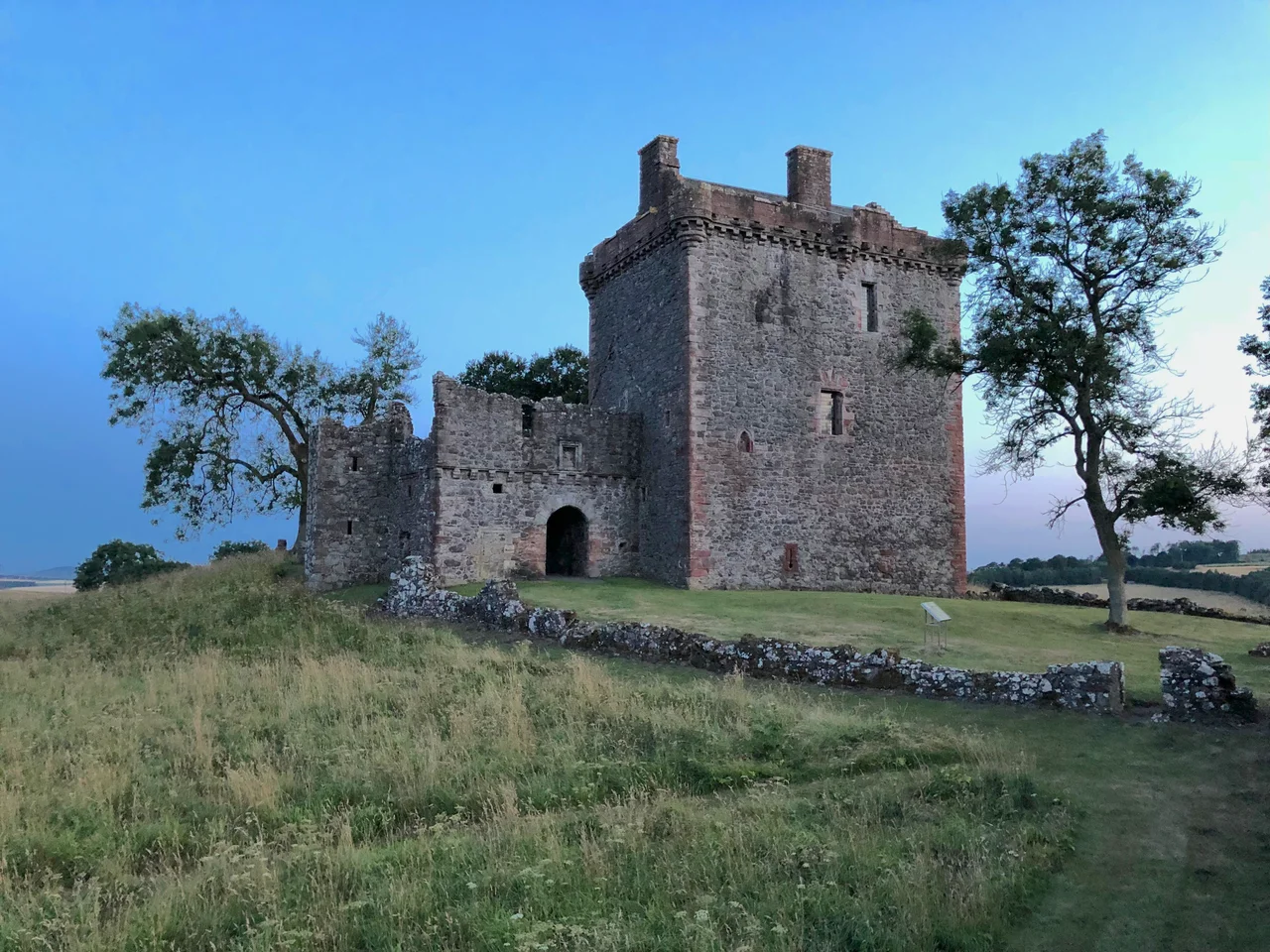

Balvaird Castle
Sir Andrew Murray married into the lands. Balvaird belonged to the Barclay family, and when Margaret Barclay - daughter of James Barclay of Kippo, heiress to a prosperous Perthshire estate - became his wife around 1495, the property and the title came with her. The new tower house Andrew built on the ridge above Strathearn was meant to declare the marriage's success: a refined, well-proportioned residence at a time when most Scottish lairds were still building blunt stone boxes. The name comes from Gaelic - Baile a' Bhàird, 'Township of the Bard.' Whether a poet ever actually lived here is unknown. What is certain is that Balvaird is one of the most architecturally accomplished tower houses of its century.
A Marriage and a Tower
Andrew Murray was a younger son of the Murrays of Tullibardine, the kind of cadet branch noble who needed to make his own way. Margaret Barclay brought him the lands and probably the site of an earlier Barclay castle, traces of whose earthwork defences may still survive around the present tower. Balvaird is first mentioned in the written record in 1498, in the Register of the Great Seal of Scotland, as 'the place of Balward.' The tower itself probably went up around 1495, the year of the marriage. The inverted keyhole gun-holes - small openings shaped for early hand-held firearms - date the construction firmly to the late 1400s. This was a fortification, but a comfortable one.
Carved Heads and a Kitchen on the Ground
What makes Balvaird unusual among Scottish castles of its date is the architectural refinement. Carved stone heads serve as corbels supporting the corner roundels of the wall-walk. An elaborate aumbry - a wall cupboard - decorates the first-floor hall in a style more typical of an ecclesiastical building, leading some scholars to suggest that the carved stonework may have been salvaged from a church and reused here. Above the stair sits a cap-house in the shape of a miniature tower-house. The red sandstone ornament throughout would have been an extravagant choice. And the kitchen, unusually for the period, was placed on the ground floor rather than tucked into a corner of an upper room - a practical decision that hints at a household of some scale.
A Gatehouse, a Garden, an Orchard
The Murrays kept extending. A gatehouse went up in 1567, securing the main approach with an outer courtyard that probably contained stabling and added a second line of defence. To the south of the tower lay a formal garden. To the north-east, a much larger walled area served as an orchard or pleasance - a planted ornamental space for leisure. By the time these additions were finished, Balvaird was no longer just a defensive house but a fully equipped country estate. The family lived here for more than 150 years, until they were elevated to the Viscountcy of Stormont and moved in 1658 to the more comfortable Scone Palace near Perth. After that the castle accommodated farmworkers.
Restoration and the Modern Owner
MacGibbon and Ross, the great Victorian cataloguers of Scottish castles, noted in 1887 the presence of a 'recumbent statue lying in the castle' - possibly the funerary effigy of Lady Margaret Barclay herself, the original bride. Historic Scotland later took on the castle's restoration, partially excavating the site and stabilising the structure. The grounds are open at all times, but the tower itself has been closed to the public for several years for safety reasons due to structural deterioration. The Murray family owned Balvaird until 2017, when ownership passed to an American entrepreneur, Brady Brim-DeForest, who acquired the baronial Lordship of Balvaird with the castle. The wind still cuts across the ridge. The view across Strathearn still opens at the foot of the Ochils, the same view Andrew Murray and Margaret Barclay would have seen on the day they first walked up the hill to their new house.
From the Air
Balvaird Castle stands at 56.289 north, 3.343 west, on a ridge in the Ochil Hills about 5 kilometres south of Abernethy in Perth and Kinross. From the air the late-medieval tower house is visible as a distinctive stone structure on an exposed ridge, with the broad valley of Strathearn opening northward and the high ground of the Ochils extending south. Best appreciated from 2,000 to 4,000 feet. Dundee Riverside (EGPN) lies roughly 17 nm north-east. Edinburgh (EGPH) is about 30 nm south, Glasgow (EGPF) 50 nm south-west. The M90 motorway runs to the east of the castle.
Nearby Stories
- Drummond Castle 0.4 km away
- St Andrews 0.8 km away
- Aberfeldy 2.2 km away
- Yellowcraig 2.7 km away
- Fordell Castle 3 km away
- Battle of Sauchieburn 3.2 km away
- Battle of Dun Nechtain 3.3 km away
- Airlie Castle 13 km away