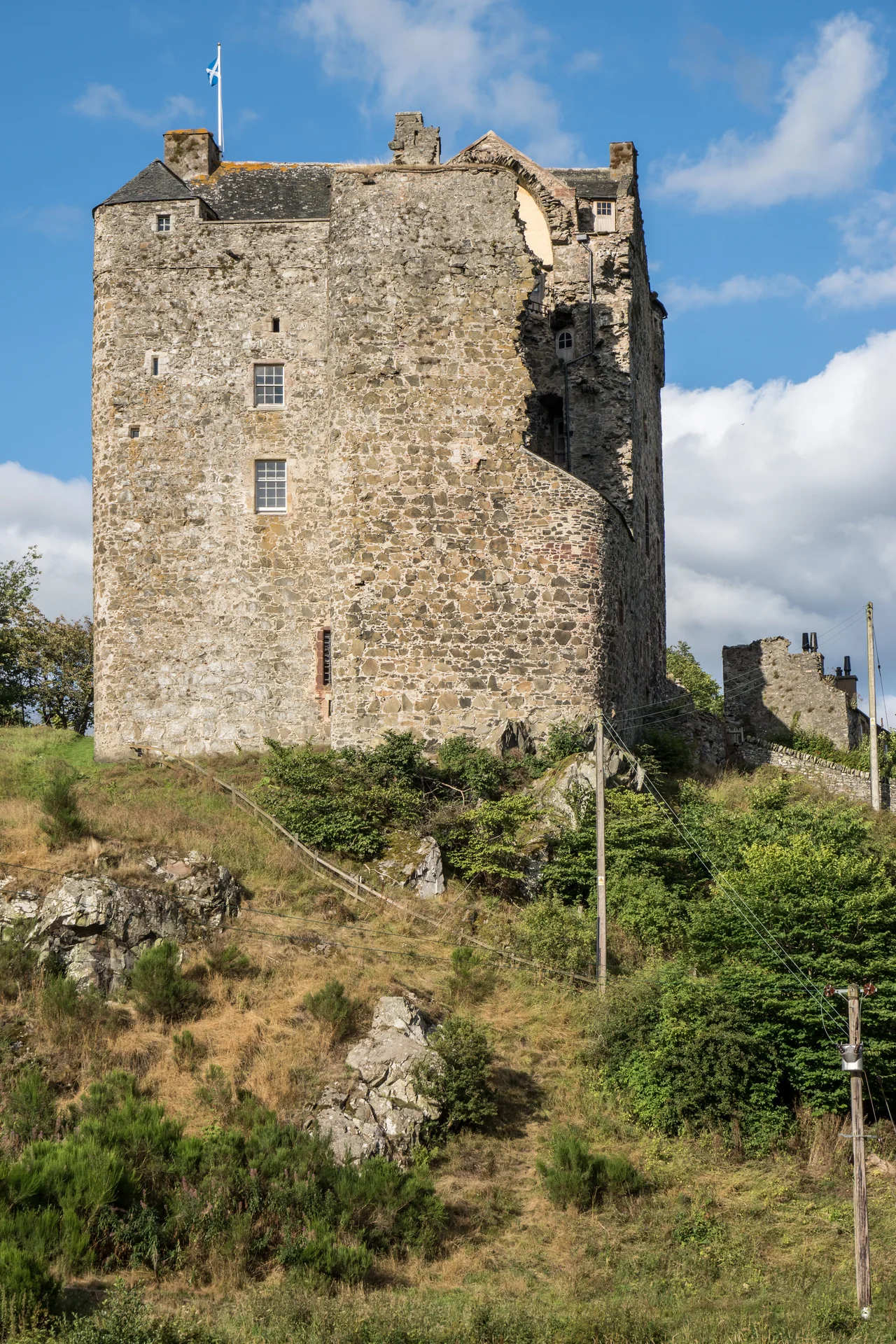

Neidpath Castle
Walter Scott wrote a poem about her. The Maid of Neidpath, he called her - Jean Douglas, daughter of William Douglas, Earl of March - who fell in love with a man her family considered beneath her, was forbidden to marry him, watched him sent away, and slowly wasted from grief. When he returned, the legend says, she had thinned so dramatically he did not recognise her, and she died of a broken heart on the spot. She is said to haunt the rubble-built tower above the River Tweed, dressed in a brown full-length gown with a large white collar.
The Fraser Beginning
An earlier castle probably stood here between 1263 and 1266, built by Simon Fraser of Oliver Castle while he served as High Sheriff of Tweeddale. The barony passed to the Hay family through marriage in the early 14th century, when the heiress Margaret - granddaughter of the sheriff - married into Clan Hay. Sir William de Haya, who died around 1390, built the present L-plan tower house in the late 14th century. It is a rubble-built structure, meaning the walls were assembled from undressed stones bedded in lime mortar rather than the precisely cut ashlar that wealthier builders preferred. That choice was practical rather than aesthetic: rubble was faster, cheaper, and on a defensive site above a river, perfectly adequate.
Royal Visitors
Mary, Queen of Scots came to Neidpath in 1563, the year after her return from France and her brief, troubled personal rule of Scotland. Her son James VI followed in 1587, by then nearly grown and consolidating the authority that would eventually take him to the English throne. The Hays did not stay at Neidpath as their principal residence for long - Sir Thomas Hay, William's son, married Sir Hugh Gifford's daughter and heiress and acquired Yester Castle, which became the family seat. Neidpath continued to be used, but as a secondary stronghold rather than the centre of operations. In the 1660s the 2nd Earl of Tweeddale remodelled the tower and added outbuildings - the kind of practical updates that turned medieval fortifications into Restoration-era country residences.
The Maid
The story of Jean Douglas is the kind of romance that 19th-century Scotland could not resist. She was the youngest daughter of William Douglas, Earl of March. The man she loved was the son of the laird of Tushielaw - acceptable family, but not acceptable for her station. The earl forbade the marriage and sent the suitor away. Jean refused to recover from his absence; the Scots word dwine, meaning to waste away, is the verb the old accounts use. By the time her lover returned, the legend says, she was so reduced that he did not recognise the woman standing before him - and the shock of that non-recognition killed her. Walter Scott picked up the story in his poem 'The Maid of Neidpath,' and the ghost has been part of the castle's identity ever since. She appears in a long brown dress with a large white collar.
After the Earls
When the 4th Duke of Queensberry died in 1810, the castle passed - along with the earldom of March - to the Earl of Wemyss, while the dukedom went to the Scotts of Buccleuch. The split was characteristic of how Scottish titles fractured through the 18th and 19th centuries when great houses ran out of direct male heirs. Today Neidpath is still in private hands - it is a wedding venue and a filming location, viewable by appointment. The setting is the genuine draw: the tower stands above a steep bend in the River Tweed about a mile west of Peebles, in country that has barely changed in centuries. There is even a Saskatchewan hamlet named Neidpath after this Scottish castle, founded by immigrants who wanted to bring a piece of the Borders with them across the Atlantic.
From the Air
55.652°N, 3.215°W, above the River Tweed approximately one mile west of Peebles in the Scottish Borders. Best viewed at 1,500-2,500 feet to take in the tower, the river bend, and the surrounding hills. Edinburgh Airport (EGPH) is 23 nautical miles north; Glasgow Airport (EGPF) about 40 nautical miles west-northwest. The Tweed valley is the dominant geographic feature, with the castle perched above a steep meander. The Pentland and Moorfoot Hills lie north, the Manor Hills southwest.
Nearby Stories
- Heriot-Watt University 1.7 km away
- Gifford, East Lothian 4.2 km away
- Craignethan Castle 7 km away
- Melrose Abbey 7.1 km away
- Battle of Kilsyth 13 km away
- Moniaive 20 km away
- Kielder Observatory 20 km away
- Battle of Lochmaben Fair 28 km away