
Heriot-Watt University
In 1821 a group of Edinburgh artisans wanted to learn the science underneath their trades. The institution they built to teach themselves became, in 1966, a full university by royal charter. It is now the eighth-oldest university in the United Kingdom and the first ever institution anywhere called a mechanics' institute. The name on the gate is a partnership across two centuries: George Heriot, the Jacobean goldsmith whose seventeenth-century endowment funded the technical college that would one day grant degrees, and James Watt, the eighteenth-century instrument-maker whose steam engine reorganised the world. Together they stand for an idea Edinburgh kept faith with: that learning is for the people who do the work.
The First Mechanics' Institute
In April 1821, Leonard Horner and Robert Bryson opened the School of Arts of Edinburgh, intending to provide working artisans with classes in mathematics, chemistry, and physics applied to their trades. It was the first such institution anywhere in the world. The classes were held in the evenings. The fees were small. The pupils were stonemasons, instrument-makers, joiners, bookbinders - people whose hands made the city work and who now wanted to understand the science beneath the practical skill. Within years the model had been copied across Britain and beyond. By 1851 there were over 700 mechanics' institutes in the United Kingdom. None of them existed before the Edinburgh one did. The world had imported the idea from a small school that began with about 450 students and a library of around 500 technical works.
Watt Institution, Watt College
In 1851 the School of Arts was renamed the Watt Institution and School of Arts, after the engineer James Watt. The curriculum broadened beyond pure mathematics and physical sciences to include social sciences and humanities, and the student body broadened too - middle-class students arrived in significant numbers, and by 1885 the skilled working class for whom the institution had been founded was no longer the majority. Women were first admitted thanks to the campaigning of Mary Burton, who in 1874 became the institution's first female director. In 1870 the Watt Institution had to leave its Adam Square home when the square was demolished to make way for Chambers Street. In 1885 the Heriot Trust - the same trust that ran George Heriot's School - was reorganised by the Balfour Commission, and one of the outcomes was the creation of a new technical college named Heriot-Watt, combining the two endowments. From this point the institution was called Heriot-Watt College, and from 1902 it was a Scottish central institution. Degrees followed, university status came in 1966.
Riccarton and a Research Park
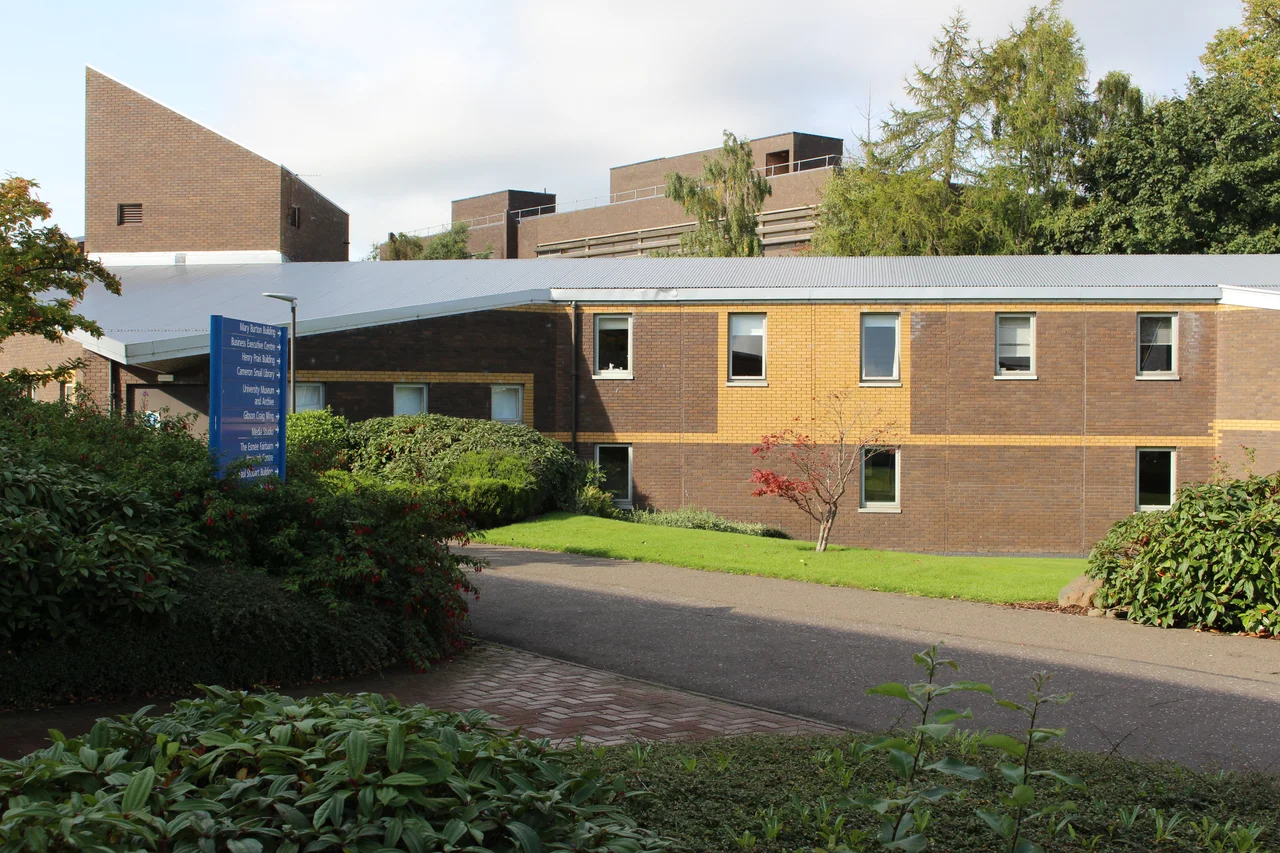
By the 1960s Heriot-Watt had outgrown its central Edinburgh sites and started moving to a new campus at Riccarton, southwest of the city. The Riccarton estate runs to 380 acres of parkland, with academic buildings scattered among lakes and woodland - more rural college than urban university. In 1971 the institution opened Europe's oldest research park on the same site, hosting companies that wanted to collaborate with the university's engineers and scientists. Recent investment has been substantial: the UK's first purpose-built graduate centre, the Oriam Sports Performance Centre (Scotland's elite training facility, 33 million pounds), the UK's first FlexBIO flexible downstream bioprocessing centre, and a 5,000-square-metre Watt Innovation Building supporting the GRID research network. The University's Institute of Petroleum Engineering is based at Riccarton, reflecting Edinburgh's role in North Sea oil and gas research. The campus has its own bus routes, its own lake, and its own museum.
Three Continents
Heriot-Watt is unusual among British universities for the genuinely transnational reach of its physical campuses. The Scottish Borders campus in Galashiels runs the School of Textiles and Design, which traces its origin to 1883 when the Galashiels Manufacturer's Corporation began running technical classes for textile workers - a parallel mechanics' institute that joined Heriot-Watt in 1998. The Dubai campus opened in 2005 in Dubai International Academic City, the first British university to do so. In 2021 it relocated to Dubai Knowledge Park, where King Charles III formally opened the new campus on 30 November 2023 alongside Scotland's then First Minister Humza Yousaf. The Malaysian campus opened in Putrajaya in September 2014 - the country's first 'green campus', 35 million pounds invested, set on a lakeside site. A small Orkney campus in Stromness houses the International Centre for Island Technology, focused on renewable energy and marine research. From Galashiels to Putrajaya, the university is bigger than any one country.
What the Numbers Show
Heriot-Watt now teaches across six schools and one institute: Energy, Geoscience, Infrastructure and Society; Engineering and Physical Sciences; Social Sciences with the Edinburgh Business School; Mathematical and Computer Sciences; Textiles and Design; the Global College foundation pathway; and the Urban Institute, a research collaboration with the University of Edinburgh. Annual income in 2024-25 ran to 293.9 million pounds, of which 52.3 million came from research grants and contracts. Distance learning programmes reach students through 53 approved learning partners worldwide. The mechanics' institute that opened with 450 evening students in 1821 now has, including its overseas campuses, tens of thousands of students. The original mission has shifted in some ways and held firm in others. It is still a university built around the proposition that technical education matters - that the engineers and chemists and textile designers and renewable energy specialists doing the work of a complicated economy deserve a serious place to learn how the work really works.
From the Air
The Riccarton campus of Heriot-Watt University sits at 55.909N, 3.320W in southwest Edinburgh, about 5 nm southwest of Edinburgh Castle and 4 nm south-southwest of Edinburgh Airport (EGPH). From the air the campus is identifiable as a compact cluster of academic buildings set within 380 acres of parkland and lakes, just east of the A720 Edinburgh City Bypass. Easy landmarks: the Pentland Hills lie immediately to the south, Currie village 1 nm west, the Water of Leith winds past to the north. Murrayfield Stadium is 4 nm northeast. Best viewing altitude 2,000-3,500 ft. Look for the modernist concrete buildings around two artificial lakes; the campus is most photogenic in autumn when the surrounding parkland turns colour. Heriot-Watt's other campuses in Galashiels (Scottish Borders, 30 nm south), Dubai, Putrajaya and Stromness are not in this geographic frame.
Nearby Stories
- Ardoch Roman Fort 2.2 km away
- Craignethan Castle 3.1 km away
- Haddington 3.8 km away
- Balvaird Castle 4.3 km away
- Battle of Kilsyth 9.4 km away
- Siege of St Andrews Castle 9.9 km away
- Neidpath Castle 11 km away
- Melrose Abbey 15 km away