
Siege of St Andrews Castle
On the first of March 1546, the Protestant preacher George Wishart was burned at the stake in front of St Andrews Castle. Cardinal David Beaton watched from a cushioned window above. Wishart was thirty-three years old, a scholar who had translated the Helvetic Confession into Scots and preached the Reformation across Fife and Angus. He died slowly, the way fires of green wood always made men die. Eighty-eight days later, on the morning of 29 May, sixteen men forced their way into the castle and stabbed Beaton to death in his bedchamber. Then they hung his body from the same window from which he had watched Wishart burn. The siege that followed lasted eighteen months and broke a country.
The Assassins Inside
The conspirators were Fife lairds, well-connected Protestant gentry, some of them friends of the burned preacher, others men who had quarrelled with Beaton over land or politics. They divided into four teams. Norman Leslie, Master of Rothes, slipped in disguised as a mason, exploiting building work that was under way at the castle. James Melville came in pretending to have an appointment. William Kirkcaldy of Grange and eight men walked through the drawbridge gate. They overpowered the porter Ambrose Stirling, stabbed him, and threw his body in the ditch. Peter Carmichael stabbed the Cardinal in his chamber, or perhaps on the spiral stair of the east blockhouse. The lairds then salted Beaton's body, wrapped it in lead, and buried it in the Sea Tower of his own castle. The poet David Lyndsay later put words in the Cardinal's ghost: They salted me, then closed me in a chest. Whatever you think of David Beaton, that detail is hard to read without flinching for him.
The Castilians and the Mine
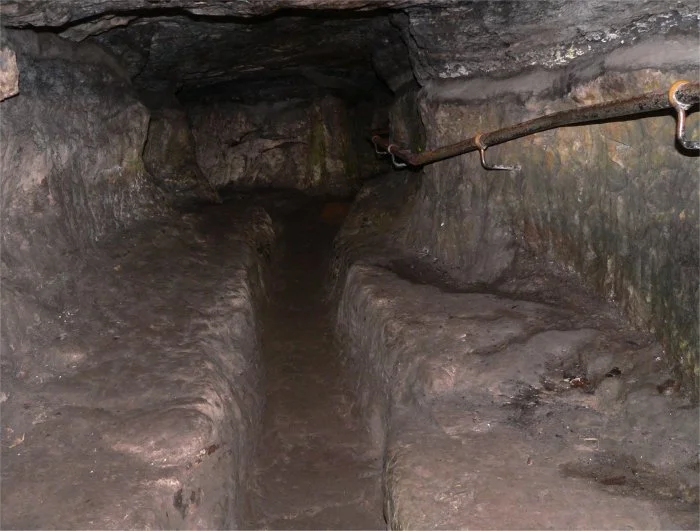
The conspirators barricaded themselves inside and called themselves the Castilians. Regent Arran, James Hamilton, 2nd Earl of Arran and Governor of Scotland, could not act immediately because he was busy at Dumbarton Castle. By autumn 1546 the Scottish siege began in earnest. Arran's gunners dug a mine, a tunnel through solid rock meant to undermine the Fore Tower or break into the castle from below. The defenders heard them and dug a counter-mine. Both tunnels survive, rediscovered in 1879 and open to the public today, the only siege mines from the period in Britain that can still be walked through. Arran's guns, Crook-mow and Deaf Meg among them, battered the walls but the gunners died fast under return fire. The Castilians killed Arran's master gunner John Borthwick and several artillerymen in two days, and the Regent pulled his cannon back. The defenders ate sparingly. Walter Melville and twenty other men died of poor rations and bad fish.
Knox Walks In
In April 1547, during a truce while the besieged waited for a papal absolution that would, on paper, allow them to surrender on good terms, the Castilians invited a man named John Knox to enter the castle. He had been Wishart's bodyguard once. He was already known as a fiery preacher; the castle wanted a chaplain. Knox came in. For a few months he had the freedom of the place, walking out to preach in the parish church and back to preach to the garrison. He used the bottle dungeon as a sermon illustration: Many of God's children were imprisoned here. He could not have known that within months he would be in a French galley, chained to an oar, looking at the sky through a small barred hole and praying for God to release him. Knox's time at St Andrews shaped everything that followed in his life and through him the Scottish Reformation itself.
The French Fleet and the End
The papal absolution arrived in April. The Castilians refused to surrender, saying privately that they would rather have a measure of wheat than all the Pope's remissions. Henry VIII of England had died in January, and the new king Edward VI sent supplies but never the army that would have changed everything. In July 1547, Henri II of France sent a fleet under the Italian admiral and engineer Leone Strozzi. The French ships shelled the castle ineffectively for weeks while the garrison weakened with plague. Then on Sunday 30 July, French guns placed on the towers of St Salvator's College and St Andrews Cathedral itself opened fire at dawn. Within six hours the castle was rendered indefensible. By eleven in the morning the east blockhouse was shot away from the rest of the castle and the south quarter was a ruin. Heavy rain silenced the guns. Kirkcaldy of Grange opened negotiations with Strozzi. The garrison surrendered. The Castilians were taken to France. Most were imprisoned. Knox and others were chained to oars in the galleys. He rowed for nineteen months. Norman Leslie was held at Cherbourg. Henry Balnaves at Rouen. Some were kept in the dungeons of Mont Saint-Michel, from where Kirkcaldy, the Leslies, and Carmichael overpowered their captors and escaped. The siege made the Auld Alliance stronger and the English position in Scotland weaker. In 1548 the child Queen Mary was shipped to France. Years later Knox came home and finished the Reformation that Wishart's death had begun. Every event has its origins. This one has more than most.
From the Air
Located at 56.34 N, 2.80 W, on the rocky promontory at the north edge of St Andrews. The nearest airport is Dundee (EGPN), about 12 miles northwest. Leuchars Station (EGQL, military) lies about 5 miles north. Edinburgh (EGPH) is about 45 miles southwest. The siege ground includes the castle ruins, the cathedral towers (used as gun platforms by the French), and St Salvator's College tower. Best viewed at 2,500 feet AGL on coastal flights along the Fife shore. The countermine tunnels run underground from the castle's Fore Tower south-southwest.
Nearby Stories
- Tantallon Castle 2.2 km away
- Battle of Kinghorn 4 km away
- Lindores Abbey 4.1 km away
- Battle of Dun Nechtain 11 km away
- Eyemouth Disaster 20 km away
- Edradour Distillery 35 km away
- Eyemouth Lifeboat Station 52 km away
- River Dee Ferryboat Disaster 60 km away