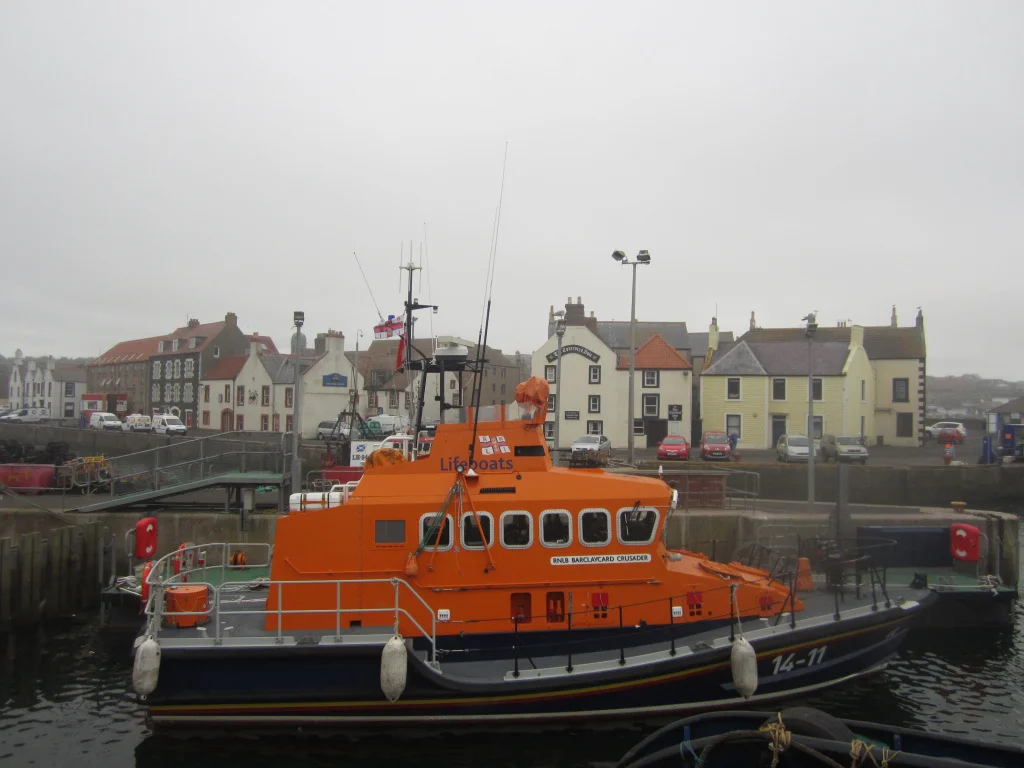

Eyemouth Lifeboat Station
Eyemouth is a fishing harbour cut into cliffs north of the English border, and on the 14th of October 1881 a sudden October storm caught the local fleet at sea and killed 189 men in a single afternoon - the disaster Berwickshire still calls Black Friday. Five years earlier, in October 1876, the town had hauled its first lifeboat through the streets behind six horses on the way to a christening on the beach. The pattern of working coastal towns repeated itself here: the danger came first, then the deaths, then the lifeboat. At Eyemouth the danger was the daily weather and the lifeboat would still be needed nearly a century and a half later.
The First Boat
Captain Gray-Jones, RNLI Assistant Inspector, came to Eyemouth in December 1875 to assess the case for a station. The town had over 350 active fishermen, which meant the case was obvious and a shortage of volunteer crew unlikely. An order went to Woolfe of Shadwell for a 30-foot 8-oared self-righting pulling-and-sailing lifeboat at £275, with a launching carriage from Napton & Co. for another £117 5s 0d. A boathouse on the East Pier with launchway came in at £517 10s 0d. The boat shipped by rail from London to nearby Burnmouth, and on 10 October 1876 six horses hauled it through Eyemouth to the beach. Mrs Grindlay broke the bottle and named her the James and Rachel Grindlay, after her late husband, the Edinburgh donor whose legacy had paid for everything. The first launch was a ceremony. Every launch after was a working day with stakes.
Frank and William Oates
Eyemouth got its first motor lifeboat in 1937, a £3,835 boat with a top speed of 7.66 knots. At the naming ceremony on 21 August 1937 it was christened Frank and William Oates, funded by their brother Charles George Oates of Leeds. Frank Oates was a Victorian naturalist who had explored Africa in the 1870s and died in 1875 - he never lived to see the lifeboat that carried his name. His brother William had explored Africa too. Both men were uncles to Captain Lawrence Oates, the cavalry officer who in March 1912 walked out of Scott's tent in a Polar blizzard with the famous understatement "I am just going outside and may be some time," giving his life on the Antarctic ice in the hope of saving his weakening companions on the doomed Terra Nova Expedition. The story of two generations of Oates men, who pushed into the world's unmapped places and did not always come home, became the name on the side of a Berwickshire lifeboat ready to fight its own version of the cold.
Moored Afloat
The Eyemouth lifeboat launch ramp was demolished as part of harbour reconstruction in 1963. The station closed temporarily and the Clara and Emily Barwell was withdrawn. When the station reopened in 1964 with a larger boat, Swn-Y-Mor - one of the Civil Service-funded lifeboats - the new arrangement was that Eyemouth lifeboats would no longer be hauled in and out of a boathouse. They would moor afloat in the harbour, ready to slip lines and run. The arrangement has held ever since. Today's all-weather boat is a Shannon-class 13-metre lifeboat called Helen Hastings, on station since 2018, capable of 25 knots in any weather a coxswain dares ask of her. The inshore boat Sheila, a D-class, has been on station since 2023.
The Sea They Work
Eyemouth Bay opens directly to the North Sea. The cliffs behind the town climb to St. Abbs Head, where the seabird colonies wheel and scream and the waters offshore have been the grave of more wrecks than any plaque can record. HMS Pathfinder went down nine miles south of here in 1914, and an Eyemouth fisherman was among those who pulled survivors from the water - then gave a newspaper interview that contradicted the Admiralty's mine story and named the submarine for what it was. The fishing economy has shrunk since the days of Black Friday's 350-fisherman fleet, but Eyemouth boats still go out, and the lifeboat still launches for them. The roll of bravery medals from this station extends across nearly a century and a half. Every name carries a callout, every callout a boat's-length decision in heavy water about whether to push on, whether to swing wide, whether the people aboard the casualty are alive enough to fight for. The cliffs do not care. The lifeboat goes anyway.
Gunsgreen Quay
The current station sits at Gunsgreen Quay, looking out across the small harbour and the cliffs that frame it. Gunsgreen House itself, the white 18th-century mansion on the opposite quay, was a centre of organised smuggling in its day and is now a heritage museum. The town is quiet most of the year and busy in summer with walkers on the Berwickshire Coastal Path. Look for the orange hull at its mooring as you walk through. When the pager sounds, the volunteers who run the boats are running too.
From the Air
Eyemouth at 55.87°N, 2.09°W, on the Berwickshire coast about 9 nm north of Berwick-upon-Tweed. Recommended viewing altitude 1,500-3,000 ft AGL to see the small harbour cut into cliffs, the village above, and St. Abbs Head 4 nm north with its lighthouse. Nearest ICAO airport: EGPH (Edinburgh) 35 nm west; EGNT (Newcastle) 60 nm south. The cliffs rise sharply from the sea here - this is some of the most dramatic seaboard on the east coast of Britain. HMS Pathfinder wreck site lies 8 nm south. The Berwickshire Coastal Path runs along the clifftops linking Burnmouth, Eyemouth, Coldingham, and St. Abbs.
Nearby Stories
- Chillingham Castle 3 km away
- Battle of Ancrum Moor 9.3 km away
- Bass Rock 11 km away
- HMS Nottingham (1913) 12 km away
- HMS Pathfinder (1904) 15 km away
- Yester Castle 18 km away
- German submarine U-1274 23 km away
- Alexander L. Kielland (Platform) 282 km away