.jpg)
Battle of Ancrum Moor
Sir Ralph Eure had been told he could keep what he could burn. In late February 1545, the English commander led roughly five thousand men, most of them German and Spanish mercenaries, across the Scottish border for another season of pillage. King Henry VIII had decided that since Scotland would not give him the infant Mary, Queen of Scots, as a bride for his son Edward, he would teach the Scots to regret their refusal. The campaign was later called the Rough Wooing, an accurate name. Eure had already burned Brumehous Tower with the lady of the house and her children and servants still inside. Now he was marching home with prisoners and plunder. On Ancrum Moor, two miles from Jedburgh, a smaller Scottish force caught him. By nightfall, Eure was dead, and an army that had outnumbered the Scots by perhaps three to one was scattered across the borderland.
The Rough Wooing
Henry VIII's ambition was simple and ugly. He wanted Mary, Queen of Scots, betrothed to his son Edward, who would later reign briefly as Edward VI. The marriage would dissolve the Auld Alliance between Scotland and France and put Scotland firmly inside an English orbit. In December 1543, after months of internal argument, the Scottish Parliament rejected the proposal and renewed the French alliance. Henry's response was to declare war. He ordered the Earl of Hertford to burn Edinburgh, Leith, and as much of southern Scotland as could be reached, which Hertford accomplished with two expeditions in 1544. The Scottish chronicler George Buchanan called the campaign the Rough Wooing, a sarcastic name that has stuck. By 1545, Ralph Eure was continuing the work in the Borders, paid partly in promises of Scottish land that Henry was distributing to his commanders as if it were already his to give.
An Unlikely Alliance
The Scottish response began with grudges. The Earl of Arran, Regent for the infant Mary, and the Earl of Angus had been bitter enemies for years; they had fought a pitched battle in the streets of Edinburgh in 1520. But Angus's family lands were among those Eure had been promised by Henry, and Angus reportedly declared that he would witness the title deeds with a sharp pen and red ink. The phrase combined courtly idiom and threat with characteristic Borders precision. Angus brought roughly 300 lances. Norman Leslie, Master of Rothes, and his father George Leslie, fourth Earl of Rothes, brought a similar number from Fife. They were joined by Borderers under Walter Scott of Branxholme and Buccleuch, whose lands had also been raided by Eure. Together, perhaps 1,500 to 2,500 Scots moved south to meet Eure near Jedburgh.
Pikes, Treachery, and a Charge
The English army was substantially larger: 3,000 mercenaries from Germany and Spain, 1,500 English Border horse under Sir Brian Layton, and 700 'assured' Scottish Borderers who had sworn loyalty to England in exchange for protection. The battle turned on two things. The Scottish pikes, according to a contemporary account, were longer than the English spears 'be fyve quareteris, or an elne,' meaning by an ell or more, perhaps three feet. When the formations clashed, the Scots simply reached the English first. The English line buckled. As Eure's mercenaries tried to rally on the eastern slope of Palace Hill, the assured Scottish Borderers in their ranks made their decision. They tore off the red crosses of St George that marked their English service and reverted to their old allegiance. The army broke. The English fled across hostile country in winter conditions, hunted by Scots who knew every hollow and burn.
Arran on the Field
Regent Arran arrived after the fighting was over and found his old rival Angus standing among the corpses. According to an English report, Arran asked a prisoner to identify Eure's body. When it was shown to him he wept and said, 'God have mercy on him, for he was a fell cruel man and over cruel, which many a man and fatherless bairn might rue, and wellaway that ever such slaughter and bloodshedding should be amongst Christian men.' The chronicler John Lesley and Robert Lindsay of Pitscottie both record Arran giving thanks for an unexpected victory in which 'so small a number discomfited so great a host and one so well appointed.' Arran's own household account book, held by the National Records of Scotland, records payments for messengers carrying news of the battle and the celebration afterwards at Hume Castle. The English losses included roughly 800 dead, among them Eure and Layton, and 1,000 taken prisoner.
Lilliard's Stone
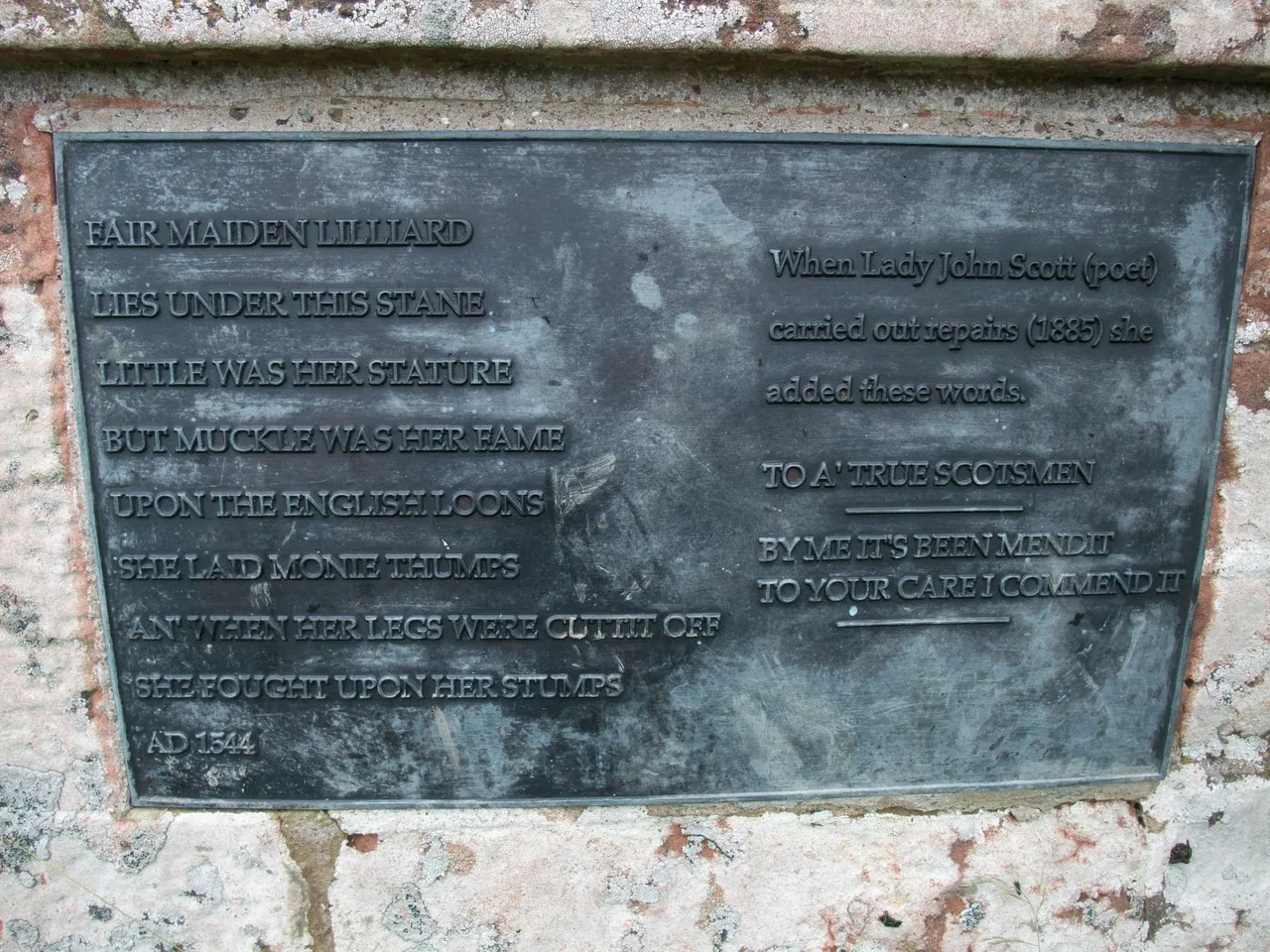
Local legend tells of a young woman called Lilliard who is said to have fought at Ancrum Moor after the death of her lover. Her story is engraved in popular memory and a stone marker known as Lilliard's Stone stands near the battlefield. The story is almost certainly apocryphal. The place name appears as 'Lillesietburn' in twelfth-century records, predating any battle, and as 'Lillyat Cros' in 1378. The Lilliard tradition probably attached itself to the existing place name centuries after the fact. The real legacy of Ancrum Moor is less romantic but more consequential. The victory temporarily halted English raiding. News of the defeat reached Francis I of France, who sent troops to aid the Scots, though they achieved little. The Rough Wooing dragged on for another five years before ending in failure for Henry's ambitions; Mary went to France, not Edward. Today the battlefield is included in the Inventory of Historic Battlefields in Scotland and protected under the Historic Environment (Amendment) Act 2011. The ground itself is quiet pasture, rising gently toward Palace Hill, where the English line broke and so much of the Rough Wooing's logic broke with it.
From the Air
Coordinates: 55.537°N, 2.608°W. The battlefield lies on rolling ground roughly two miles north of Jedburgh near the A68. Recommended viewing altitude 2,000-4,000 ft AGL. Palace Hill is the modest rise to the east of the marked battlefield. Scottish Borders airspace, generally uncongested. Nearest airports: Newcastle (EGNT) approximately 35 nm south-east, Edinburgh (EGPH) approximately 38 nm north-west, Carlisle Lake District (EGNC) approximately 40 nm south-west.
Nearby Stories
- Berwick-upon-Tweed Lifeboat Station 8 km away
- Kielder Water 8.8 km away
- Wallington Hall 11 km away
- Battle of Homildon Hill 12 km away
- Penicuik 12 km away
- Lockerbie 15 km away
- Oliver Castle 18 km away
- Yester Castle 19 km away