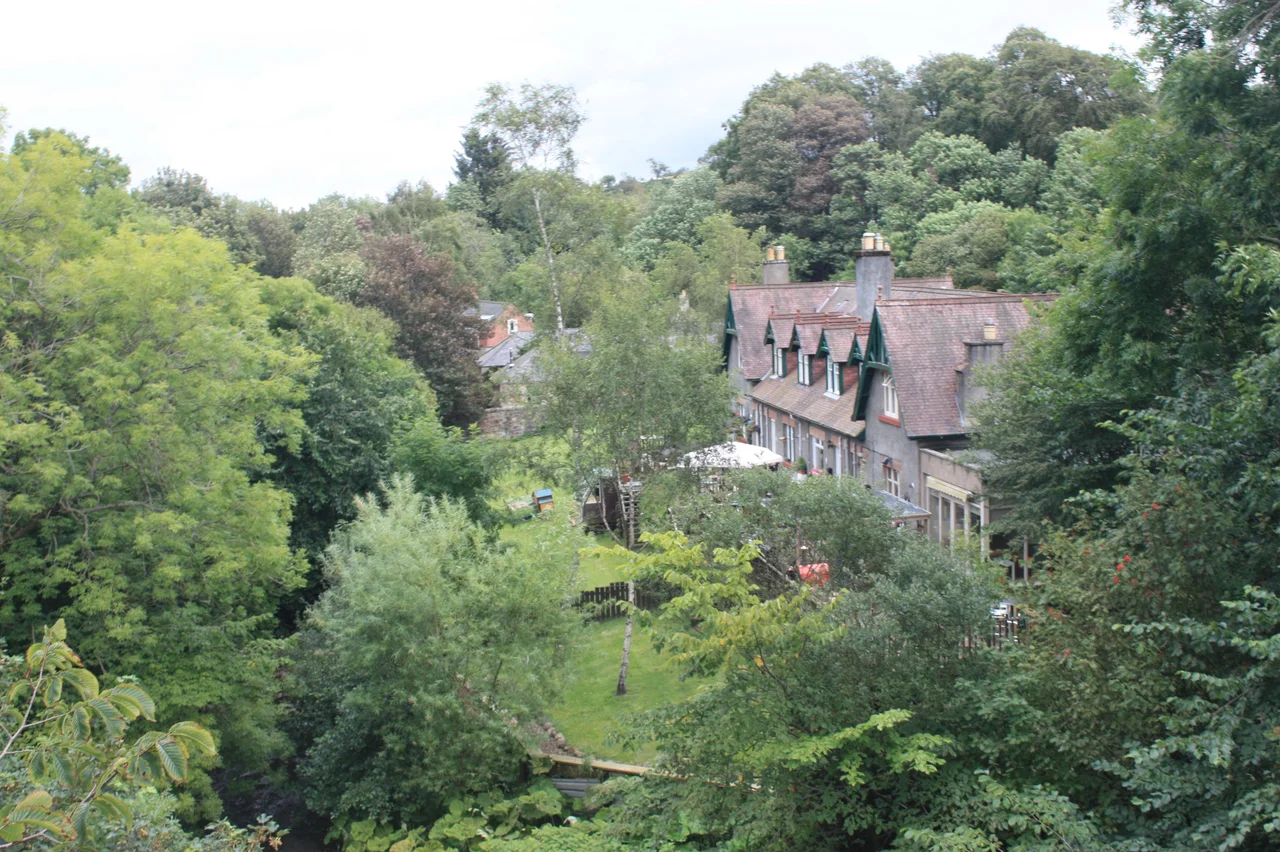

Penicuik
Pennycook. That's how the locals say it - not Pen-i-cuik, the way a stranger might guess from the spelling, but Pennycook, three soft syllables. The name comes from a Brythonic compound, pen y gog, meaning 'hill of the cuckoo' in the language that was spoken in southern Scotland before the Gaels and the Angles arrived. The cuckoo is gone from the modern town's name in any language anyone here actually speaks. But the bird still calls in the Pentland foothills above the River North Esk on May mornings, and the syllable that names it has been clinging to this hill, in one language after another, for at least 1,500 years.
Paper and Power
Penicuik has been a papermaking town since 1709, when Agnes Campbell - a printer in her own right and one of the few women running an industrial concern in early-18th-century Scotland - established Valleyfield Mill on the North Esk. The river drops steeply through the town, and that drop was the whole reason the mill could exist: it powered the wheels. The Dalmore mill at nearby Auchendinny followed, and for nearly three centuries Penicuik made paper for Scotland and the empire beyond it. The Dalmore mill finally closed in 2004, ending an industry that had defined this place since Queen Anne was on the throne. The river still drops through the valley, but the wheels have stopped turning.
The 309 Names
In 1811 the War Office bought Valleyfield Mill from Charles Cowan, who had owned it for thirty-two years, and converted it into a prison camp. The Napoleonic Wars had begun in 1803 and Britain was holding thousands of French prisoners of war; the existing facility at nearby Glencorse Barracks (originally Greenlaw Military Prison, completed in 1803) wasn't enough. So Valleyfield became a second camp. Conditions killed 309 men there before the war ended. In 1830 Alexander Cowan - of the same papermaking family - commissioned a monument from the architect Thomas Hamilton to mark their graves. It still stands. The men buried beneath it had names and homes and families they never saw again. The monument records them not as enemies but as the dead, which is what they had become.
The Curling Match and the Pretender
On 8 November 1745, Charles Edward Stuart - the Young Pretender, Bonnie Prince Charlie - crossed the River Esk at Pomathorn Bridge as he marched his Jacobite army south. He was making for London. He got as far as Derby before turning back. Just over a century later, Penicuik hosted something more peaceful but equally Scottish: the inaugural Grand Match of curling in 1847, contested between the north and the south of Scotland on the high pond of the Penicuik House estate. The Grand Match is one of those events that only happens when the lochs and ponds freeze hard enough to hold thousands of people. Penicuik sits at 180 metres elevation, and in 1847 the high pond was thick enough. The low pond is still used for curling, on the rare years when winter cooperates.
Mauricewood, 1889
On the morning of 5 September 1889, a fire broke out at the Mauricewood Colliery. Sixty-three men and boys died underground. Only seven came out alive. The Shotts Iron Company, which owned the pit, closed it after the disaster - not as a tribute but as a calculation. The dead were miners, mostly local, with families in the streets above them. A memorial in Penicuik cemetery still names them, sixty-three names cut into stone, and the cemetery looks south toward the Pentland Hills where on a clear day you can still see the line of those hills exactly as the men and boys would have seen them on the last morning they walked to work.
The Doctor Who Inspired Sherlock
Joseph Bell, surgeon and lecturer at Edinburgh's medical school, grew up partly in Penicuik. One of his students was a young Arthur Conan Doyle, who noticed how Bell could deduce a patient's occupation and habits from a few minutes' observation - the limp that betrayed an old injury, the calluses that betrayed a trade. Doyle later said Bell was the direct model for Sherlock Holmes. He wasn't the town's only contribution to history. Charles Thomson Rees Wilson, born on a farm nearby, won the 1927 Nobel Prize in Physics for inventing the cloud chamber, which made the paths of subatomic particles visible for the first time. Sir James Hamilton, born in Penicuik in 1923, led the British team that developed Concorde. A small Midlothian town with paper mills, a coal mine, and a cuckoo for a name kept producing the people who let the rest of the world see things it had never seen before.
From the Air
Located at 55.826 N, 3.22 W, on the west bank of the River North Esk in Midlothian, about 10 miles south of Edinburgh on the A701. Visible reference points: the Pentland Hills rising immediately to the west, the deep cut of the North Esk valley, and the long open ground between the town and Edinburgh. Nearest airport: Edinburgh (EGPH), about 11 nautical miles north-northwest. Recommended viewing altitude 2,500-4,000 ft AGL. Snow lies an average of 30 days a year here, more than twice as much as in Edinburgh - useful winter visibility information.
Nearby Stories
- Bannockburn 3.2 km away
- Wishaw 5.2 km away
- Oliver Castle 7.1 km away
- Bass Rock Lighthouse 11 km away
- Yester Castle 11 km away
- Kirkcaldy 11 km away
- Battle of Ancrum Moor 13 km away
- New Cumnock 26 km away