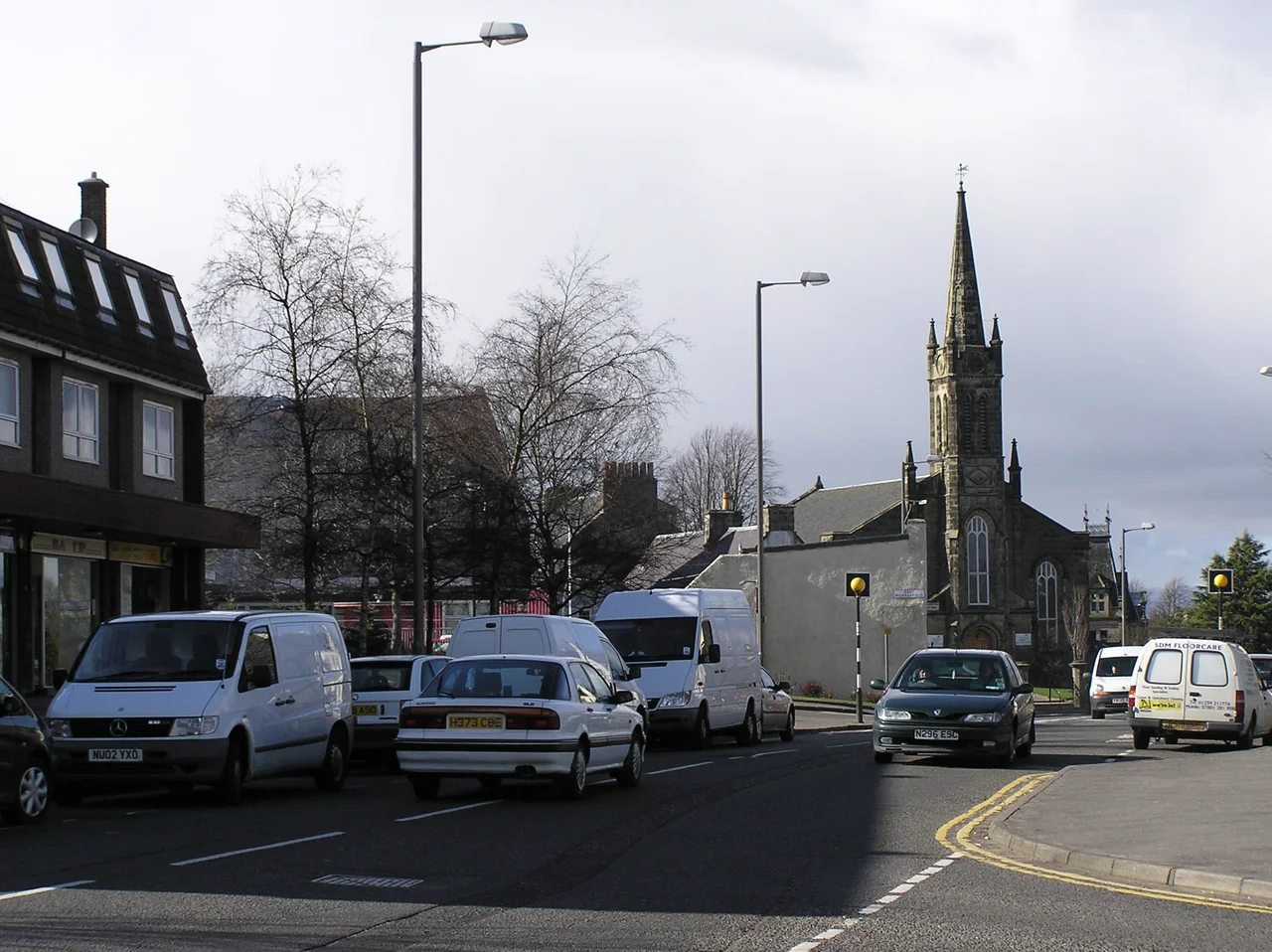

Bannockburn
On 23 and 24 June 1314, somewhere between the Pelstream and the Bannock Burn — two small streams flowing down from the Carse of Stirling — a Scottish army under Robert the Bruce destroyed a larger English army under Edward II. The Scots had perhaps 6,000 to 8,000 men. The English had at least twice that, possibly three times. By the second evening the English were broken, Edward had fled toward the safety of Dunbar with the Scottish cavalry pursuing, and Stirling Castle — the prize both armies had come for — was Scottish again. The Battle of Bannockburn did not, by itself, end the First War of Scottish Independence. But it shifted everything. For both sides, the cost was real: hundreds of knights and thousands of foot soldiers lay on the field between the streams, men who had marched north or south at their lord's bidding and never went home. The town now called Bannockburn has spent seven centuries living next door to that memory.
Between the Two Burns
The town is named after the Bannock Burn, a stream running through it before flowing into the River Forth. The probable site of the battle lies between the Pelstream and Bannock burns, on relatively flat ground that gave the Scottish schiltrons — those bristling formations of pikemen that were the deadly answer to medieval cavalry — room to manoeuvre and the English heavy horse little room to charge effectively. Bruce had chosen his ground carefully. He had concealed pits behind the front line to break up a cavalry attack. He had a small but disciplined army, hardened by years of guerrilla warfare in the Highlands and Galloway. Edward II had brought what looked, on paper, like an overwhelming force — but the English army was a coalition of contingents under quarrelsome lords, and it had marched a long way to relieve a single castle. A large monument and visitor centre now stand near the battle site. In earlier generations tourists came to look at the Borestone, a fragment of stone in which Bruce was said to have planted his standard. The dignity of the barony of Bannockburn is currently held by Hope Vere Anderson, a descendant of the Sandilands and Vere families of Lanarkshire who were the original Barons of Bannockburn in the fourteenth century.
Bonnie Prince Charlie at the House
More than four centuries later, after the catastrophe of Culloden in 1746, Charles Edward Stuart — Bonnie Prince Charlie — stayed at Bannockburn House. It was here that he met Clementina Walkinshaw, who would become the mother of his only acknowledged child, Charlotte. The Stuarts and Bannockburn made a strange pairing: a defeated Catholic prince taking shelter on ground that his Protestant great-great-grandfather, James VI, had stood on, and where his ancestor James IV had inherited the crown at Sauchieburn just a few miles to the south. Scotland is a small enough country that its historical sites lean on each other in this way. Bannockburn House still stands, a B-listed seventeenth-century mansion, now owned by a community trust and open to visitors.
The Town That Wove the Tartans
What Bannockburn used to be famous for, beyond the battle, was tartan. In the late eighteenth and early nineteenth centuries the Wilson family of Bannockburn became Scotland's most prolific tartan weavers, designing and producing the chequered woollen cloth for the British Army's Highland regiments. The Wilsons made the tartans that, in 1822, suddenly became politically essential — King George IV visited Edinburgh that year, with Walter Scott as his master of ceremonies, and insisted that the Highland chiefs attend his banquets in their clan tartans. Many of the chiefs had no idea what their clan tartan looked like, because the modern concept of a clan tartan had only just been invented. They went to the Wilsons in Bannockburn for suitable patterns. The Wilsons supplied them. Many of what are now taken to be ancient ancestral tartans were in fact designed in Bannockburn between 1815 and 1840 to meet a sudden, royal demand. The woollen mills employed seven to eight hundred people around 1880. The last mill closed in 1924.
What Bannockburn Is Now
By the late twentieth century Stirling and Bannockburn had grown into a single contiguous conurbation, and Bannockburn was incorporated into the royal burgh of Stirling. The 2001 census recorded a population of 7,352. The town has a library, local shops, two football clubs (Bannockburn Amateurs, founded 1968, and Milton FC, founded 1972), a rugby club, and a cricket club. Bannockburn Amateurs have won the West of Scotland Amateur Cup five times. Bannockburn Primary School sits in the centre of the community; Bannockburn High School is in nearby Broomridge and has had to be extended in 2007 and 2008 to keep up with new housing schemes. The railway station that operated from 1852 to 1949 is gone; train passengers now go into central Stirling. The town is served by the 38, 51, and C30 bus routes. A new station with park-and-ride was proposed in 2009 and has not yet materialised. Two Church of Scotland parishes, the Catholic Our Lady and St Ninian's, a United Free Church, a Gospel Hall, and a Christadelphian hall (formerly a carpet factory) cover the town's religious needs. The town's most famous Telford-designed circular-arch road bridge over the Bannock Burn is still in service.
From the Air
Bannockburn sits at 56.09°N, 3.91°W, immediately south of Stirling. From altitude the great volcanic plug of Stirling Castle is visible to the north, with the Wallace Monument on its own crag a little further northeast, and the carse of the Forth opening out toward the Firth. The Ochil Hills rise to the northeast; the Touch Hills are to the west. The town is now part of the contiguous Stirling conurbation. Edinburgh Airport (EGPH) is 22 nm east-southeast; Glasgow Airport (EGPF) is 22 nm southwest. The Battle of Bannockburn visitor centre and the surrounding battlefield is south of the town centre, in what used to be open carse between the Pelstream and Bannock burns. The Battle of Sauchieburn site (1488) is a few miles further south, making this corridor south of Stirling one of the densest medieval battlefields in Britain.
Nearby Stories
- Murder of Alesha MacPhail 3.1 km away
- Ben Lomond 5 km away
- Lochleven Castle 8.8 km away
- Battle of Dunsinane 15 km away
- Pentland Hills 16 km away
- Breadalbane Hydro-Electric Scheme 17 km away
- Beith 17 km away
- Rannoch Moor 24 km away