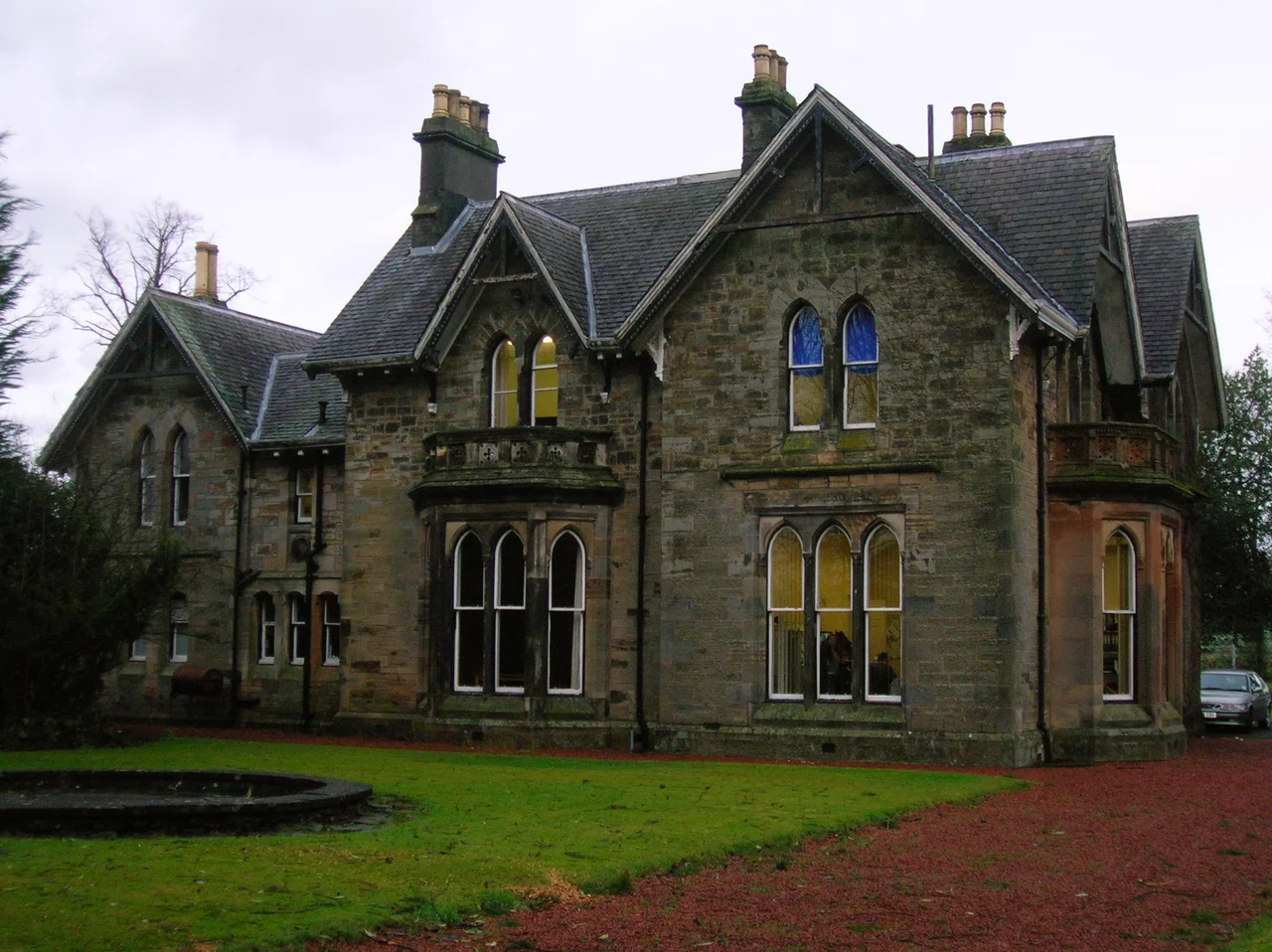

Beith
In 1733, between forty and fifty Beith men marched on the Customs House at Irvine, broke in, and walked out with a small fortune in confiscated tea, tobacco, and spirits. The raid was successful enough that by 1789 the government had quartered seventy-six soldiers in the town. Their job was to make the illicit trade unprofitable. Their actual effect, as a generation of grumbling diaries record, was to billet themselves on the law-abiding citizens, who had to feed them. Beith's Main Street pub is still called the Smugglers Tavern, which tells you something about how a town remembers its less reputable past. Twenty miles southwest of Glasgow, sitting on the crest of a hill above the Garnock Valley, Beith has spent eight centuries making things, hiding things, and producing people who turned out to be more remarkable than their small hometown could have predicted.
The Hill of the Birches
Beith's name comes from Ogham, the so-called Celtic Tree Alphabet, where Beithe in Old Irish means the birch tree, related to the Latin betula. The Court Hill above the town gave the medieval feudal barony its full name: Hill of Beith. An alternative theory derives the name from a Cumbric word for boar, baɣeδ, and the local pronunciation supports it. Either way, the etymology points to a wooded landscape long since cleared. Saint Inan, who flourished around 839 AD, is said to have preached from a cleft in Lochlands Hill still called St Inan's Chair. The town's parish festival carries his name. The sixteenth-century poet Alexander Montgomerie, regarded as one of the finest Scottish exponents of the sonnet and one of the masters of Middle Scots, was probably born at Hessilhead Castle just beyond Gateside. From the start, Beith was a place where words mattered.
James Montgomery, and Witherspoon's Long American Journey
Some of Beith's stories are larger and more painful than the town's size suggests. In the 1740s Robert Shedden, who had bought the lands of Morrishill in 1748, brought a young enslaved African to Beith from Virginia. The man was called only Shanker by his captors. Shedden's plan was to have him trained as a joiner so that he could be sold for a higher price back in Virginia. Robert Morrice, husband of Shedden's sister Elizabeth, taught the carpentry. When Shanker was baptised in Beith Parish Church under the new name James Montgomery, he gained, by Scottish law, a measure of legal personhood. He chose to claim it. He left for Edinburgh. The Reverend who baptised him was John Witherspoon, then minister of Beith. In 1745 Witherspoon had led the men of Beith to Glasgow to defend the Hanoverian throne against the Young Pretender; he was captured at the Battle of Falkirk and imprisoned for a time in Doune Castle. Witherspoon would later emigrate to America, become president of what is now Princeton University, and sign the Declaration of Independence in 1776. He died on his farm Tusculum, just outside Princeton, in 1794, and is buried in the Princeton Cemetery. The actress Reese Witherspoon has claimed to be one of his direct descendants, though genealogists have not been able to verify the lineage. A plaque in Beith town centre, placed by DSDI in 2009, marks the connection.
Fingerprints, Furniture, and the Man Who Was Never Listened To
Henry Faulds was born in Beith in 1843. While working as a medical missionary in Japan, he became the first person to propose, in print, the use of fingerprints to identify criminals. He also sent his classification system and fingerprint forms to Charles Darwin, who passed them to his cousin Francis Galton. Darwin never took up the idea directly. He died in 1930, aged eighty-six, bitter that the science of fingerprinting, by then well-established in police work around the world, had largely forgotten where the idea began. A memorial stone stands in Tokyo for his work in Japan, and another was placed in Woolstanton, near where he is buried, in 2007. On 12 November 2004, a substantial memorial with interpretation plaques was dedicated to his memory in Beith town centre, close to the New Street site where he was born. Faulds's case is not isolated. Beith repeatedly produced people whose work outran their hometown. From 1845 to the 1980s, the town held the rather quiet distinction of being the most important furniture-manufacturing centre in Scotland. Matthew Pollock, Robert Balfour, Beithcraft and Macneill Brothers turned out boardroom panelling, lift cages, mantlepieces, and library fittings; one local claim is that Beithcraft supplied furniture for the RMS Queen Elizabeth 2. The last major manufacturer, Beithcraft, closed in 1983 after a devastating fire, with the loss of 420 jobs. Beith Juniors football club, formed in 1938, still carries the trade in its nickname: the Cabes, short for Cabinet Makers.
Munitions, Memory, and the Auld Kirk
The Beith Auld Kirk began as a parish church in 1593, built in the form of a cross and dedicated to Saint Inan. The clock and bell tower were added in 1800; from 1807 to 1810 most of the building was moved a little further up the hill to become the new Parish Church, leaving the front door, clock, and belfry as a kind of half-ghost on the original site. The kirk became a burial ground for the Woodside family, then closed for further interments. A sundial from the 1840s still stands in the yard. Beneath this older landscape, the town has carried a heavier modern responsibility. The Defence Munitions site between Beith and Barrmill was developed in 1943 as a Royal Naval Armaments Depot and remains in operation, though its workforce has shrunk through successive Ministry of Defence reorganisations. Local industry once also relied on the Glengarnock Steelworks, which fell from a peak of 3,000 employees to 200 by its closure in 1985, and on the Linwood car plant, where the Hillman Imp was built before Peugeot-Citroen closed the factory in 1981. An estimated 13,000 workers in the wider region lost their jobs in the Linwood aftermath. Beith today has around six thousand people, ten housing estates added between 1966 and the present, and roughly eighty percent of its workforce commuting out for work. The Court Hill, the Auld Kirk, the rocking stone on Cuff Hill where Saint Inan is said to have prayed, all are still there. The town has stopped making furniture. It has not stopped remembering how to.
From the Air
Located at approximately 55.75 degrees North, 4.63 degrees West, on a hilltop in the Garnock Valley of North Ayrshire. Glasgow International (EGPF) lies about thirteen miles northeast; Glasgow Prestwick (EGPK) is about twenty-one miles south. From the air, Beith sits as a compact cluster on its hill above Kilbirnie Loch to the east and the wooded Garnock Valley to the south. The A737 to Glasgow is the most obvious infrastructural marker.
Nearby Stories
- Machrie Moor Stone Circles 2.6 km away
- Murder of Kriss Donald 3.7 km away
- Troon 5.5 km away
- Luss 6.8 km away
- HMS Vandal 11 km away
- Doune Castle 16 km away
- Knockshinnoch Disaster 17 km away
- Gulf of Corryvreckan 28 km away