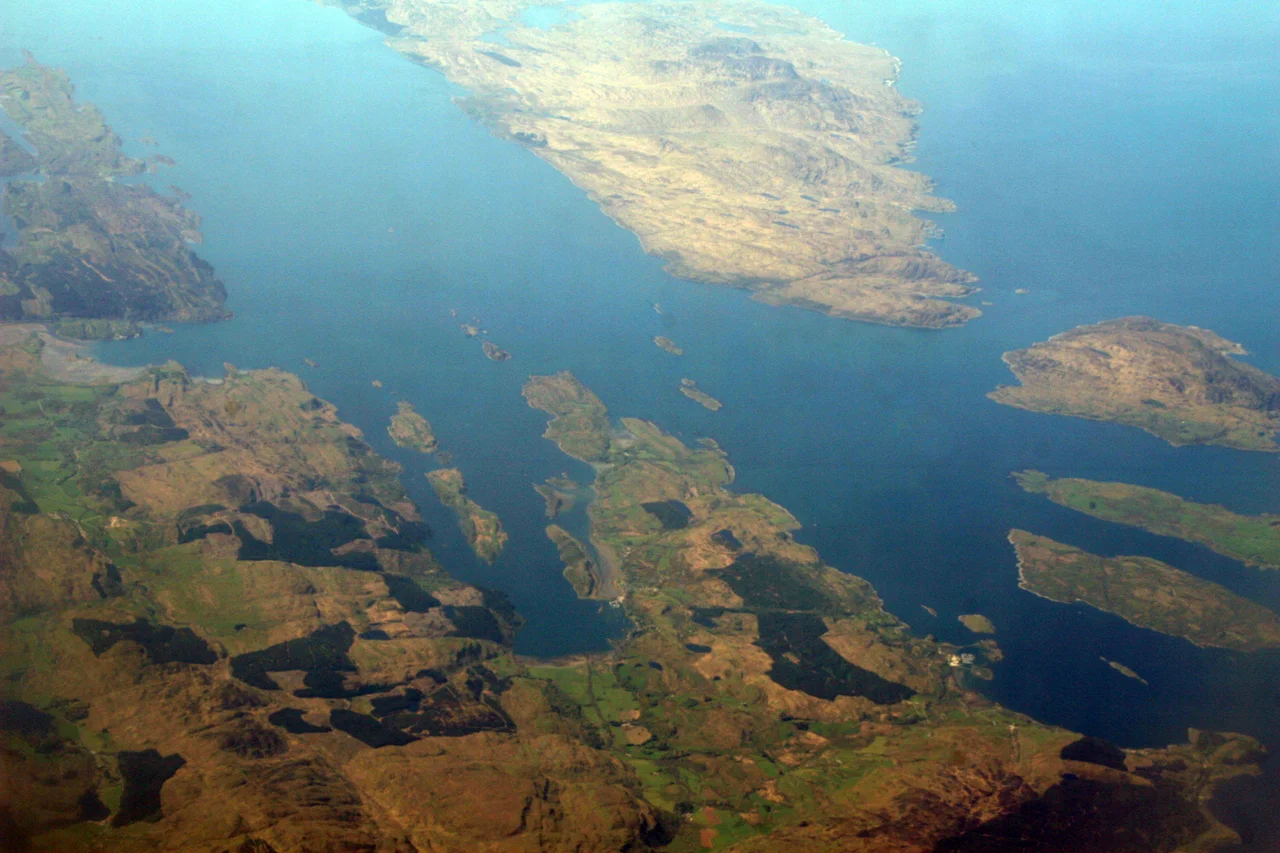

Gulf of Corryvreckan
On a bright afternoon in mid-August 1947, George Orwell read his tide tables wrong and steered a small boat toward what locals already understood to be one of the most dangerous stretches of sea in Britain. He was halfway through Nineteen Eighty-Four. Forty minutes later he, his three-year-old son, his niece, and his nephew were clinging to bare rock on an uninhabited skerry with no food, no shelter, and a stove-in boat at the waterline. The water that nearly killed him is the Gulf of Corryvreckan, where the Atlantic squeezes between the islands of Jura and Scarba and produces, three or four times a day, the third-largest whirlpool on Earth.
The Cauldron of the Speckled Seas
Corryvreckan comes from the Gaelic Coire Bhreacain, the cauldron of the speckled seas or, in some readings, the cauldron of the plaid. Both names try to describe what happens here. As the flood tide pushes Atlantic water into the narrow strait between Jura and Scarba, it accelerates to 8.5 knots and meets an underwater landscape designed to torment it: a sudden hole more than two hundred metres deep, a basalt pinnacle rising abruptly toward the surface, then back to depth. The water has nowhere to go but up, and around, and down again. The result is standing waves that can reach more than nine metres in a strong flood, and a roar audible ten miles away on calm nights. The Royal Navy's official sailing guide, the West Coast of Scotland Pilot, calls it "very violent and dangerous" and recommends that no vessel attempt the passage without local knowledge. Divers who have plumbed the central pinnacle describe it as "potentially the most dangerous dive in Britain."
The Hag and the Plaid
Before the navigators came the storytellers. In Scottish mythology the gulf belongs to the Cailleach Bheur, the hag goddess of winter, who uses it as her washtub. As autumn turns to winter she lowers her great plaid into the boiling water; the roar of the wash can be heard twenty miles away and lasts three days; when she lifts the cloth out, it is pure white and becomes the blanket of snow that covers the Highlands. A second legend belongs to a Norse king named Breacan, who anchored here either to impress a princess or to flee his father, and was swept under. His body was carried ashore by his loyal dog. Some say the gulf is named after him; others say his name was just a Gaelic pun. The poet Charles Mackay turned the place into a moral tale called "The Kelpie of Corrievreckan," set to music for clarinet and piano by Ruth Gipps in 1939. Whatever you believe, the names agree on one thing: this is water that takes things from you.
Orwell and the Outboard
Eric Blair, writing under the name George Orwell, had fled London in April 1947 for a remote farmhouse called Barnhill at the northern tip of Jura, three miles down a track from the nearest road. He was tubercular, exhausted, and in a hurry. The novel he was finishing would become Nineteen Eighty-Four. On a day trip back from nearby Glengarrisdale that August, with his small adopted son Richard and two other relatives aboard, Orwell misread the tide. The little engine sheared off its mounts and dropped into the sea. They paddled with oars. As the whirlpool finally began to slacken they reached a rocky outcrop called Eilean Mor, where the boat capsized as they tried to disembark. They had no supplies. They lit a fire to keep warm, and a passing lobster boat saw the smoke. Three months later, back at Barnhill, Orwell finished the first draft of his novel. He sent the final typescript to his publisher on 4 December 1948, and died of tuberculosis fourteen months after that. His brother-in-law Bill Dunn - who had one leg - became, a few years later, the first person to swim the gulf.
What Lives Here
The same conditions that nearly drowned Orwell created an extraordinary ecology. Minke whales and porpoises feed in the fast-moving water. Only the most stubborn corals and hydroids hold the central pinnacle, building dense mats of Tubularia indivisa and Sertularia cupressina; soft corals shelter in hollows; barnacles encrust the most exposed rock. The Cetacean activity here is so reliable that boat trips from Oban Airport, and from harbours on Jura, Mull, and Islay, advertise Corryvreckan as a guaranteed wildlife encounter. The area is being considered for Special Area of Conservation status. The waters around it have been a soft-corals haven for divers willing to wait for the brief window of slack tide that opens between flood and ebb, four times a day, for about fifteen minutes.
The Cultural Wake
Powell and Pressburger filmed the climactic boat scene of I Know Where I'm Going! (1945) at Corryvreckan, combining real footage with studio gimbals and buckets of water thrown at Wendy Hiller. The Ardbeg distillery on neighbouring Islay sells a cask-strength whisky called Corryvreckan. Roger Deakin's swimming memoir Waterlog circles back to the gulf as a touchstone. The Scottish death-metal band Hand of Kalliach released an album simply called Corryvreckan in 2024. The composer Aileen Sweeney wrote a chamber piece called The Corryvreckan Whirlpool for the Kaleidoscope Chamber Collective in 2023, which one reviewer described as "a delightful folk tune." That is, of course, exactly the wrong adjective. There is nothing delightful about Corryvreckan. There is awe, and there is luck, and there is the quiet of the slack tide when the cauldron briefly forgets what it is.
From the Air
The Gulf of Corryvreckan lies at 56.154N, 5.707W, between the northern tip of Jura and the small island of Scarba. From altitude in flood tide it appears as a band of white turbulence in an otherwise dark sea; the whirlpool itself sits at the northern side of the gulf. Best viewed from 3,000-5,000 ft for context including Jura's Paps to the south, the Slate Islands to the north, and the Garvellachs to the west. Oban (EGEO) is the nearest airport, 30 km north-east. Tides matter on the surface; from the air, the visible effects are strongest two to three hours into a flood.
Nearby Stories
- Fingal's Cave 1 km away
- Bonawe Iron Furnace 3 km away
- Torosay Castle 7.7 km away
- Jura Distillery 12 km away
- Strachur 13 km away
- Erraid 15 km away
- Bruichladdich Distillery 15 km away
- Rothesay Castle 15 km away