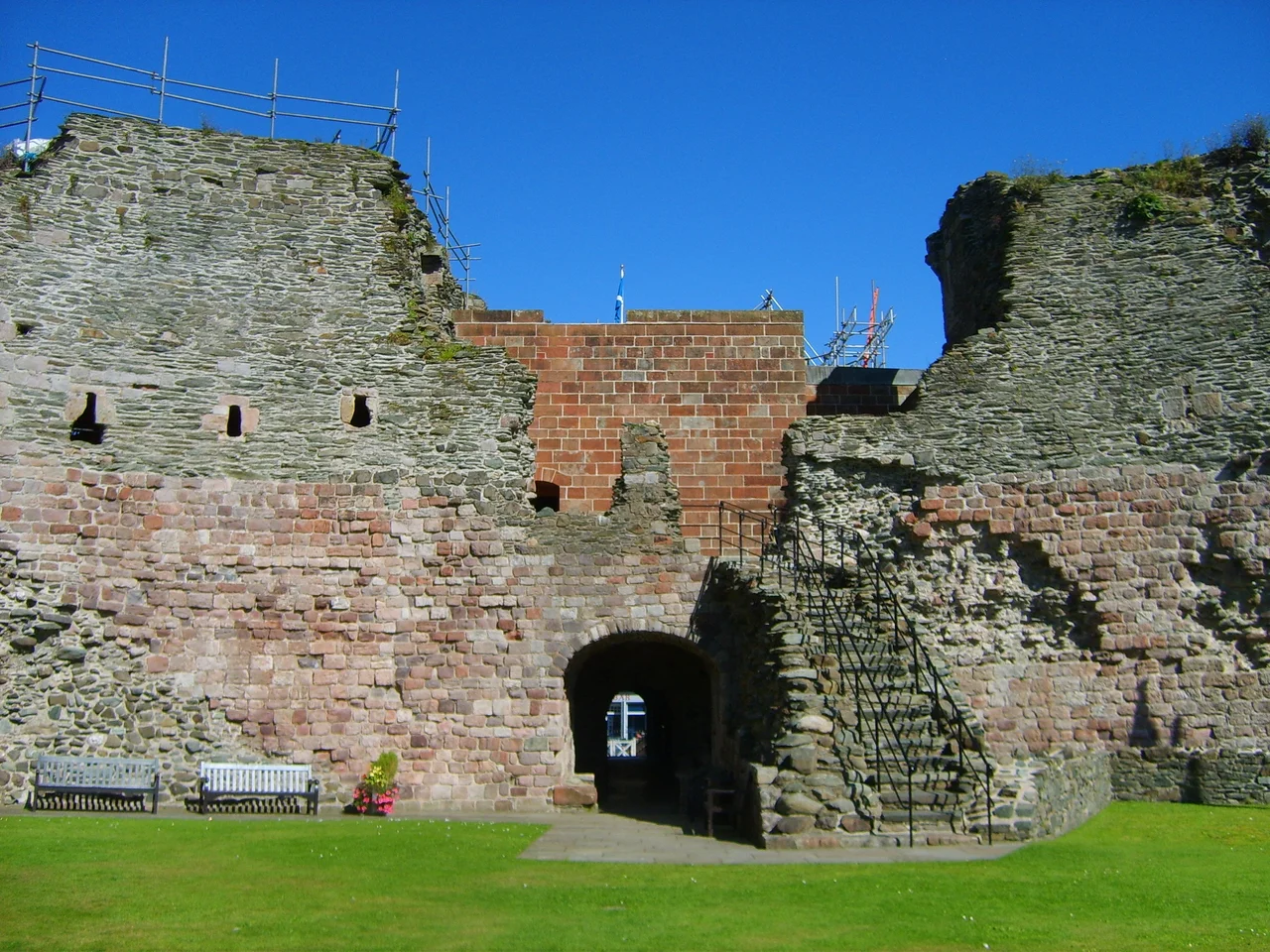

Rothesay Castle
Rothesay Castle is round, and that alone makes it strange. Almost every other medieval castle in Scotland is built on a polygon - square, rectangular, L-plan, courtyard - because corners are easier to defend. Rothesay's builders, working on the Isle of Bute in the early 13th century, raised a near-perfect circular curtain wall instead. Forty-two metres across, nearly three metres thick, eight metres high, ringed by a broad moat connected to the sea. It is one of the most remarkable castles in Scotland not for its size but for its plan. The shape gave its attackers a problem and gave its chroniclers a story, because here is the earliest recorded assault on a Scottish castle, told in a Norwegian saga: a fleet of Norse axes, three days of hacking at the curtain wall, and the stone giving way.
Built by a Steward
The castle was built either by Alan fitz Walter, Steward of Scotland, who died in 1204, or by his son Walter, who died in 1246. During Alan's tenure the family added the Isle of Bute to their lordship. A wooden castle came first, but a stone circular curtain wall - 9 ft thick, 26 ft high, around 138 ft across, sitting on a low mound - was in place by the 1230s. The wall was built of coursed ashlar and had only two openings: a main gate with a simple timber door, and a small postern in the west wall. A broad moat connected to the sea. Battlements ran around the top, accessed by open stairs. Holes in the upper masonry would have supported a timber bretasche, a projecting wooden gallery that extended the battlement outward. It was a strong castle. But not strong enough.
The Norwegian Axes
Rothesay's fame begins with an attack. In the 1230s, the Norwegian-backed fleet of Óspakr-Hákon, King of the Isles, came to Bute and assaulted the castle. Hákonar saga Hákonarsonar, the Old Norse king-saga that preserves the story, records that Óspakr's forces fought for three days to take the place, breaking down part of the eastern wall by hewing the stone with their axes. This is the earliest recorded account of an assault on a Scottish castle. In 1263, Rothesay was taken again, this time by the Norwegian forces of Hákon Hákonarson, King of Norway, on his way south to fight the Battle of Largs. Although the battle was tactically indecisive, Hákon's campaign was a strategic failure, and Norse power in western Scotland effectively ended with it. In the later 13th century, the castle was strengthened by the addition of four round towers built into the curtain wall. Only the northwest tower survives intact.
Stewart Kings and a Duke's Title
During the Wars of Scottish Independence, Rothesay was held by the English; Robert the Bruce took it in 1311. It returned to English hands in 1334, then to the Scots again. After the Stewart accession to the throne in 1371, the castle became a favourite residence of kings Robert II and Robert III - and Robert III died here in 1406. In 1398, Robert III made his eldest son David the Duke of Rothesay, beginning the tradition by which the heir to the Scottish (and now British) throne carries the title. In 1462 the castle survived a siege by the forces of John of Islay, Earl of Ross - the last Lord of the Isles - whose long campaign against royal authority eventually ended in his attainder. Construction of a forework gatehouse keep began in the early 16th century to provide more modern accommodation for James IV, and the curtain wall was raised to ten metres in height under James V.
Cromwell and Argyll
In 1527 the castle withstood a siege by the Master of Ruthven, which destroyed much of the burgh of Rothesay. In 1544, the castle fell to the Earl of Lennox during the so-called Rough Wooing - the English crown's brutal attempt to force a marriage between Mary, Queen of Scots, and Edward VI. Oliver Cromwell's New Model Army garrisoned Rothesay during the Commonwealth's occupation of Scotland in the early 1650s. On their departure in 1660, the troops partially dismantled the structure. What remained was burned in 1685 by the supporters of Archibald Campbell, 9th Earl of Argyll, during his rising in support of the Monmouth Rebellion against James VII. After that, the castle was effectively abandoned. Two centuries of slow decay followed, with rubbish piling up in the courtyard and the moat silting over.
The Marquess Who Saved It
In 1816-17 the 2nd Marquess of Bute employed seventy men to excavate the ruins, hauling out the accumulated rubbish. Real conservation work began in 1871, when the 3rd Marquess - a serious restorer of historic buildings - hired his regular architect, William Burges, to advise. The Burges restorations continued until 1900 and included clearing the moat and adding red sandstone to the forework, reinstating the hall roof. The result altered the character of the building in ways that purists still question, but it preserved structures that would otherwise have collapsed. In 1961 Rothesay Castle was given to the state. It is now a Scheduled Ancient Monument in the care of Historic Environment Scotland. Visitors can climb the walls and look out over the town, the bay, and back across the Firth toward the mainland - the same horizon the Norse fleets and the Stewart kings once watched from the same stones.
From the Air
Located at 55.8365°N, 5.0550°W in Rothesay, the principal town on the Isle of Bute. From altitude the castle shows as a distinctive circular wall structure with a square forework on its north side, set just back from the seafront in the centre of Rothesay. The Isle of Bute is the long narrow island lying between the Cowal peninsula (to the west across the Kyles of Bute) and the Cumbraes and Ayrshire coast (to the east across the Firth of Clyde). Nearest aerodromes: Glasgow (EGPF) approximately 30 nm to the northeast, Glasgow Prestwick (EGPK) about 25 nm to the southeast. Best viewing altitude 1,500-3,000 ft to make out the circular curtain wall plan.
Nearby Stories
- Inchcailloch 0.9 km away
- Lamlash 1.9 km away
- 1948 KLM Constellation Air Disaster 6 km away
- Jura, Scotland 7.8 km away
- Glen Cinema Disaster 10 km away
- Strachur 10 km away
- RAF Machrihanish 13 km away
- Gigha 16 km away