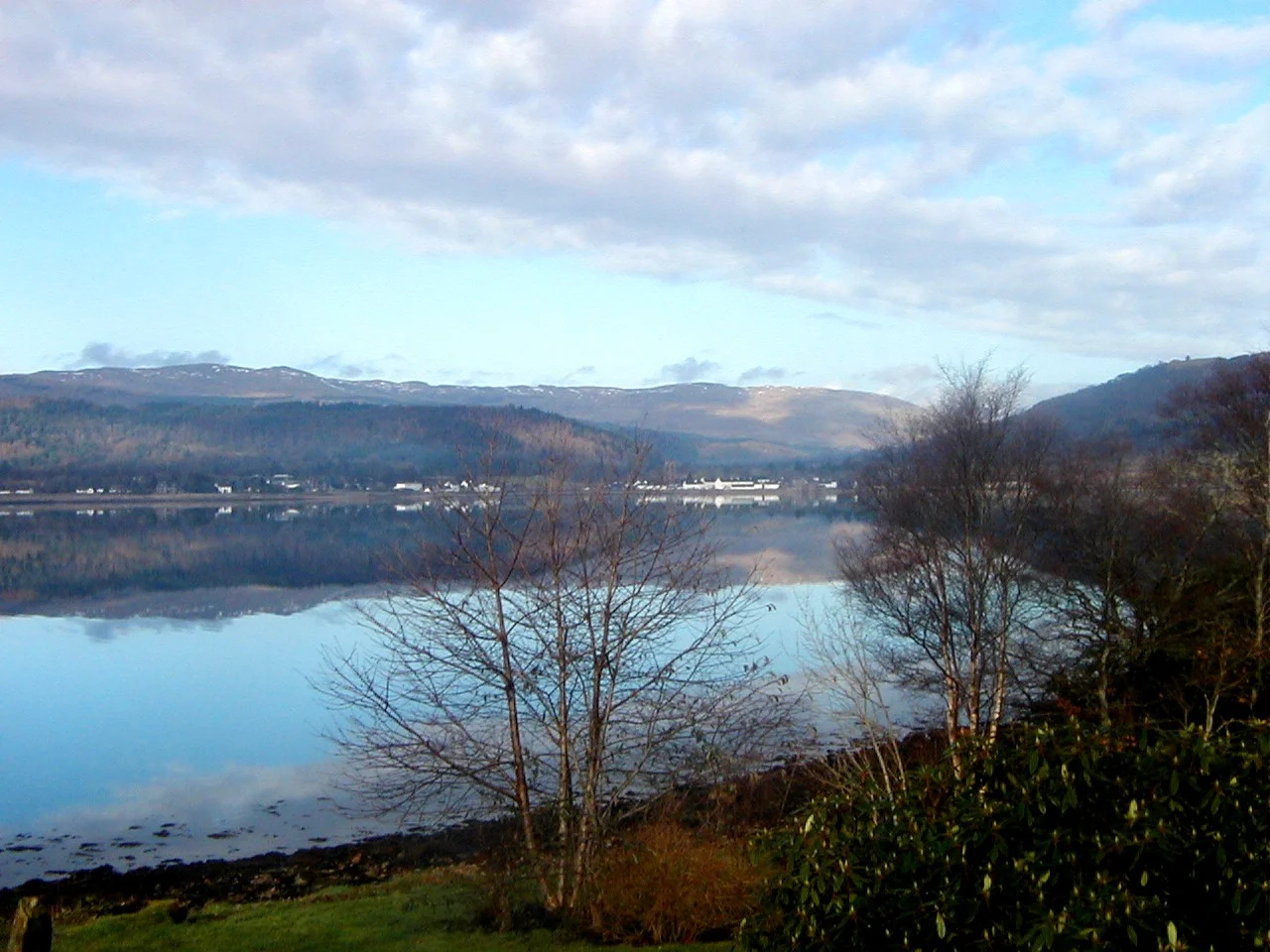

Strachur
On a hill above the village, locals say, sits the Cailleach Bheur - a stone that moves from hilltop to hilltop when no one is watching. You will not find it in any guidebook proper, but the people of Strachur know it is there, somewhere along the ridges that rise toward 3,000 feet above Loch Fyne. The name of the village itself comes from the Gaelic *srath* and the River Cur - the river valley of the Cur - and that river still tumbles down from the eastern hills, turning south to feed Loch Eck three miles away. Strachur is a small place, but its valley is old, and its stories have weight.
Where Cowal Meets the Sea Loch
The peninsula of Cowal pushes south between Loch Long and Loch Fyne like a green wedge of upland country, bordered to the north by the A83 and threaded with single-track roads that curl around hillsides and disappear into forestry. Strachur sits seven miles south of that arterial, on the eastern coast of Loch Fyne, looking across deep cold water toward Inveraray on the opposite shore. For generations, the way across was the ferry from St Catherine's, just north of the village - until it closed in the 1960s and the long drive around became the only option. The parish borders the Loch Lomond and the Trossachs National Park, and much of it climbs steeply into uplands that touch 3,000 feet. Loch Eck laps at its south-eastern edge for three miles. This is country where the geography decides almost everything: where you build, where you graze, how long it takes to reach anywhere else.
A Campbell Stronghold and a Smiddy Museum
By tradition, Strachur was one of the original strongholds of Clan Campbell, and in 1870 the principal landowners were Campbell of Strachur and McLachlan of that ilk. The grand houses of the parish - Strachur Park, Castle Lachlan, Strachurmore, Glenshellis, Balliemore, Glenbranter - were the centres of estate life. Strachur House was later bought by Fitzroy Maclean, the Highland adventurer and writer, and remains his son Charles's residence. The MacLachlans still live on the Strathlachlan estate, and the walls of Old Castle Lachlan have been restored to stand as a memorial to their family. The parish church dates from 1789 and seats 400 - a generous capacity for a small parish, reflecting an era when church attendance was a civic obligation. Just as evocative as the great houses, perhaps, is the village smiddy: it closed as a working blacksmith's in the 1950s after four generations of the Montgomery family had worked iron there over more than 150 years. Today it is the Smiddy Museum, open from Easter through September.
Glenbranter and the Lauder Legacy
Between Loch Eck and Strachur lies Glenbranter, an estate that once belonged to Sir Harry Lauder - the Scottish music hall star whose songs traveled the world in the first half of the twentieth century. Lauder was laird here, and a memorial in Glenbranter honours his son, Captain John Lauder of the Argyll and Sutherland Highlanders, who died on 28 December 1916 during the First World War. The estate later passed largely to the Forestry Commission, which still encourages public access. In the 1930s, the Ministry of Labour ran a work camp here for unemployed men - one of the Instructional Centres designed to "harden" people whose industries had collapsed in the Depression. The men, many from mining villages in the industrial West of Scotland, were not content with the regime: in 1935 they organised public walk-outs, and in 1936 they held a mass meeting to protest conditions. During World War II, Glenbranter House became HMS Pasco, a Royal Navy shore establishment training landing craft signals operators. The house, never properly maintained, was demolished in the 1960s.
Shinty, Swamp Football, and a Single Post Office
Strachur is small, but it has its enthusiasms. The local shinty team reached the Camanachd Cup final in 1983, losing 3-2 to local rivals Kyles Athletic in a match that anyone of a certain age in the village can still describe. In June 2008, in a kind of inversion of the dignity of shinty, the village hosted the UK swamp football championships - a sport in which the playing surface is a peat bog and the result mostly depends on who minds being filthy least. The village runs to a post office, two churches, the well-known Creggans Inn, and a local bar called the Clachan. Lady Veronica Maclean, the food writer, lived here and ran Creggans Inn for years. Strachur Primary School averages about 60 pupils and runs beach cleans along Loch Fyne with the Loch Lomond Park Rangers. The medical practice covers a vast geographical area from Cairndow down to Strathlachlan - one GP for hundreds of square miles of mountain country.
From the Air
Coordinates 56.1664°N, 5.0675°W. Strachur sits on the eastern shore of Loch Fyne in Argyll, with the long sea loch stretching north toward Inveraray and south toward the Kintyre peninsula. Recommended viewing altitude 2,500 to 4,000 feet AGL to take in the loch, the surrounding 3,000-foot uplands of Cowal, and Loch Eck to the south-east. Nearest ICAO airports: Glasgow International (EGPF) about 35 nm to the east, Glasgow Prestwick (EGPK) about 50 nm south-east, and Oban (EGEO) about 35 nm to the north. Expect rapidly changing weather - Atlantic systems crowd in off Loch Fyne, and orographic cloud forms quickly on the surrounding ridges.
Nearby Stories
- Duart Castle 3.8 km away
- Gulf of Corryvreckan 5.2 km away
- Rothesay Castle 7.4 km away
- Bonawe Iron Furnace 8.3 km away
- Glasgow Airport 9.1 km away
- Inchcailloch 9.3 km away
- Killin 16 km away
- Jura Distillery 22 km away