
Glasgow Airport
On 30 June 2007, a baggage handler named John Smeaton stepped out of the Glasgow Airport terminal for a cigarette break and walked straight into a terrorist attack. A Jeep Cherokee, loaded with gas canisters and set alight, had been driven into the entrance doors. Smeaton, off-duty police officers, and ordinary travellers tackled the two men who fled the burning vehicle. One of them later died of his burns. Asked afterwards what message he had for any future attackers, Smeaton offered a line that became famous: 'You come to Glasgow, Glasgow will set about you.' It was not bravado. It was a city telling itself, in real time, what kind of city it intended to be.
From Abbotsinch to International
The airport's roots reach back to 1932, when a flying field was opened at Abbotsinch, a strip of low ground between the Black Cart Water and the White Cart Water near Paisley, in Renfrewshire. The Royal Auxiliary Air Force moved No. 602 Squadron's Westland Wapiti aircraft in the following year, and an RAF station headquarters formed in July 1936 under Bomber Command. The site spent the 1950s as a Royal Navy aircraft storage unit and base for Royal Naval Volunteer Reserve squadrons. The Navy left in October 1963. By that point Glasgow's existing civil airport at Renfrew, three kilometres east, had reached the limits of its short runway and its Art Deco terminal. A new airport was needed, and Abbotsinch was already there. The old Renfrew terminal is gone now, its runway replaced by a level section of the M8 motorway and its apron by a Tesco supermarket.
The Queen Opened a Door
Abbotsinch took over civil duties from Renfrew on 2 May 1966. Queen Elizabeth II officially opened the new airport on 27 June of that year. The original terminal was a Brutalist concrete building by Sir Basil Spence, the same architect who designed the modern Coventry Cathedral. For the airport's first quarter-century, transatlantic flights were locked into Prestwick under the 1946 Bermuda Agreement between Britain and the United States. Glasgow could only handle UK and intra-European traffic. That changed in stages. The BAA took ownership in 1975, privatised in the late 1980s, and launched a major redevelopment in 1989. By 1996 the airport was handling over 5.5 million passengers a year, making it the fourth-busiest in the United Kingdom. Spence's concrete facade now hides behind a prefabricated metal extension and a glass walkway, glimpsed clearly only from the back of the building, where the original mock barrel-vaulted roof remains visible airside.
The Pan Am 103 Legacy
On 21 December 1988, Pan Am Flight 103 was destroyed by a bomb over the Scottish town of Lockerbie, killing all 259 people on board and eleven on the ground. The disaster reshaped how the world handled airline security. In the early 1990s, in direct response, Glasgow Airport became the first airport in the United Kingdom and one of the first in Europe to screen all baggage on every flight, ending the previous practice of checking only hold luggage on flights judged to be 'high risk.' It was a quiet, unglamorous shift, but it set the new global standard. Every traveller passing through Glasgow today, taking off shoes and unpacking laptops, is moving through a system that Lockerbie helped to build. The terminal where John Smeaton worked, nearly two decades later, was a building shaped twice by tragedy.
The Modern Airport
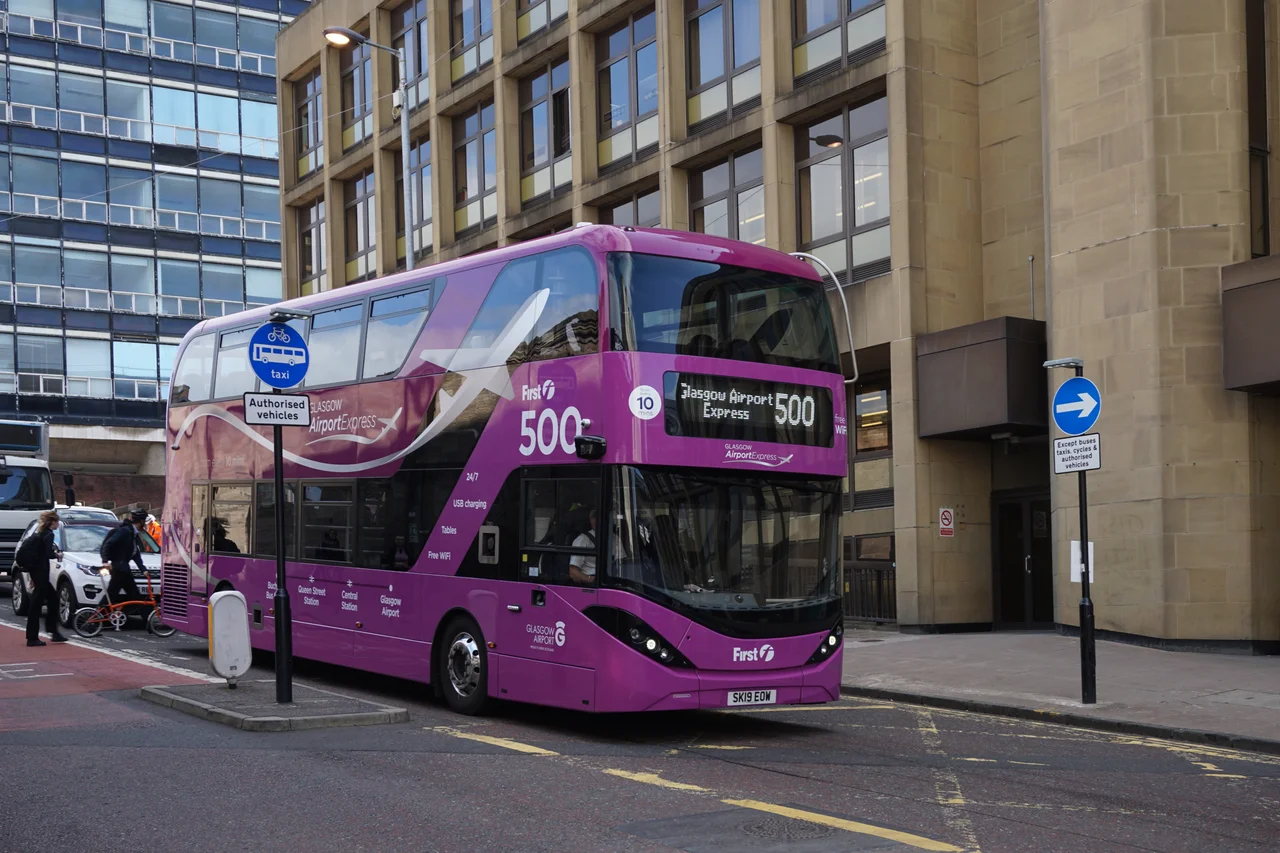
Today Glasgow handles eight million passengers a year. In 2024 it served 8.06 million, up 9.6 per cent on the previous year, making it the second-busiest in Scotland after Edinburgh and the ninth-busiest in the United Kingdom. AviAlliance, which completed its acquisition of AGS Airports in January 2025, owns and operates the place, alongside Aberdeen and Southampton. The terminal has three piers: West, Central, and East. The West Pier, the international gateway, gained the capacity to handle the Airbus A380 in 2019 after an eight-million-pound upgrade. The Central Pier, part of Spence's original 1966 building, is dominated by British Airways shuttles to Heathrow, Gatwick, and London City. Loganair, the Scottish regional carrier, is headquartered on site and maintains its hangar here. easyJet, Jet2.com and TUI Airways all use Glasgow as a hub. The promised Glasgow Airport Rail Link was cancelled by the Scottish Government in 2009; access remains by the M8 motorway and the Glasgow Airport Express bus.
From the Air
Glasgow Airport, ICAO EGPF, IATA GLA, sits at 55.872 N, 4.433 W on the south bank of the Clyde, 8.6 nautical miles west of Glasgow city centre. Elevation 26 feet. Single runway 05/23, 8,720 feet, asphalt. Approaches into runway 23 cross Glasgow's western suburbs of Drumchapel, Clydebank, Bearsden, and Foxbar; approaches into runway 05 cross Renfrew and the lower Clyde. The airport is bounded by the M8 motorway to the south, the town of Renfrew to the east, and the river to the north — terrain that constrains any future runway extension. Prestwick (EGPK) sits 28 nautical miles to the south-west; Edinburgh (EGPH) is 40 nautical miles east.
Nearby Stories
- Mauchline 3.6 km away
- Shotts 4.2 km away
- HMS Ulysses (1917) 7.7 km away
- Rothesay Castle 8.8 km away
- Inchcailloch 10 km away
- Strachur 14 km away
- Battle of Dollar 16 km away
- Crawford Castle 16 km away