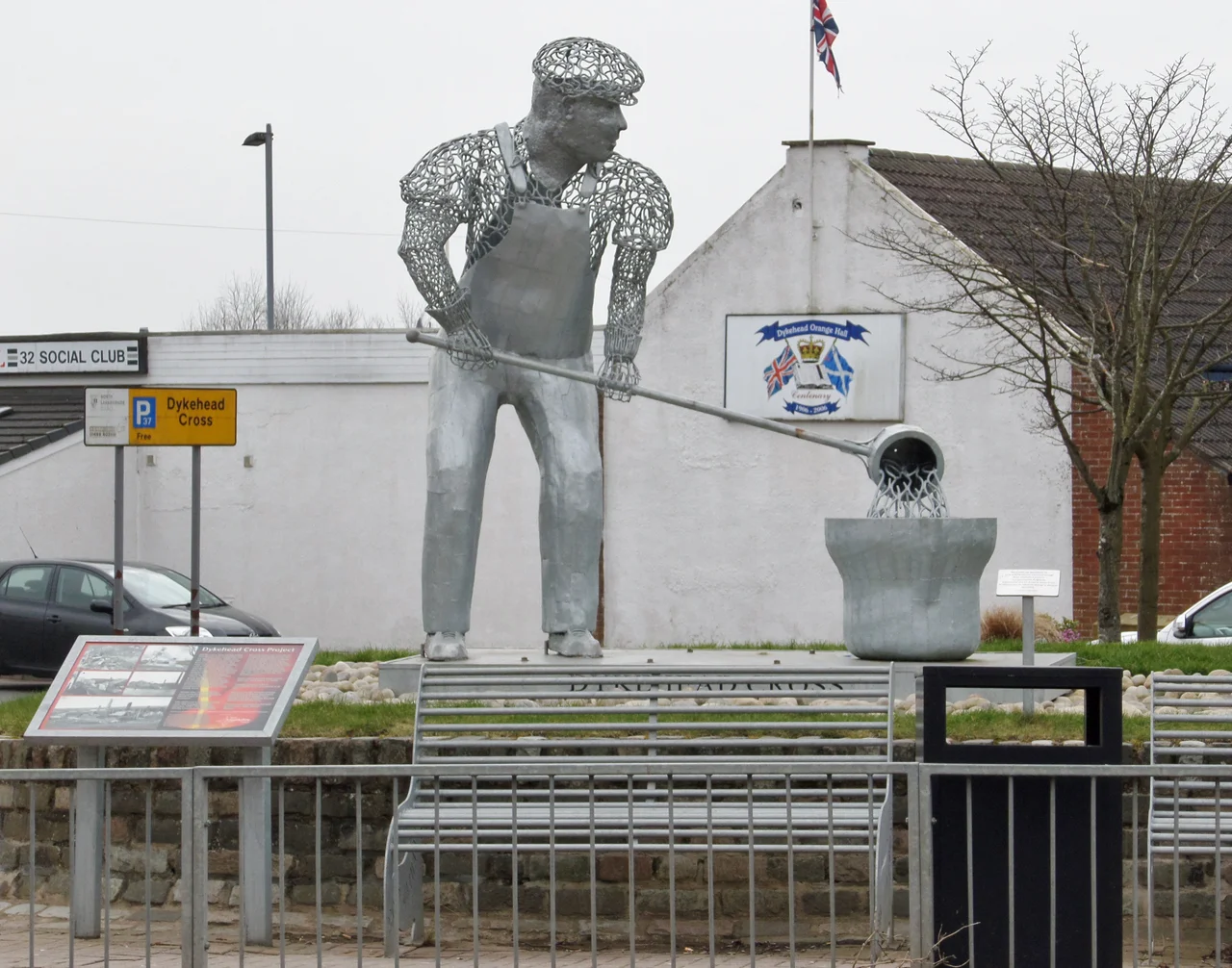

Shotts
'Shotts lights the world.' That was the village slogan in the late 1800s, and it was not boastful. The Shotts Iron Works on the Calderhead burn produced gas-lamp standards — the cast-iron posts that held the streetlights of a generation — and these were exported throughout the British Empire and beyond. If you stood under a gas-lamp in Calcutta, Hong Kong, or Sydney in the year 1890, there is a real chance the post above your head was cast in Shotts. The town's name itself is properly Bertram Shotts, after a legendary giant highwayman called Bertram de Shotts, though toponymists prefer the Anglo-Saxon scēots — 'steep slopes.' The giant is a better story. The slopes are a better explanation.
From Bothwell-muir to the Ironworks
Until 1457 Shotts was just a corner of the Lanarkshire parish of Bothwell, designated 'Bothwell-muir' — the moor of Bothwell. The pre-Reformation church of Bertramshotts was mentioned in a papal bull of 1476. The parish that emerged was one of the largest in Lowland Scotland, ten miles long and eight wide, made up of five small villages — Dykehead, Calderside, Stane, Springhill, and Torbothie — strung along the old coach roads between Glasgow and Edinburgh. What turned a sleepy moorland parish into an industrial town was the arrival of the canal and then the railway in the early 1800s, which made it possible to move coal and iron in bulk. By the late nineteenth century, 22 coal mines were working the area, the ironworks were exporting gas lamps to four continents, and the population had multiplied. Northfield Colliery, the last of the pits, did not close until the 1960s — by which time most of the others had already gone.
Wren's Nest and the Pie Empire
In 1956 Cummins Engine Company — the American diesel manufacturer — opened its first manufacturing facility outside the United States in Shotts, taking over a former textile mill known locally as the Wren's Nest. The factory made high-speed diesel engines and a new kind of engine for railway passenger trains. In 1980 it was expanded with a building so architecturally distinctive — a rationalist functionalist design by the firm Ahrends, Burton & Koralek — that it was eventually Category A listed by Historic Environment Scotland, who call it 'one of the most significant and important examples of large industrial buildings in later 20th century Britain.' The factory closed in 1996 with the loss of 700 jobs. Meanwhile, on Torbothie Road, the Bell family had been quietly building a different sort of empire. In the 1930s they ran a bakery and catering vans. By the 1950s they were producing pre-prepared puff pastry wholesale. Today, from the Hawthorn Bakery in Shotts, Bells makes a reported 16 million pies, bridies, and sausage rolls every year — the kind of statistic that, viewed from the right angle, makes a small town into a major actor in the Scottish national diet.
World Champions on the Pipes
What Shotts is famous for now, more than its iron or its pies or its engines, is its pipe band. The Shotts and Dykehead Caledonia Pipe Band has won the World Pipe Band Championships sixteen times. That is more than any other band in the world. The band was founded in 1910 by miners and their sons, drawing on the deep tradition of pipe music in industrial Lanarkshire — a tradition that wove together Highland heritage, the Scottish Lowlands, and the Irish-Catholic communities that arrived during the nineteenth century. At their highest level, the pipes and drums of Shotts and Dykehead represent something the town has long understood: that excellence is built quietly, over generations, by people whose names are not widely known. The Henderson Theatre, a 147-seater black box opened in 1982 in the Shotts Community Education Centre, is named after Archibald James Henderson, a coal miner who formed half a dozen local drama groups in the town.
Prison and Survival
HMP Shotts, opened in 1978 between Shotts and Salsburgh, is the highest-security prison in Scotland — and after the mines closed it became a major source of employment for the town. The road between work and incarceration here is short, sometimes literally so. The town is served by Shotts railway station on the Shotts Line between Glasgow and Edinburgh, and three primary schools and Calderhead High School educate the next generation. The Highland Games at Hannah Park ran from 1950 to 2022 and then ended — a small loss but a real one in a town that has watched the things it built quietly disappear. What remains is a hard place that produces good engineers, ferocious pipers, a noticeable share of Scotland's professional footballers, and one of the most distinctive industrial buildings of the late twentieth century, still standing on Calderhead Road waiting to be used again. Notable Shotts people include the miners' leader Mick McGahey, the eighteenth-century anatomist Matthew Baillie, the philosopher John Millar, the actor Andrew Keir, and the Scottish-Lanarkshire poet Janet Hamilton.
From the Air
Shotts is at 55.82°N, 3.80°W in North Lanarkshire, between Wishaw to the west and Harthill to the east, sixteen miles east of Glasgow. From altitude the town shows as a compact settlement on the higher ground between Glasgow and Edinburgh, with the South Calder Water rising nearby. The M8 motorway runs to the north; Edinburgh Airport (EGPH) lies 16 nm east-northeast and Glasgow Airport (EGPF) 17 nm west. The Kirk o' Shotts transmitting station — a 280-metre television and radio mast just to the north of the town — is a useful visual landmark from many miles away. The Cummins building on Calderhead Road, distinctive in its rationalist design, is Category A listed; HMP Shotts is the large secure compound between Shotts and Salsburgh.
Nearby Stories
- Cathcart Castle 2.4 km away
- Roslin Castle 4.7 km away
- Ravenscraig Castle 5.2 km away
- Crawford Castle 8.3 km away
- Catrine 9 km away
- Battle of Dollar 9.8 km away
- Battle of Philiphaugh 18 km away
- Loch Achray 20 km away