
Ravenscraig Castle
King James II of Scotland died in an accident with his own artillery. On 3 August 1460, besieging Roxburgh Castle, he stood too near one of his cherished cannon when it exploded. He had loved the new technology of gunpowder warfare - had named his bombards, had brought them to siege after siege. In the months before his death he had begun something new on a rocky promontory above Kirkcaldy on the Firth of Forth: a castle designed not just to use artillery but to withstand it. His widow, Mary of Guelders, finished what he started. Ravenscraig may be the first castle in Scotland built to take cannon fire.
Mary's Memorial
Construction began around 1460 and Mary of Guelders, James II's widow, carried it forward after his death - intending the castle as both a dower house and a memorial. She kept building until her own death in December 1463. The mason Henry Merlioun, working under the master of works David Boys, completed the east tower and the basement of the central section during these years. Timber joists were organised by Andrew Balfour of the royal wardrobe, boated down the Allan Water from Stirling and shipped across to Fife in 1461. Mary's steward Henry Kinghorn and other household members were already living in the finished accommodation while the rest of the castle rose around them. After Mary's death, ownership passed to her son James III, who in 1471 gave Ravenscraig to William Sinclair, Earl of Orkney and Caithness, in exchange for the Earldom of Orkney itself - which James annexed from Norway and added to the Scottish Crown.
Walls Built for Cannon
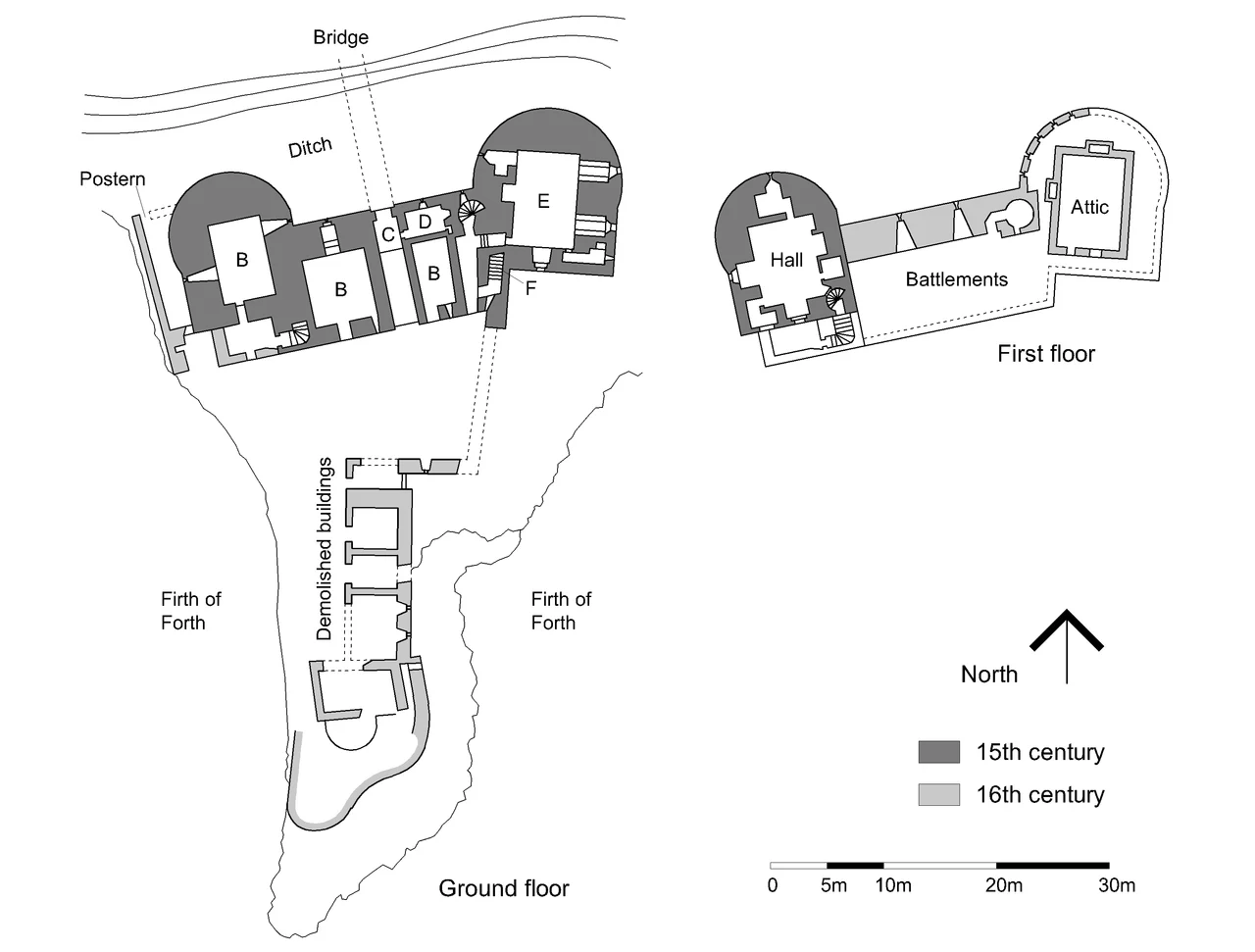
The castle is small but its design is deliberate. Built on a narrow rocky promontory, it is defended on three sides by steep cliffs falling into the Firth of Forth. The main defence faces north, toward land. Two D-plan towers with outer walls 4.25 metres thick - thicker than almost any Scottish castle of comparable date - were built specifically to absorb cannon shot. Between them, an artillery platform with battlements held the castle's own guns, the gun holes pointing landward. A deep rock-cut ditch crosses in front. A drawbridge gave access. The gun holes themselves use the inverted keyhole design that became common in the late 15th century - a circular hole below for the barrel of a small cannon, with a vertical slit above for aiming. The west tower stands four storeys with vaulted cellars, a hall, and small chambers. The east tower stands three storeys, set lower into the cliff with a well at its base. Both have windows facing the sea but only narrow slits facing land. The Sinclairs, who completed Ravenscraig after 1471, shared the royal interest in artillery fortifications.
Cromwell and the Linoleum King
During Cromwell's 1650-51 invasion of Scotland, Ravenscraig was attacked and damaged. The castle remained in Sinclair hands - the family later built Dysart House nearby in 1755 and 1756 - and eventually passed to the St Clair-Erskines, Earls of Rosslyn. In 1896 the 5th Earl sold the entire estate to Sir Michael Nairn, the Kirkcaldy linoleum magnate whose factories had made the town the linoleum capital of the world. Nairn lived in Dysart House and treated Ravenscraig as a romantic ruin in his grounds. The First World War found a new use for the place. The castle's thick walls made an excellent ammunition depot. In 1955 Ravenscraig passed into state care, and since 1971 it has been open to the public under Historic Environment Scotland. Its strange afterlife continues. The Celtic punk band The Real McKenzies filmed the video for their song Drink Some More on the battlements. A castle commissioned by a queen as a memorial to her king has become, four hundred years on, a backdrop for songs about whisky and a place to watch the Firth of Forth wash against the cliffs that defended it.
From the Air
Ravenscraig Castle sits at 56.12N, 3.14W, on a rocky promontory on the south coast of Kirkcaldy looking out over the Firth of Forth. Best viewed at 1,500-2,500 feet to see the two D-plan towers, the rock-cut defensive ditch, and the cliff-edge setting. Edinburgh Airport (EGPH) lies 20 miles to the south across the Firth. Kirkcaldy stretches inland to the north. Look for the railway line along the coast and the harbour to the west.
Nearby Stories
- Tay Bridge Disaster 1.4 km away
- Bell Rock Lighthouse 4.5 km away
- Newbattle Abbey 4.9 km away
- Burngrange Mining Disaster 7 km away
- Battle of Dollar 9.8 km away
- Battle of Dunkeld 16 km away
- HMS Pathfinder (1904) 19 km away
- Battle of Nesbit Moor (1402) 19 km away