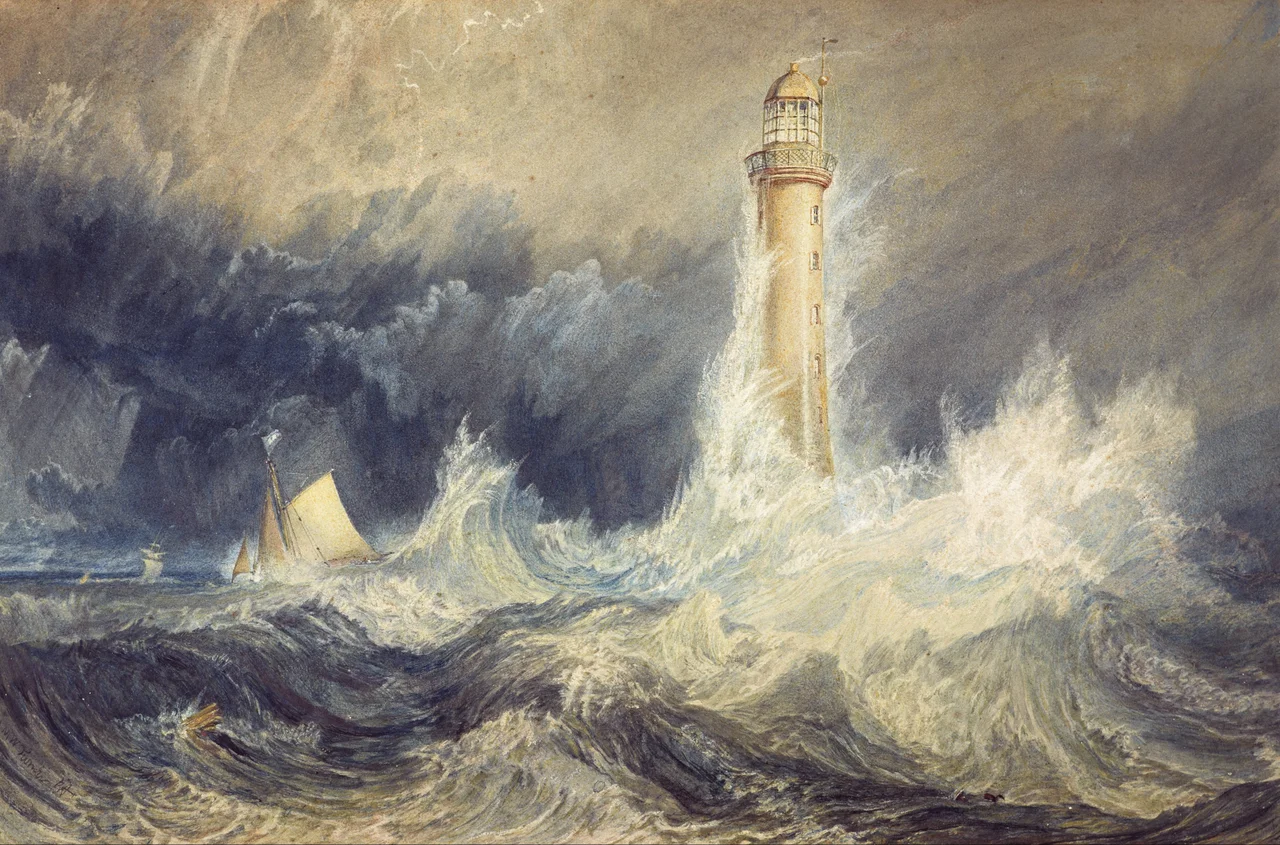

Bell Rock Lighthouse
For twenty hours of every twenty-four, the Bell Rock is invisible. Twelve feet of cold North Sea covers it at high tide, leaving nothing but the curve of a lighthouse rising out of empty water - 35 metres of interlocking granite, perfectly carved, holding the sea at arm's length for two hundred years. The light is visible from 35 statute miles inland. When Robert Stevenson sailed out here in August 1807 with sixty men, the rock had already wrecked an estimated six ships every winter. By the time he was finished three years later, he had built what would be called one of the Seven Wonders of the Industrial World on a place that did not exist most of the day.
The Abbot's Bell
The rock is also called Inchcape, and the legend explaining its name goes back to the 14th century. The Abbot of Arbroath, the story has it, had a warning bell installed on the reef so that ships running before bad weather would hear it ringing in the swell. A year later a Dutch pirate stole the bell. The 19th-century poet Robert Southey immortalised the tale in his ballad "The Inchcape Rock," in which the pirate later perishes on the very reef he had silenced. Whether the bell ever existed is doubtful. The hunger for a story to explain the wrecks, however, was very real. By 1799 the Masters of Trinity House in Leith had decided that a permanent lighthouse was needed, and they commissioned a young Scottish engineer named Robert Stevenson to design it.
Sixty Men on a Drowning Rock
The proposal was shelved at first. Stevenson was twenty-eight, the design was radical, and the cost frightened the East Coast burghs who would have to pay. Then in 1804 a warship was wrecked on the rock and all aboard perished. The outrage in Parliament unblocked everything. Stevenson sent his design to John Rennie, the great engineer of his generation, who approved it. Legislation passed in 1806. Sixty men, including a blacksmith to keep the picks sharp, sailed for the rock on the 17th of August 1807. Because the reef was underwater for twenty hours of every twenty-four, the men first lived on a ship moored a mile off, rowing out to work each day. One of the boats was lost adrift. Their first construction was therefore a beacon house on tall wooden struts so that fifteen men at a time could live above the waves while they cut foundations beneath them.
Granite That Holds the Sea
Stevenson refused to use black powder; he feared it would shatter the very rock the lighthouse was meant to stand on. So the foundations were cut by hand, with picks. The granite for the tower itself came from Cairngall, quarried over the winter while the rock was unworkable. Each stone was carved to interlock with its neighbours in three dimensions, a technique borrowed from John Smeaton's Eddystone Lighthouse, which Stevenson had studied in 1801. The design was so good that the masonry on which the entire structure rests has never been replaced or adapted in over two hundred years. Stonemasons agreed, after some initial reluctance, to work even on the Sabbath to meet the schedule. The cost in flesh was real. In September 1808, a stonemason named John Bonnyman had a finger crushed and amputated; Stevenson later made him one of the first lighthouse keepers as recompense. In June 1809 the principal builder Michael Wishart was caught under a falling crane and his feet were ruined; he too became an assistant keeper.
The Sycamore and the Stevensons
On the 15th of December 1955, an RAF Bristol Sycamore helicopter on a sea-winching exercise from Leuchars struck the lighthouse's anemometer with its tail rotor and crashed into the sea. The pilot, Flight Sergeant P. A. Beart, was never recovered. The navigator, Sergeant E. F. Hall, was found. The lighthouse lost its light but its keepers were unhurt. Bad weather kept rescue and repair away until December 20. The lighthouse was automated on the 24th of October 1988. Today the Northern Lighthouse Board monitors it remotely from headquarters in Edinburgh. The Stevenson family - Robert and his sons David, Alan and Thomas - went on to design dozens more lighthouses around Scotland. Thomas's son, Robert Louis Stevenson, was supposed to join the family business. Instead he wrote Treasure Island. The light on Bell Rock still turns.
From the Air
Bell Rock Lighthouse stands at 56.43°N, 2.39°W, 11 nm east of the Firth of Tay and 12 nm southeast of Arbroath in the open North Sea. The tower is 35 metres tall, rising directly from the sea at all but the lowest tides. From 2,000-5,000 ft AGL in clear weather the lighthouse is unmistakable: a solitary stone tower with no land visible around it, occasionally surrounded by a fringe of exposed reef at low water. Nearest airports: Dundee (EGPN) 18 nm west; Leuchars (EGQL) 17 nm west-northwest; Aberdeen (EGPD) 50 nm north. The lighthouse has a small helipad for maintenance access. Visible from up to 35 statute miles inland on clear nights.
Nearby Stories
- Claypotts Castle 6.3 km away
- Inverbervie 7.3 km away
- HMS Pathfinder (1904) 16 km away
- Battle of Mons Graupius 19 km away
- Balgonie Castle 19 km away
- Longstone Lighthouse 68 km away
- Farne Islands 100 km away
- German submarine U-58 (1938) 162 km away