
Inverbervie
In 1787, on the banks of the Bervie Water where it tumbles down to the North Sea, an enterprising Kincardineshire miller built the first flax spinning mill in Scotland. The water turned the wheels, the wheels spun the flax, and the linen industry that would eventually dress half of Scotland began here, in a small coastal town most travellers know mostly as the place between Stonehaven and Montrose on the A92. Inverbervie, or just Bervie to its own people, takes its name from a Gaelic word meaning river mouth, layered over an even older Brittonic word that meant exactly the same thing. The river itself takes its name from an Old Irish word, berbaim, meaning I boil.
Eight Mills at Their Peak
From that first Haughs Mill in 1787, the flax industry exploded. By 1910, eight mills were running in and around Inverbervie: two at Haughs, Laurel Mill, two at Springworks, Lint Mill, Pitcarry and Craigview, between them employing up to 600 workers. The population swelled to over 2,500 around the turn of the twentieth century. Streets that today carry the names of the old mills, like Laurel Crescent and Craigview, were built where the mills once stood. The whole machinery of small-town industrial Scotland was on display here in microcosm. Then the bottom fell out of British linen. The Craigview Mill, the very last one operating, was finally closed by the Sidlaw Group in 1993. The streets remain. The mills have been replaced mostly by housing.
Telford's Lost Harbour
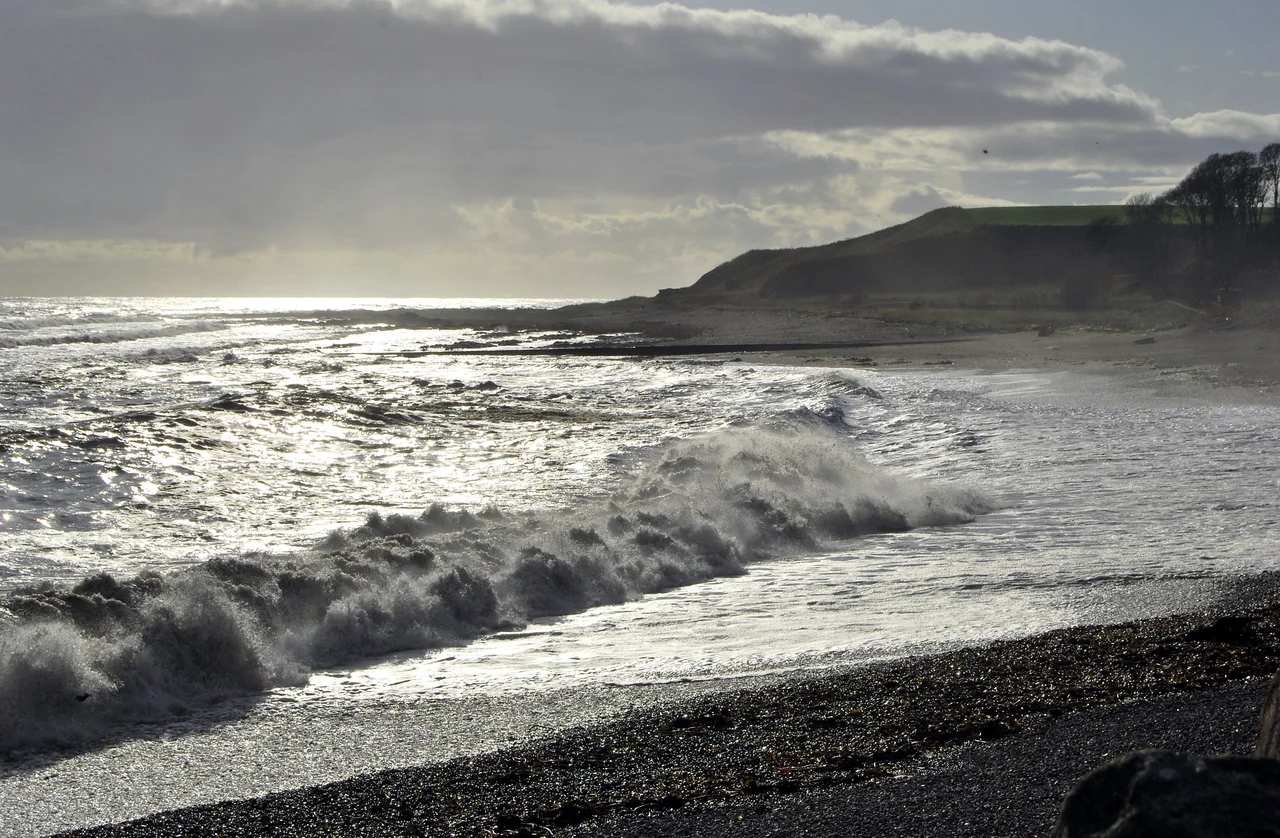
There used to be a harbour at Inverbervie, important enough that Thomas Telford himself, the great Scottish civil engineer who built the Caledonian Canal and the Menai Bridge, was brought in to improve it in 1819. Within eleven years it had vanished. A shingle bar built up at the river mouth and blocked the entrance, and no amount of Telford engineering could keep the North Sea from rearranging Bervie Bay according to its own preferences. The town turned its back on the sea after that and concentrated on its mills. Today the beach is shingle and quiet, a place for walking rather than commerce. Hallgreen Castle, founded in 1376, still stands on a bluff at the southern end of town, looking out across the water as it has done for over six centuries.
Hercules Linton and the Cutty Sark
Walk up to the ruins of the original Bervie Parish Church, about a hundred metres southeast of the current building, and among the headstones in the old graveyard you can find Hercules Linton, born in Inverbervie in 1837 and buried here in the same town in 1900. Linton was the naval architect who designed the Cutty Sark, the famous tea clipper launched at Dumbarton in 1869 that became, for a few brief years, one of the fastest sailing ships in the world. The Cutty Sark survives today as a museum ship at Greenwich in London. Its designer rests at the edge of the small Aberdeenshire town where he was born. There is no statue of him in Inverbervie. There ought to be.
The Chip Shop Champion
The Bervie Chipper on King Street took home the title of UK Fish and Chip Shop of the Year for 1997. It is a real thing, awarded by the National Federation of Fish Friers, and it is a serious matter in a small Scottish coastal town to hold a national title. The Bervie Sports Centre, which opened in March 1989, is another quietly proud institution. So is the Mearns Leader, the local paper edited from neighbouring Stonehaven, and Mearns FM, the volunteer-run community radio station that broadcasts from Stonehaven Town Hall to one of the largest listening areas of any community radio licence in Britain, because the Mearns is a place of widely scattered villages and people listening at kitchen tables.
The Branch Line That Was
From 1865 to 1951, Inverbervie had its own railway, the terminus of a branch line from Montrose, with around twenty trains a day calling at Bervie railway station at its peak in 1900. The line carried mill workers, fish, mail, and tourists. It closed to passengers in 1951 and to freight in 1966, victim of the same Beeching-era logic that took out so much rural Scottish track. Today Inverbervie has the X7 Coastrider bus, running on the A92 between Aberdeen, Stonehaven, Montrose and Dundee. The town remains within Aberdeenshire (since 1996), though it was Kincardineshire until 1975, and is represented in Westminster by Conservative MP Andrew Bowie. From the air, the town is a tidy circle of houses on a hillside, with the Bervie Water flowing down behind it to the sea.
From the Air
Inverbervie lies at 56.84 degrees north, 2.28 degrees west on the Kincardineshire coast, about 11 nautical miles northeast of Montrose and 9 nautical miles south-southeast of Stonehaven. The town sits on a low hill rising from Bervie Bay, with the A92 coastal road running through the middle. Hallgreen Castle is visible at the southern end. Nearest major airport is Aberdeen (EGPD) approximately 20 nautical miles north-northeast; Dundee (EGPN) lies about 30 nautical miles south-southwest. The Mearns coastline extends north and south from here, with low cliffs and shingle beaches typical of the area.
Nearby Stories
- Cullerlie Stone Circle 4.3 km away
- Battle of Mons Graupius 13 km away
- Kildrummy Castle 13 km away
- Claypotts Castle 15 km away
- Arbroath Abbey 19 km away
- Longstone Lighthouse 107 km away
- German submarine U-58 (1938) 123 km away
- Farne Islands 139 km away