.jpg)
Longstone Lighthouse
She was twenty-two and looking out a window. The window faced south-east, away from the storm, and through it Grace Darling saw something moving on Big Harcar rock about a mile off. The dawn was just lifting on 7 September 1838. The paddlesteamer Forfarshire had broken in two during the night somewhere out in the worst gale of the season. Grace knew none of this. She just saw shapes that should not have been there. She woke her father. They watched together for some minutes through the lighthouse's telescope until they were sure - human figures, perhaps eight or nine, alive, still on the rock. The lifeboat from North Sunderland would never be able to launch in this weather. William Darling and his daughter Grace got into their own small coble and started rowing.
Why the Lighthouse Existed
The Farne Islands had killed ships for centuries before Longstone Lighthouse was built. Captain John Blackett's coal-burning beacons had marked the islands since 1778, and Trinity House had improved on them with three new oil-fuelled lighthouses in 1811. But the Brownsman Island light, the outermost of the new towers, proved to be in the wrong place - too far inshore to warn ships about the outer reefs. In 1823 the George and Mary went down off the Farnes with all 100 souls aboard. More ships followed in 1824. Trinity House moved fast. They bought the lease of the islands from the Blackett family in 1825 and commissioned a new lighthouse on Longstone Rock, the very outermost of the Outer Group. Joseph Nelson designed and built it. Construction was swift. The new light was first lit on 15 February 1826. Total cost: £4,771.
William Darling Moves In
William Darling had been keeper at the Brownsman lighthouse, and he moved his family across to Longstone when it opened. His daughter Grace - born 24 November 1815 in Bamburgh, where her grandfather had been the village joiner - grew up in lighthouses. By 1838 she was twenty-two, the seventh of nine children, an experienced rower in heavy weather, accustomed to the routines of a working light: trimming the wicks, polishing the reflectors, keeping the lens spotless. The original Longstone lamp was a four-sided rotating array of twelve Argand lamps, three on each side, each mounted in a 21-inch parabolic reflector. The whole apparatus revolved by clockwork and showed a white flash every thirty seconds. Maintaining it was relentless work, performed in conditions that ranged from bleak to terrifying.
The Forfarshire Rescue
Grace and her father reached Big Harcar rock through what survivors described as 'mountainous' seas. The Forfarshire's stern had been torn off and sunk during the night; the surviving fragment of the bow had eight crew and one passenger clinging to it, plus the bodies of a young woman and two children who had not survived the night. Father and daughter could not take everyone in one trip. They loaded five into the coble, rowed them back to Longstone, then William and two of the rescued men rowed back for the remaining four. The whole rescue took several hours. They saved nine lives. The Victorian press did not know what to do with Grace. A young woman, modest, devout, who had rowed through a gale to save strangers - she became a phenomenon overnight. The Royal National Institution for the Preservation of Life from Shipwreck awarded her the silver medal. She received fan mail, marriage proposals, requests for locks of her hair. Painters came. Wordsworth wrote a poem about her. Souvenir teacups appeared in shops. Grace was uncomfortable with all of it. She died of tuberculosis on 20 October 1842, aged twenty-six, in Bamburgh.
The Light Continues
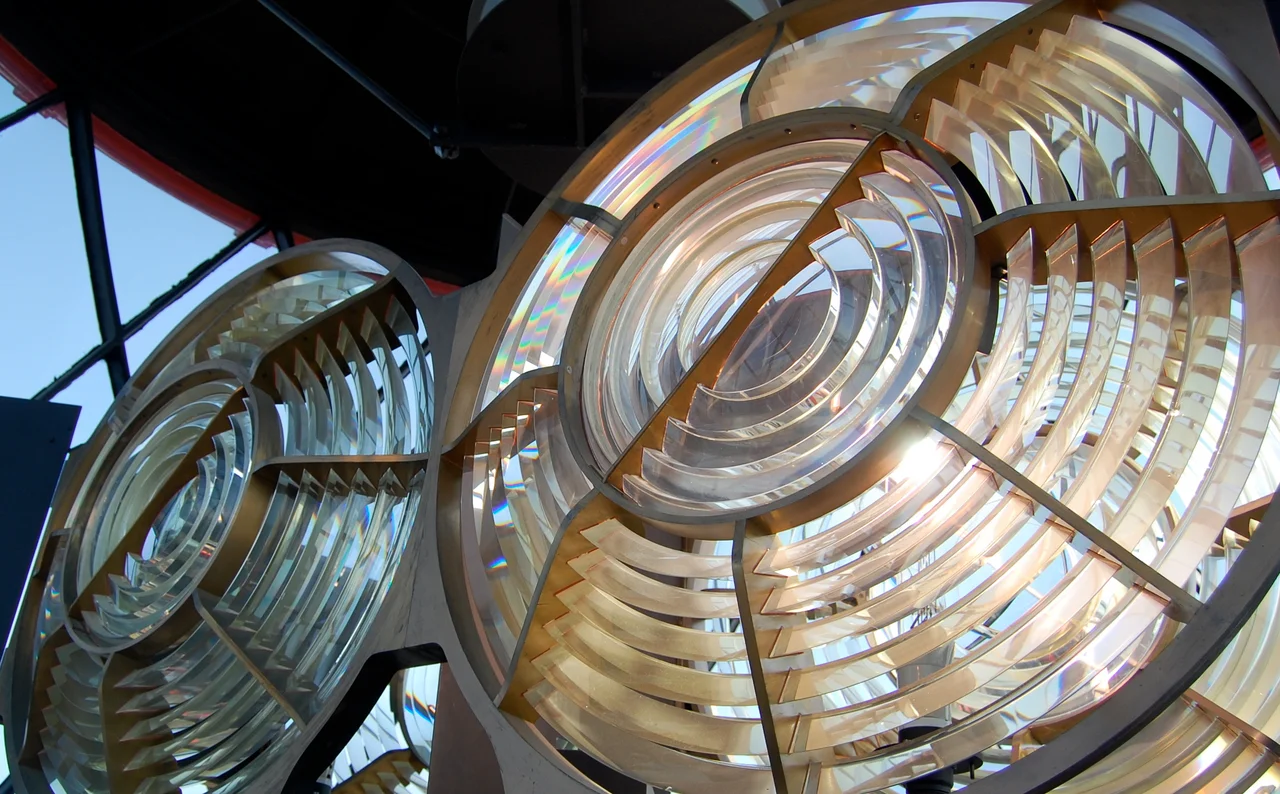
The Longstone optic has been upgraded several times. In 1873 Chance Brothers of Smethwick installed a new Fresnel lens system, maintaining the characteristic white flash every thirty seconds. In 1876 a fog siren powered by a caloric engine was added, sounding two blasts every two minutes. The horizontal white band that breaks up the red paint of the tower was added in 1895. The fog signal house was destroyed by bombing in 1942 during the Second World War; the keepers' quarters were rebuilt around it in 1951. In 1990 the light was fully automated and the keepers withdrawn. Since 2015 it has run on solar power, with an LED light source inside the original Chance Brothers 'spectacle' optic. The range has been reduced from 24 miles to 18; the intensity from 645,000 candelas to 116,000. The diesel generators are now standby only. The light Grace Darling tended is still on every night, automatically, while her own grave in Bamburgh churchyard faces seaward so passing ships can see it.
From the Air
55.64N, 1.61W on Longstone Rock, the outermost island of the Outer Farnes, 2 mi northeast of Inner Farne and 3 mi offshore from Seahouses. The red-and-white striped tower is unmistakable from the air. From altitude, look for the small rocky island with the bold tower and adjacent white keeper's quarters; Big Harcar (the rock where the Forfarshire wreck happened) lies just to the south-west. Nearest ICAO: Newcastle (EGNT) 50 mi south. Best photographed at 2,000-3,000 ft AGL with morning light. The waters around Longstone are notorious for sudden weather changes - the same conditions that wrecked the Forfarshire in 1838 still occur regularly.
Nearby Stories
- St Abbs Lifeboat Station 1.2 km away
- Etal Castle 1.6 km away
- Warkworth Castle 3.4 km away
- Otterburn Training Area 12 km away
- Eyemouth Disaster 28 km away
- German submarine U-2367 79 km away
- Saltburn Pier 117 km away
- Alexander L. Kielland (Platform) 265 km away