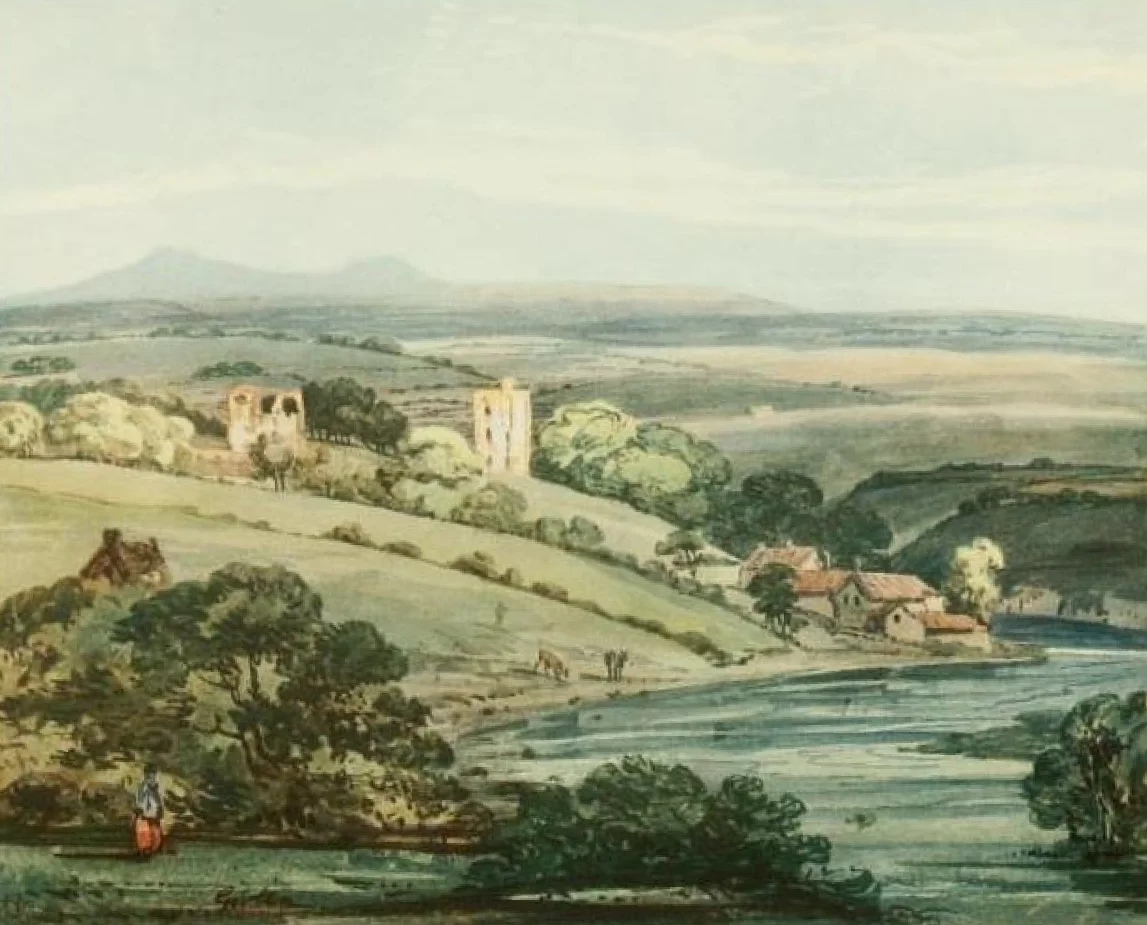

Etal Castle
On 20 January 1428, two English families who lived three miles apart settled an argument outside these walls. The Manners of Etal and the Herons of Ford had been feuding for years. By the time the morning was done, William Heron was dead, and the legal aftermath ran on long enough to require arbitration by the Church. John Manners argued that William had assaulted the castle and died in the attempt, that he himself had nothing directly to do with the killing. The Church accepted the argument enough to settle it bloodlessly: John would pay for 500 masses for William's soul and hand 250 marks to his widow. The price of a neighbour, paid in sacraments and silver. Etal Castle has stood here since around 1341, when Robert Manners obtained from Edward III a licence to crenellate against the Scots. It has been a feud-house, a border fort, and a ruin, and most of what survives is the residential tower that watched over all of it.
Building to Defy the Scots
The Manners family had held the manor of Etal since at least 1232. When Robert Manners began fortifying the site around 1341, he was not building a castle in the grand sense, just a strong rectangular enclosure with a residential tower in the north-east corner, a corner tower at the north-west, and a curtain wall four feet thick around the perimeter. The licence to crenellate may have covered only the perimeter walls, since the central tower may already have stood from the late thirteenth century. By the 1350s the surrounding manor was a working enterprise of mills for corn and fulling, lime kilns, and coal mines. In 1355 a powerful regional figure named Sir Edward de Letham acquired the wardship of the property, possibly as a reward from Edward III for keeping him loyal against the Scots. De Letham and his wife allegedly ran the estate into the ground, prompting a royal commission to investigate.
The Day James IV Came Through
August 1513 was Etal's worst month. James IV of Scotland had invaded England with an army equipped with modern artillery, the kind of guns that made the old border castles look like dovecotes. He took Norham first, then Wark, then turned south toward Etal. The garrison did not wait to be battered. They surrendered quickly in the hope of escaping a sack, but the Scots partly slighted the castle anyway, deliberately damaging it to prevent its later use. The reprieve was brief. Within weeks, James IV was killed at the Battle of Flodden, a few miles south, and the English retook Etal. Lord Dacre used the castle to store the captured Scottish artillery under the guard of Sir Philip Tilney, and stayed on extensively through 1515 and 1516. By 1541 a royal commission found Etal in very great decaye and recommended repairs.
The Slow Decline
When James VI of Scotland inherited the English throne in 1603 and united the two crowns, the Border castles lost their reason for being. There was no longer a frontier to defend. Etal slipped quietly into private ownership and gradually into ruin. Thomas Girtin painted its watercolour in 1797, on the basis of a visit the previous autumn. Lord Joicey bought the castle in 1908 and by 1922 his work had cleared the ivy and repointed the stone. The state took the castle into its guardianship in 1975, and four archaeological excavations between 1978 and 1998 attempted to map the underlying complex. The south-east corner still defies certainty. Excavations in 1978 found no trace of a second corner tower there, and a geophysical survey in 1998 came back inconclusive. The castle keeps some of its secrets even now.
What Remains
Today the residential tower stands four storeys high, reached by a spiral staircase, with two vaulted guardrooms flanking the entrance passage. The gatehouse carries the Manners coat of arms above the entrance and what architectural historian Anthony Emery has described as flamboyant window tracery, an unexpected flourish on a workmanlike border fort. The north-west corner tower is small and tight, about 14 by 10 feet inside. Most of the curtain wall is reduced to its foundations. The castle now belongs to the Joicey family but is managed by English Heritage and protected under UK law as both an ancient monument and a Grade I listed building. Walk the perimeter and you can still feel the modest scale of the place, a private fortification trying to be enough against everything the fourteenth and fifteenth centuries could throw at it.
From the Air
Located at 55.647°N, 2.121°W in the village of Etal, Northumberland, originally overlooking a bridge over the River Till. Best viewed at 1,000-2,500 ft AGL with the river and steep wooded banks visible to the east. The castle is a small rectangular footprint, approximately 182 feet on its longest dimension, with the residential tower at the north-east corner the most prominent surviving structure. Nearest major airports: Newcastle (EGNT) approximately 42 nm south-east and Edinburgh (EGPH) approximately 45 nm north-west. Ford Castle, the seat of the rival Heron family, lies less than 2 nm to the south.
Nearby Stories
- Otterburn Training Area 1.3 km away
- Galashiels 1.6 km away
- Battle of Piperdean 2.7 km away
- Bamburgh Castle Lifeboat Station 3.7 km away
- Warkworth Hermitage 9.1 km away
- Seton Palace 11 km away
- Battle of Arkinholm 27 km away
- German submarine U-58 (1938) 260 km away