_(14883232666).jpg)
Galashiels
Sour Plums. That's the town's motto, written in Scots as Soor Plooms, and it commemorates the day in 1337 when a band of English soldiers stopped to pick wild plums on the slopes near Galashiels and a group of Scots came across them by chance and killed them all. The town's coat of arms shows two foxes reaching up into the fruit tree. It is one of the more unusual civic emblems in Scotland - a memorial to a small, savage, almost accidental act of violence - and Galashiels has carried it for nearly seven centuries. The townspeople still sing it. Once a year, in summer, the Braw Lads ride through the streets and the old song goes up: sour plums in Galashiels.
Before the Town Had a Name
To the west of modern Galashiels runs an ancient earthwork called the Picts' Work Ditch, or Catrail. It extends many miles south, its height and width varying, and nobody agrees on what it was for - a boundary marker, a defensive line, a cattle drove route. On the north-western edge of the town stood another ancient site: Torwoodlee, an Iron Age hill fort with a later broch built inside it in the early 2nd century. The broch was a stone tower, the kind of structure typical of the Pictish north, and its presence so far south is unusual. The Romans destroyed it in 140 CE, soon after it was completed. Whoever built it never got to use it for long. The stones are still there, half-buried in the slope above the town that wouldn't get its name for another thousand years.
Mills on the Gala Water
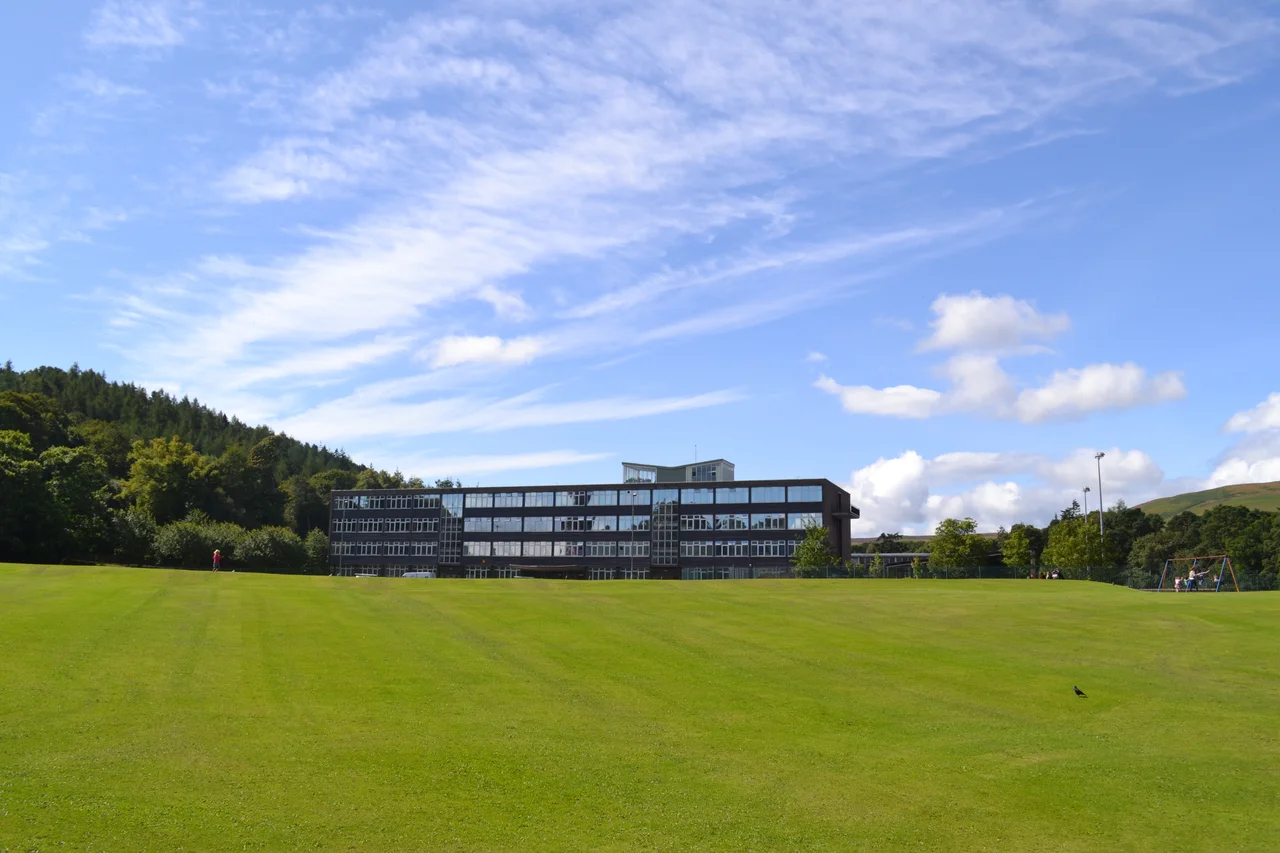
In 1599 Galashiels received its Burgh Charter. For two more centuries it remained small - around 800 people at the start of the 19th century. Then came the textile revolution. The Gala Water, which gives the town its name, ran fast enough and clean enough to power machinery, and the surrounding hills produced wool. By 1890 the population had jumped to 19,553. Mills ran day and night. The Mill Lade, an artificial channel that still threads through the modern town from Wheatlands Road down to Netherdale, fed the wheels. The town wove tartan, tweed, and the heavy woollens that clothed the British Empire. Most of those mills are gone now, converted to flats or pulled down for supermarkets. But Heriot-Watt University's School of Textiles and Design still occupies the Netherdale campus, keeping a thread of the old trade alive.
The Songs and the Singers
Robert Burns wrote two poems about Galashiels: Sae Fair Her Hair and Braw Lads. The second is sung at the Braw Lads Gathering every summer, a tradition formalised in 1930 with the support of the local artist and watercolourist George Hope Tait, who served on the town council for nearly thirty years. Sir Walter Scott built his home Abbotsford just across the River Tweed from Galashiels in 1812; the Sir Walter Scott Way long-distance path passes through the town on its 92-mile route from Moffat to Cockburnspath. Robert Coltart, a 19th-century weaver, wrote the children's song Coulters Candy - 'Ally bally ally bally bee' - to advertise the boiled sweets he made. He died in 1890. A statue of him stands in Market Square. In 1985 the Marillion song Kayleigh, partly inspired by lead singer Fish's time in Galashiels in his early years, became a hit; in 2012 the council inscribed its lyrics into the Market Square paving, and Fish came back to officially reopen the square.
The Great Tapestry
On 21 August 2021, after years of planning and £6.7 million of investment, the Great Tapestry of Scotland Centre opened in Galashiels. The tapestry it houses - 160 hand-stitched panels telling the entire history of Scotland from the geological formation of the land to the modern day - was the idea of the Edinburgh-born novelist Alexander McCall Smith. More than a thousand stitchers across Scotland worked on the panels over six years. On opening day, the chief stitcher Dorie Wilkie unveiled the 160th and final panel with McCall Smith standing beside her. Galashiels won the right to host it partly because of its textile heritage and partly because it sits where it does - on the new Borders Railway, accessible from Edinburgh in under an hour by train. The town that grew on cloth now holds Scotland's largest piece of cloth.
The Train That Came Back
In 1969 the Waverley Line - the railway that had connected Galashiels and the Scottish Borders to the national network for over a century - was closed in the Beeching cuts. For 46 years the Borders had no trains. The campaign to bring rail back never went away. In 2006 the Scottish Parliament passed the Waverley Railway Act authorising partial restoration. The new Borders Railway opened on 9 September 2015, formally launched by Queen Elizabeth II. Thirty miles of new track were laid along the old line. Four new stations went up in Midlothian and three in the Borders, with Tweedbank as the southern terminus just down the road from Galashiels. The trip from Galashiels to Edinburgh Waverley now takes under an hour, every half hour. The transport interchange beside the station opened in August 2015, just before the trains began running, and the town that had been cut off rejoined the network that had abandoned it half a century earlier.
From the Air
Located at 55.6206 N, 2.8189 W, on the Gala Water near its confluence with the River Tweed in the Scottish Borders. Visible reference points: the long valley of the Tweed running east-west, Abbotsford House just across the river to the east, the wooded slopes of Torwoodlee to the northwest, and the Eildon Hills (three distinctive volcanic peaks) about 5 miles southeast. Nearest airport: Edinburgh (EGPH), about 25 nautical miles north. Recommended viewing altitude 2,500-4,000 ft AGL. The Borders Railway runs along the Tweed valley toward Tweedbank.
Nearby Stories
- Floors Castle 3.3 km away
- Dalkeith Palace 5 km away
- Cockburnspath 7.4 km away
- Otterburn Training Area 9.8 km away
- Linlithgow Palace 10 km away
- New Lanark 17 km away
- Morton Castle 18 km away
- Battle of Arkinholm 25 km away