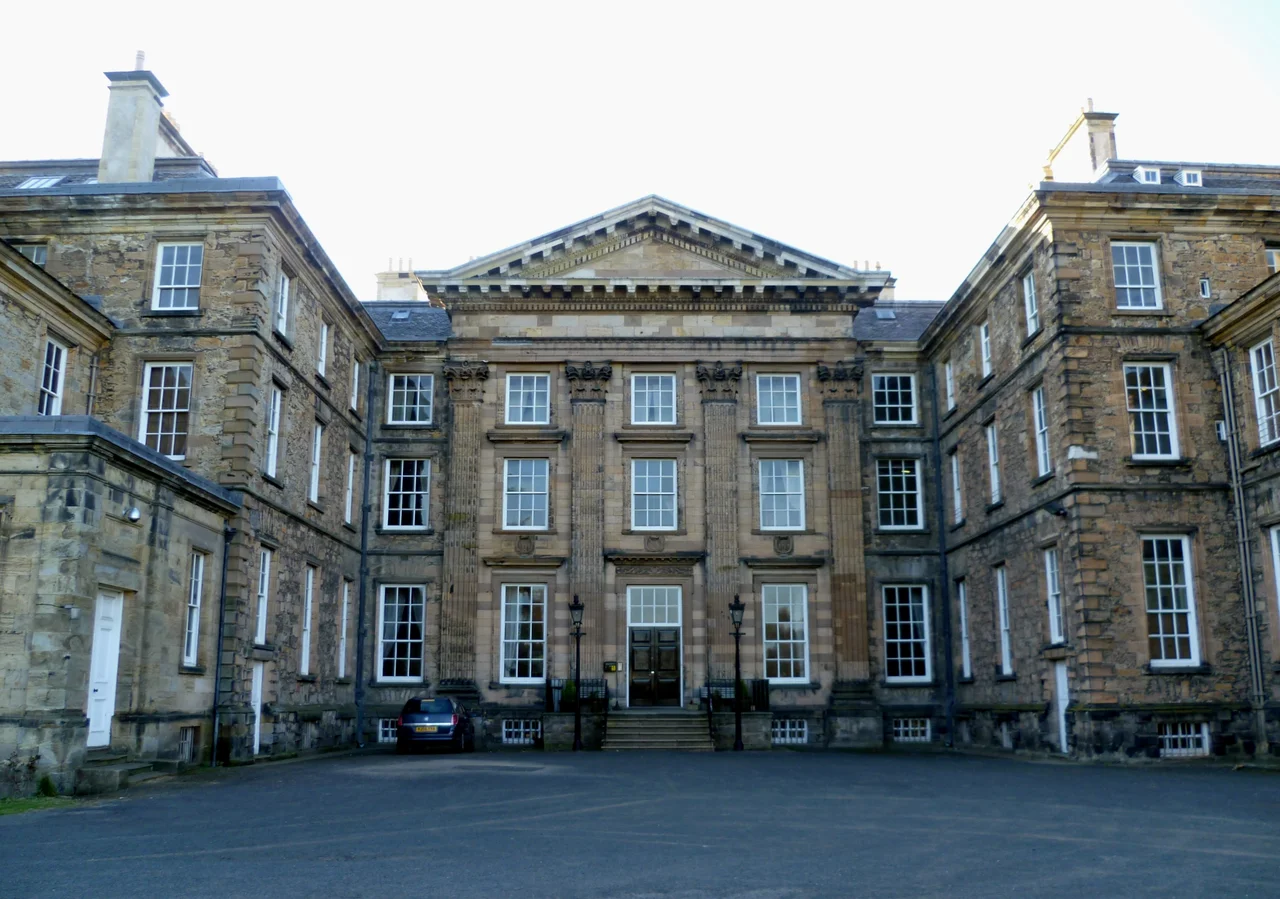

Dalkeith Palace
The graffiti on the third-floor wallpaper at Dalkeith Palace is in Polish, drawn in 1942. It remained legible as late as 2008. The soldiers who left it were from the 3rd Flanders Rifle Brigade, part of the 1st Polish Armoured Division, billeted in a Midlothian palace whose owners had not lived there since 1914. Before them came George IV, who slept here in 1822 because the Palace of Holyroodhouse was in too poor a state for a king. Before George came Bonnie Prince Charlie in 1745. Before the Bonnie Prince came Mary, Queen of Scots, in October 1565. Before any of them, in the twelfth century, Clan Graham built a castle on a bend in the River North Esk and held it for two hundred years.
The Castle on the Bend
Dalkeith Castle stood on the same ground as the present palace, on a defensible bluff above a loop of the River North Esk. The site dated from the twelfth century, when it belonged to Clan Graham, Lords of Dalkeith. When John de Graham died in 1341 or 1342, the castle and the barony passed to Clan Douglas through his sister Marjory, who had married Sir William Douglas. By the mid-fifteenth century, James Douglas of Dalkeith had become Earl of Morton. The castle's defensive position served well during turbulent centuries. In 1503 Margaret Tudor, bride of King James IV, stayed here as the Earl of Morton's guest before her formal entry into Edinburgh. In 1543 Cardinal Beaton was imprisoned in the castle. On 3 June 1548, during the Rough Wooing, English soldiers under James Wilford and Thomas Wyndham captured the castle, supported by the Spanish captain Pedro de Gamboa. Mary, Queen of Scots came in October 1565. From June 1574, Regent Morton - who had himself been captured in the 1548 siege - extended the castle.
James VI and the King Who Wanted It
When James VI reached his majority in October 1579, Morton entertained the young king at Dalkeith. The Stuart kings became regular guests. James VI and Anne of Denmark frequently stayed at the castle, with a peculiar incident in August 1592 when the prisoner John Wemyss of Logie escaped through their bedchamber, helped by the queen's servant Margaret Vinstarr. The royal master of works William Schaw prepared a nursery for the queen here in 1598, and Princess Margaret was born on Christmas Eve that year. In August 1601 the infant Prince Charles, the future Charles I, was seriously ill while staying at the castle. He recovered. When Charles returned to Scotland as king in 1633, he liked the place so much he tried to buy it from Lord Morton and turn it into a deer park. By 1637 the king had decided on the purchase. The castle was re-fortified for him, an additional drawbridge added, extra defences installed. Then came the Wars of the Three Kingdoms. Charles never completed his purchase. The castle returned to the Earl of Morton, and Charles returned to the executioner's block.
The Duchess and the Dutch Palace
In 1642 the castle was sold to the Earl of Buccleuch. His granddaughter Anne, Duchess of Buccleuch, married James, Duke of Monmouth, in 1663 - Monmouth was Charles II's eldest illegitimate son. After Monmouth was executed for treason in 1685 following his failed rebellion, his widow turned to architecture. She commissioned the architect James Smith to design a new palace, modelled on William of Orange's palace of Het Loo in the Netherlands. Construction began in 1702. Smith incorporated part of the old castle's tower house into the western side of the new building - the outline of those old walls is still visible in the western facade. The London marble-cutter Richard Neale spent sixty-four weeks at the palace with nine assistants between 1709 and 1711, carving the Great Staircase and an intricate bas-relief of Neptune and Galatea. Marble chimney pieces filled the rooms; this was the Duchess's taste. The total cost came to £17,727 sterling. The palace, built in sandstone, has Corinthian pilasters flanking the south front and a bracketed pediment unusual for its depth.
Guests, Soldiers, Students
Bonnie Prince Charlie spent two nights at Dalkeith in 1745 during his march toward Edinburgh. King George IV slept here in 1822 during his royal visit, in preference to Holyroodhouse which was in poor condition. Queen Victoria stayed in 1842. Edward VII visited in 1899 and 1903; George V in 1907 and 1910. The Buccleuch family stopped living in the palace in 1914 - the start of the long war that emptied so many British country houses - and in 1920 the gardens and glasshouses were let as market gardens. During the Second World War, Polish troops were quartered on the third floor from 1942. Their graffiti on the wallpaper - a record of soldiers far from a home they would not see again for years, in some cases never - remained as evidence of who had passed through. In the 1970s and early 1980s the palace housed the research and development office of International Computers Ltd. From 1985 the University of Wisconsin used it for a study abroad programme, with sixty to eighty American students living in the palace each semester. That lease ended in January 2021.
Fly Past
Dalkeith Palace sits at 55.8996 degrees north, 3.0679 degrees west, on the north edge of the town of Dalkeith in Midlothian, about 6 nautical miles south-east of central Edinburgh. The palace is a long, three-storey sandstone block on a wooded bluff above the River North Esk, with the river curving around the eastern side of the grounds. The Dalkeith Country Park surrounding the palace covers more than a thousand acres, with John Adam's Montagu Bridge over the river to the south. Best viewed from 1,500 to 3,000 feet for the relationship between palace, river bend, and parkland. Nearest ICAO airport: Edinburgh (EGPH) ~9 nm north-west. The A1 trunk road skirts the town to the north. The Lammermuir Hills rise to the south-east; Arthur's Seat is visible to the north. Edinburgh's south-eastern suburbs press right up to the park boundary.
From the Air
Located at 55.8996°N, 3.0679°W in Dalkeith, Midlothian, ~6 nm south-east of central Edinburgh. Recommended viewing altitude 1,500-3,000 feet. Visual landmarks: long three-storey sandstone block on wooded bluff above River North Esk; river curving around eastern grounds; Dalkeith Country Park (>1,000 acres); Montagu Bridge to the south. Nearest ICAO airport: Edinburgh (EGPH) ~9 nm north-west. Arthur's Seat visible to the north; Lammermuir Hills to the south-east. A1 trunk road skirts the town to the north.
Nearby Stories
- Blackness Castle 2.2 km away
- Skateraw Lifeboat Station 2.8 km away
- RAF Charterhall 5.6 km away
- Ochil Hills 6.3 km away
- Innerleithen 12 km away
- Falkland Palace 14 km away
- New Lanark 18 km away
- Bell Rock Lighthouse 21 km away