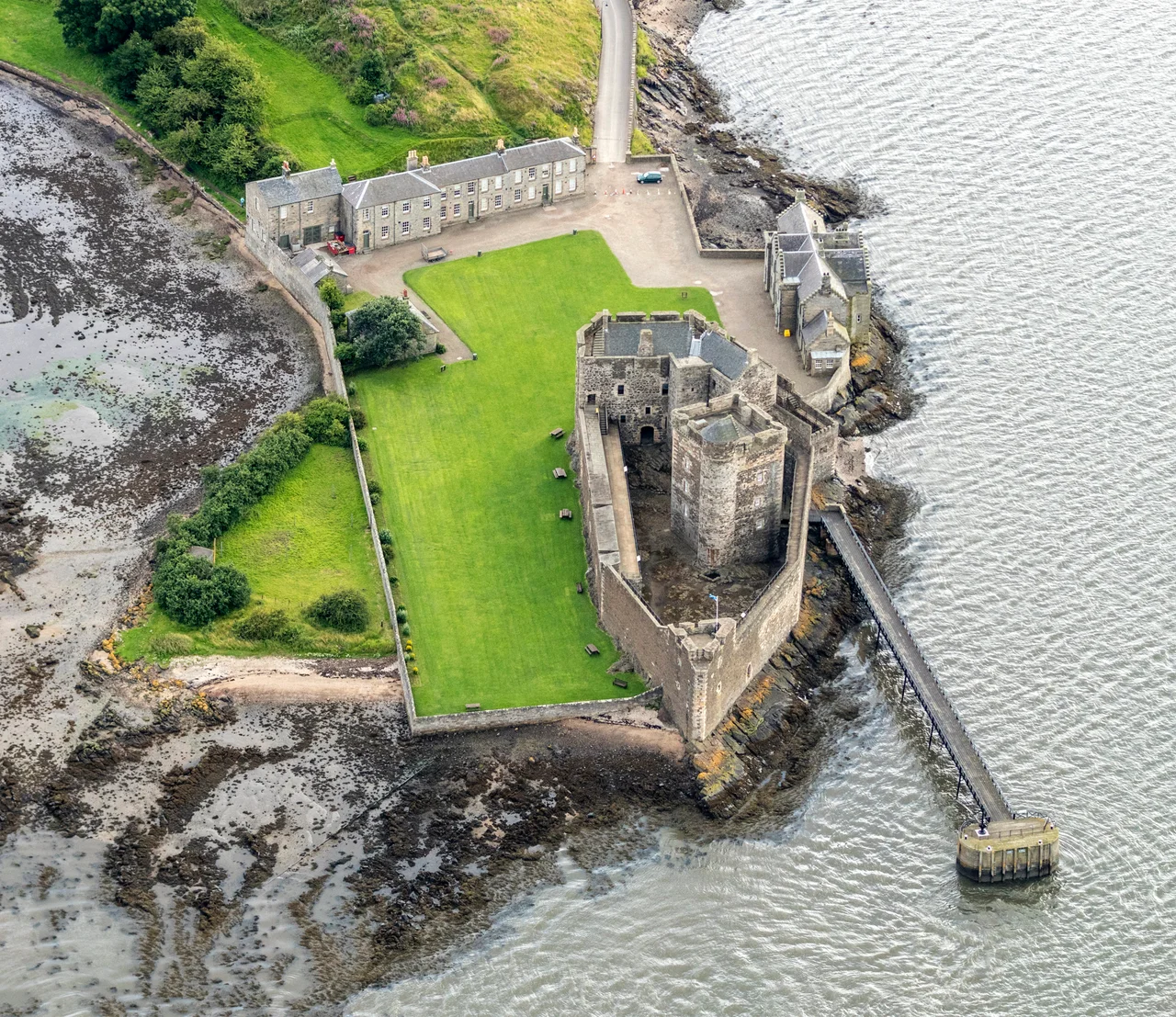

Blackness Castle
The locals call it the ship that never sailed. From a distance Blackness Castle looks exactly like a stone galleon run aground on the south shore of the Firth of Forth - narrow, long, with a high pointed bow facing north into the wind. The north tower is the stem. The south tower is the stern. The five-storey block in the middle is the main mast. It is one of Scotland's strangest castle silhouettes, and it has been guarding the Forth for nearly six centuries.
Crichton's Fort
Sir George Crichton built Blackness in the 1440s during a feud with the Black Douglases that had already cost him his tower at Barnton in Edinburgh. Crichton was Lord High Admiral of Scotland, Sheriff of Linlithgow, eventually Earl of Caithness - a man with reasons to fortify. He chose a rocky spit jutting into the Forth, where ships supplying the Royal Burgh of Linlithgow had to pass within musket range. In 1453 Crichton handed the castle to King James II. It has been crown property ever since. The pit prison in the north tower has a drain opening to the sea, which at high tide washes in and floods the chamber - a feature, not a flaw, in fifteenth-century carceral design.
Finnart's Gun-Castle
In the mid-1530s James Hamilton of Finnart took charge and turned Blackness into something Scotland had never quite seen. The illegitimate son of the Earl of Arran, Finnart had studied artillery fortification in Europe and brought back ideas that were genuinely advanced for their time. He thickened the curtain wall in places to over four metres of stone. He punched gun ports through ancient masonry. Most cleverly, he built a caponier - a passage running through the entrance wall that let defenders fire at the backs of attackers who had already breached the gate. Only three caponiers survive in Scotland, and two of them are Finnart's work. Then in 1540 he was executed for treason, and the kingdom moved on without him.
Cromwell and the End of the Idea
Finnart's gun-castle held for a century. State prisoners came and went - Cardinal Beaton, the 6th Earl of Angus, the Earl of Huntly - and Mary Queen of Scots's loyalists fought from these walls during the Marian civil war that followed her forced abdication in 1567. Then in 1650 Oliver Cromwell brought his New Model Army north and parked his guns on land and sea. Artillery technology had moved faster than Blackness's walls. The garrison surrendered under bombardment. After the Union of 1707 the castle became a French prisoner-of-war depot during the Seven Years' War and the Napoleonic Wars, then an ammunition store until 1912, then briefly a barracks during the First World War. The army finally let it go to the Office of Works.
The Set That Got Found
Blackness has always looked like a film set, and eventually filmmakers noticed. Franco Zeffirelli shot Hamlet here in 1990 with Mel Gibson. The 1996 film The Bruce used the walls. The 2008 science-fiction film Doomsday turned the courtyard into a post-apocalyptic prison. But it was the Starz series Outlander that turned Blackness into a tourist destination - the castle stood in for Fort William, where Jack Randall menaces the protagonists in some of the series's most memorable scenes. Today Historic Environment Scotland maintains the empty buildings, the small exhibition in the old barracks, and the original 1693 yett, a latticed iron gate still hanging in its hinges three centuries after the blacksmith forged it.
From the Air
56.006°N, 3.516°W, on the south shore of the Firth of Forth roughly 4 nautical miles east of Bo'ness. Approach from the north over the Firth gives the best ship-silhouette view; the castle's long axis runs north-south. Recommended viewing altitude 1,500-2,500 feet. Edinburgh Airport (EGPH) is 9 nautical miles east-southeast. The Forth Bridges - rail, road, and Queensferry Crossing - are visible 5 nautical miles east. The Antonine Wall's eastern terminus sits just inland at Carriden.
Nearby Stories
- Union Canal (Scotland) 2.9 km away
- Ochil Hills 5.3 km away
- Mugdock Castle 7 km away
- New Lanark 8.7 km away
- Darvel 13 km away
- Innerleithen 13 km away
- Lochearnhead 16 km away
- Inner Tay Estuary 16 km away