.jpg)
Skateraw Lifeboat Station
The Skateraw lifeboat opened too late to save the Alfred Erlandsen. On 17 October 1907 the Danish steamer struck Ebbscar Rock off St Abbs, 600 yards from shore, with 12 crew, the captain and his wife aboard. By the time the Skateraw boat reached the wreck, the ship had broken its back and everyone was drowned. The only survivor was a dog, washed up on the beach the next day. The horror of that night was what built the station in the first place: the RNLI committee, watching ship after ship founder on this exposed stretch of East Lothian coast, decided in 1907 to put a second boat 4.2 nautical miles east of Dunbar, where the Sarah Kay was launched, named, and committed to its 36-year service.
Why Skateraw
The Dunbar lifeboat was the official station, but getting its boat overland to where wrecks usually happened, further east along the cliffs and reefs of the open coast, took too long. By the time the Dunbar crew had hauled their carriage out to Skateraw or Cockburnspath, the ship in trouble had usually gone down. The solution was a satellite station with its own boathouse, but no permanent crew. When the lifeboat was needed, the Dunbar men would race the five miles down the coast. The Sarah Kay was Skateraw's only lifeboat for the station's entire 36-year life. She was a pulling-and-sailing boat, no engine, the kind of boat where the crew rowed or sailed straight into seas that came over them in green sheets. Coxswain Walter Fairbairn, asked to describe the Sarah Kay's launch in heavy weather, said the launching slip was one minute in a whirlpool of angry water, the next entirely dry as the waves receded.
The Naval Barge
On 7 July 1915, in gale-force conditions, a naval barge ran aground four miles east of Cockburnspath. The Sarah Kay launched shortly after one in the afternoon and pulled out into seas that swept over her continuously. The nine men aboard the barge could not be reached alongside, so the lifeboat crew threw them lines and dragged them through the surf, one at a time, into the boat. The Sarah Kay arrived back at Skateraw at nine that evening, the crew wet through and exhausted, but every man from the barge alive. It was the kind of rescue the RNLI exists for. The same kind of rescue the Skateraw boat had not been able to perform in 1907 for the men of the Alfred Erlandsen. The opening of the lifeboat station at St Abbs in 1911, directly south of the Erlandsen wreck site, would help close that gap further down the coast.
Closure and Cobbles
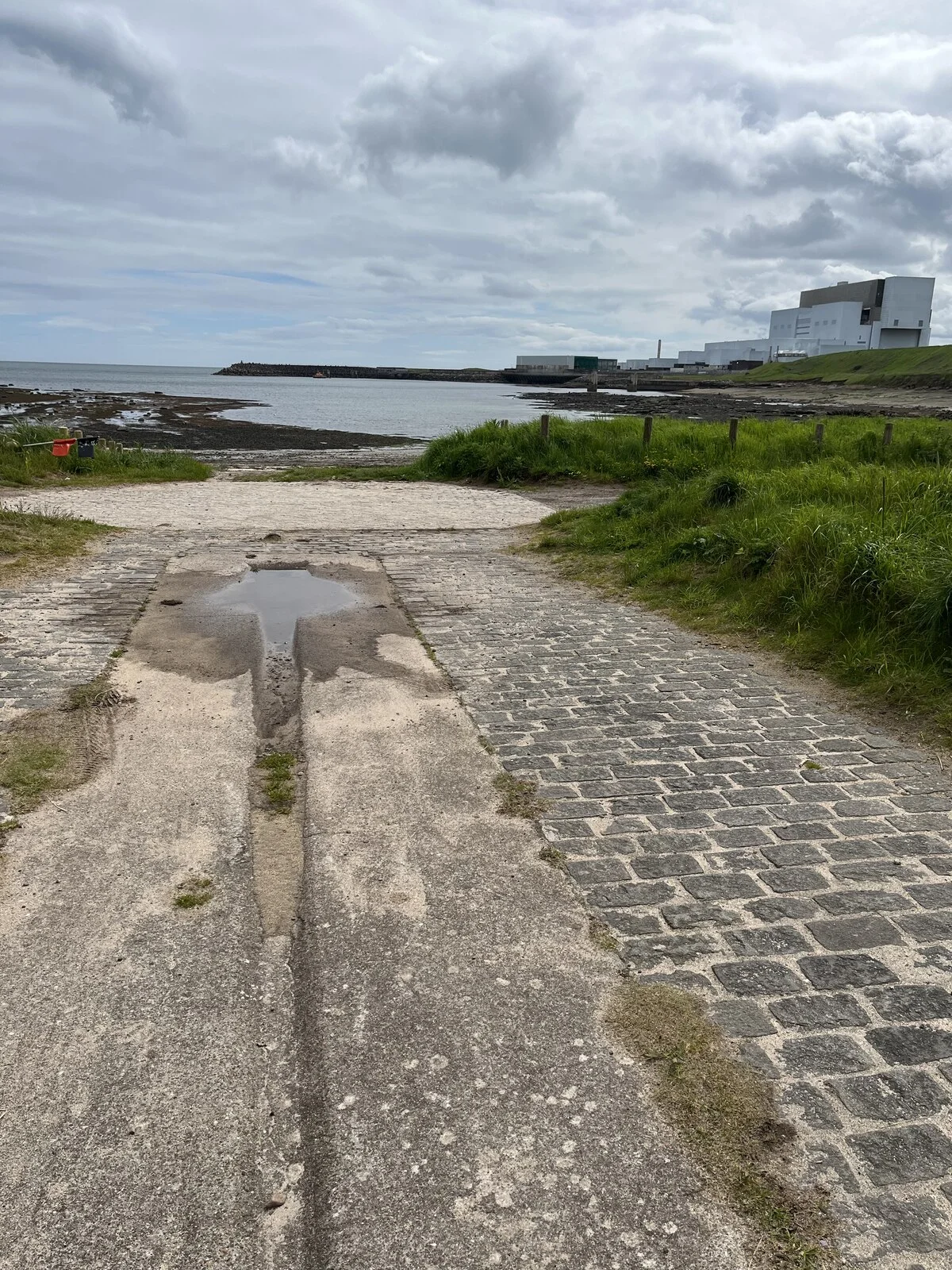
By the 1930s, motor lifeboats had been placed at all the flanking stations: Dunbar, Eyemouth, St Abbs. Skateraw remained pulling-and-sailing, increasingly outclassed. In 1943 the RNLI withdrew the Sarah Kay (Pulling and Sailing) and closed the station. The boat went south to Skegness on the Lincolnshire coast, renamed Grace Darling III after the most famous lifeboat heroine in British history, the Northumbrian lighthouse-keeper's daughter who rowed out in 1838 to rescue survivors of the Forfarshire. The Grace Darling III served at Skegness until 1966, when she was lost. At Skateraw, only the boathouse foundations and the cobbled slipway floor remain, surrounded now by the cooling-water outflows and concrete bulk of Torness nuclear power station, completed in 1988 a few hundred metres east. Atomic-age industrial site, Edwardian-age rescue station, side by side.
Where the Lifeboat Still Lives
The Dunbar lifeboat continued but with an irony attached. The modern fast-response lifeboat is too large to operate from Dunbar Harbour at low water. Since 1995, when the Dunbar crew need to launch, they drive the five miles down the coast to Skateraw Bay, where their boat is moored at Torness, in full view of the foundations of the old Sarah Kay boathouse. Almost a hundred years after Skateraw lifeboat station opened, the same stretch of beach is again where the local lifeboat lives. The boat is different. The coast is the same coast, with the same wrecks waiting if the crews aren't fast enough.
From the Air
Skateraw Lifeboat Station ruins: 55.972 N, 2.423 W on the East Lothian coast 5 miles south-east of Dunbar, immediately adjacent to Torness nuclear power station. Best viewed at 1,500-2,500 ft AGL on a coastal pass; Torness is a large, conspicuous landmark with twin reactor halls. Avoid low overflight of Torness for security and noise-abatement reasons. Nearest airport is Edinburgh (EGPH), 28 nm west; Berwick coastal area has limited diversion options. The Bass Rock lies eight nm north and provides a useful sightline reference.
Nearby Stories
- Luffness Castle 3.7 km away
- RAF Charterhall 6 km away
- Old Course at St Andrews 11 km away
- Galashiels 11 km away
- Bamburgh Castle Lifeboat Station 13 km away
- Crail 21 km away
- Longstone Lighthouse 39 km away
- German submarine U-58 (1938) 221 km away