.jpg)
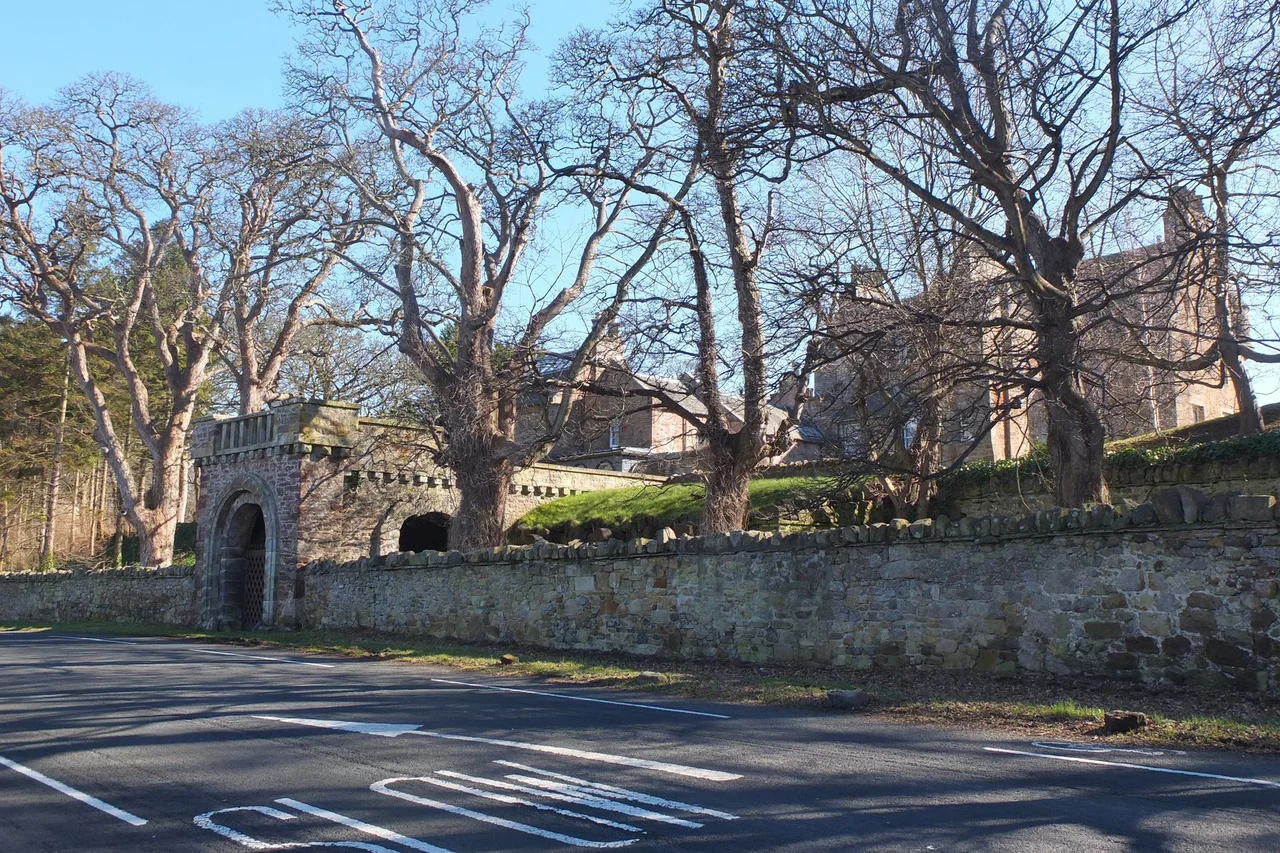
Luffness Castle
In 1256, on crusade with King Louis IX of France, Sir David Lindsay - High Chamberlain of Scotland and one of King Alexander III's regents - lay dying. He made a deathbed promise: if his body could be returned to Scotland, he would endow a religious house at his East Lothian estate. The body came home. The friary was built. Carmelite monks established themselves at Luffness around 1293, and the priory's remnants still survive, overgrown, in the woods beside the castle. Sir David's effigy lies inside the ruin - a knight in mail, his hands folded in stone prayer, seven hundred years after the promise was kept.
The Lindsay Castle
The lands around Luffness were originally part of the estates of the Gospatrick Earls of Lothian, holding the title that ran back to Anglo-Saxon Northumbria. In the twelfth century they passed by marriage to the Lindsay family. The Lindsays built the castle in the thirteenth century - contemporary descriptions call it 'a large and strong fortress.' It guarded the southern shore of the Firth of Forth near Aberlady Bay, where ships from the continent could put in. In 1311, during the Wars of Scottish Independence, an English army under Edward I occupied the castle. The fortunes of the Lindsays here were tied to the larger political weather - their castle changed hands repeatedly through Scotland's medieval upheavals. Sir David Lindsay's crusading death in 1256 left more than a friary; it left a memory of a family whose word was kept across centuries.
The French Fort
In May 1547 the castle was sacked by an English force under Edward Clinton, Lord Clinton, during the war the Scots called the Rough Wooing - Henry VIII's attempt to force the marriage of the infant Mary, Queen of Scots, to the future Edward VI. The English diplomat Ralph Sadler advised the Earl of Shrewsbury that a new fort at Aberlady would support an English garrison further inland at Haddington. The French, allies of Scotland, got there first. In 1549 French and Scots soldiers under Paul de Thermes built an artillery fort at Aberlady to cut the English supply line. On 23 June 1549, the Regent Arran summoned villagers from neighbouring parishes to fight off English soldiers trying to disrupt the works. Two days later he requested labourers from across East and West Lothian. The royal treasurer's accounts call it 'the fort of Aberlady.' In January 1550, oxen dragged the fort's guns to the nearest harbour for shipping to Monifieth, where they would be used against the English-held Broughty Castle. The Aberlady fort itself was demolished on the orders of the queen regent Marie de Guise in 1552 - its purpose served, its presence no longer necessary.
From Bothwell to Burn
In the second half of the sixteenth century, Luffness passed to the Hepburn Earls of Bothwell - the same family from which James Hepburn, Mary Queen of Scots's third husband, came. The Hepburns rebuilt the castle. In the seventeenth century it changed hands again, to the Durham family, and by 1704 an Adam Duff of Luffness is recorded. In 1739 the Hope Earl of Hopetoun bought the estate, beginning the long tenure of the Hope family that continues today. In 1822 the castle was altered and extended by the architect William Burn - one of the most prolific country-house architects of the nineteenth century. David Bryce, Burn's pupil and partner, carried out further works in 1846 and 1874. The result is the building visible today: a T-shaped tower house, three storeys with an attic, with a square turret forming the stem of the T. A turnpike stair occupies the first two floors. The novelist and castle historian Nigel Tranter thought this stair incorporated what was left of the original thirteenth-century Lindsay castle.
The Ditch and the Friary
The house sits at the north-western angle of a square fortification, delineated by a partially infilled ditch. Nobody is quite certain when the ditch was dug. It may be the outline of the French artillery fort of 1549. It may be the moat of the earlier Lindsay castle. The two possibilities sit on top of each other across the same ground, the same defensive logic recurring in different centuries. The Carmelite friary that Sir David Lindsay's deathbed promise endowed in 1293 stood a little to the south, in what is now woodland. Its remains can still be found among the trees - low fragments of wall, the suggestion of a small church and cloister. The Carmelites had been founded on Mount Carmel in the Holy Land less than a century before; Sir David, returning home from crusade, would have known them as a new and fashionable order. Luffness House today is well maintained, occupied by the Hope family, with the world the Lindsays built around it still half-visible in the ground.
Fly Past
Luffness Castle sits at 56.0143 degrees north, 2.8439 degrees west, just south of Aberlady village on the southern shore of Aberlady Bay in East Lothian. The bay opens north into the Firth of Forth. The castle is a T-shaped tower house set in walled grounds, with the partially infilled ditch of the old fortification still visible from the air. Luffness Golf Club's links course wraps around the castle's eastern and northern flanks. Best viewed from 1,500 to 3,000 feet for both castle and golf course layout. Nearest ICAO airport: Edinburgh (EGPH) ~20 nm west. Gullane village and Muirfield are 2 nm to the north-east. North Berwick Law (volcanic plug) rises sharply 6 nm to the east. The Firth of Forth opens to the north, with Fife visible across the water. Aberlady Bay itself is a nature reserve famous for migratory birds.
From the Air
Located at 56.0143°N, 2.8439°W, just south of Aberlady on the southern shore of Aberlady Bay, East Lothian. Recommended viewing altitude 1,500-3,000 feet. Visual landmarks: T-shaped tower house in walled grounds; partially infilled square fortification ditch; Luffness Golf Club links course wrapping castle east and north; Aberlady Bay (nature reserve) opening to Firth of Forth. Nearest ICAO airport: Edinburgh (EGPH) ~20 nm west. Gullane and Muirfield 2 nm north-east; North Berwick Law (volcanic plug) ~6 nm east; Fife visible across the firth to the north.
Nearby Stories
- Blackness Castle 2.2 km away
- Skateraw Lifeboat Station 2.8 km away
- RAF Charterhall 5.6 km away
- Ochil Hills 6.3 km away
- Innerleithen 12 km away
- Falkland Palace 14 km away
- New Lanark 18 km away
- Bell Rock Lighthouse 21 km away