
Cockburnspath
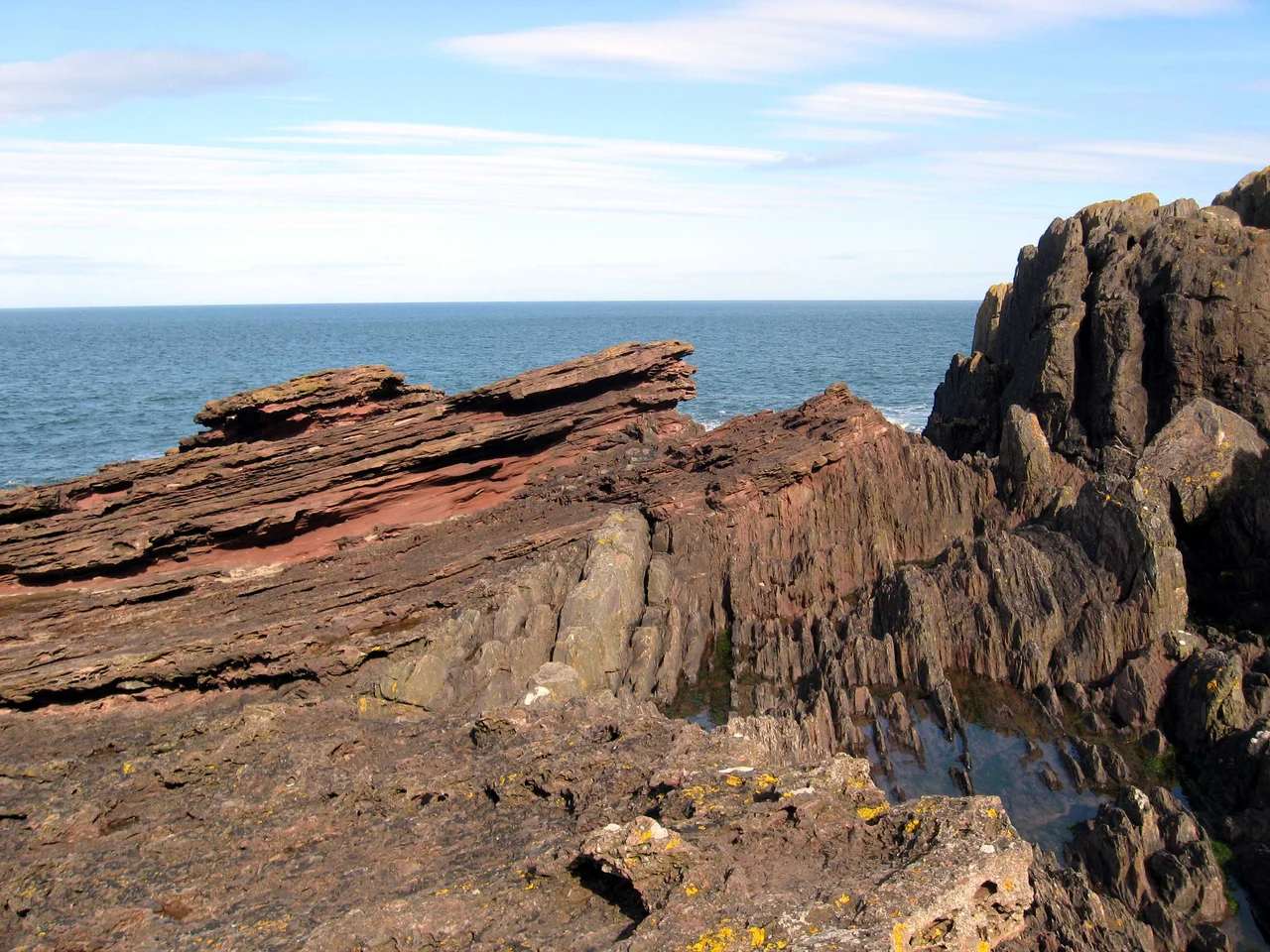
In the spring of 1788 a small boat rowed east from Dunglass Burn along the Berwickshire coast looking for proof that the Earth was older than anyone had imagined. James Hutton, the Edinburgh geologist, had a theory; his friends Sir James Hall and John Playfair came along to look. At a rocky promontory called Siccar Point, just outside the village of Cockburnspath, they found it. Layers of red sandstone lying gently on top of vertical slabs of much older grey rock, evidence that one set of mountains had risen and eroded entirely away before the next set even began to form. Playfair later wrote, the mind seemed to grow giddy by looking so far back into the abyss of time. Modern geology has its founding moment in a boat off Cockburnspath.
Colbrand's Path
The village name is older than the village. Cockburnspath was originally Colbrand's Path, after a folkloric giant named Colbrand who supposedly guarded the road. The road in question matters: this is the eastern entry into Scotland from England, the route taken by every invading army for a thousand years. Bronze Age remains scatter the surrounding fields. Sir Adam de Hepburn held the lands in the time of David II in the mid-14th century. In 1503, when James IV of Scotland married Margaret Tudor, daughter of Henry VII, Cockburnspath formed part of her dowry, royal lands passing as a wedding gift. The 16th-century market cross still standing in the centre of the village has emblems carved on its four faces: thistles on two for Scotland, roses on the other two for England, commemorating the Marriage of the Thistle and the Rose. The dynastic union became real a century later when James VI of Scotland inherited the English crown in 1603.
Hutton's Unconformity
Siccar Point is two miles from Cockburnspath, accessible by a steep coastal path. Walk down to the cliff edge and you can see what Hutton saw: nearly horizontal beds of Devonian Old Red Sandstone, perhaps 370 million years old, capping vertically tilted Silurian greywacke that is more like 435 million years old. The two formations meet at a sharp boundary called an unconformity. Hutton's insight was that the older rocks must have been laid down horizontally, then folded vertically by mountain-building, then eroded down to a flat surface, then submerged again, then covered by the younger horizontal sandstones. Each of those steps takes vast time. The boundary at Siccar Point was the proof that the Earth's history runs in cycles of immense duration. Hutton's work would later inspire Charles Lyell, whose textbook on geology accompanied Charles Darwin aboard the Beagle. The voyage that produced the Origin of Species began with a book that began at Siccar Point.
The Painters
In the 1880s, Scottish artists discovered Cockburnspath. James Guthrie and Edward Arthur Walton, founders of what would be called the Glasgow Boys, took a house together in the village in 1883 and spent that summer painting field workers, hay carts, kitchen interiors, and the village street. Guthrie's masterpiece A Hind's Daughter, with its small girl standing among cabbages, was painted at Cockburnspath. The Glasgow Boys were the modernising wing of late-Victorian Scottish painting, moving away from sentimental Highland landscapes toward unromanticised rural realism. Cockburnspath's farms, with their unfussed agricultural labour, gave them what they needed. The Hind's Daughter now hangs in the Scottish National Gallery in Edinburgh, painted from a Berwickshire cottage.
Walking the Coast
Today Cockburnspath sits at the junction of two long-distance paths: it is the eastern terminus of the Southern Upland Way, the cross-Scotland coast-to-coast that ends or begins here, and the northern terminus of the Berwickshire Coastal Path that runs south to Berwick-upon-Tweed. The village's circular-tower parish church is a regional curiosity. Nearby Dunglass Collegiate Church, medieval and intact, lies a short walk west at the border with East Lothian. Fast Castle, the dramatic clifftop ruin to the east, provided Walter Scott with the setting for The Bride of Lammermoor, the novel that became Donizetti's opera Lucia di Lammermoor. The village's most famous son is John Broadwood, born here in 1732, who founded the Broadwood piano company. He went to London as a young man, married into the Shudi harpsichord business, and built the firm that supplied pianos to Mozart and Haydn. A blacksmith's son from Cockburnspath turned out keyboards for Mozart. The village has a habit of producing wider consequences than its size suggests.
From the Air
Cockburnspath: 55.933 N, 2.360 W on the Berwickshire coast just south of the East Lothian border. Best viewed at 1,500-2,500 ft AGL on a north-south transit; the village is small and tucked behind low cliffs. Siccar Point lies two miles east of the village on the coast and is worth a low pass at 1,000 ft AGL for the geological features. Nearest airport is Edinburgh (EGPH), 28 nm north-west. The Lammermuir Hills rise to the west; the North Sea is immediately east. Watch for sea-fog (haar) which can roll inland and cover the coast within minutes.
Nearby Stories
- Luffness Castle 3.7 km away
- RAF Charterhall 6 km away
- Old Course at St Andrews 11 km away
- Galashiels 11 km away
- Bamburgh Castle Lifeboat Station 13 km away
- Crail 21 km away
- Longstone Lighthouse 39 km away
- German submarine U-58 (1938) 221 km away