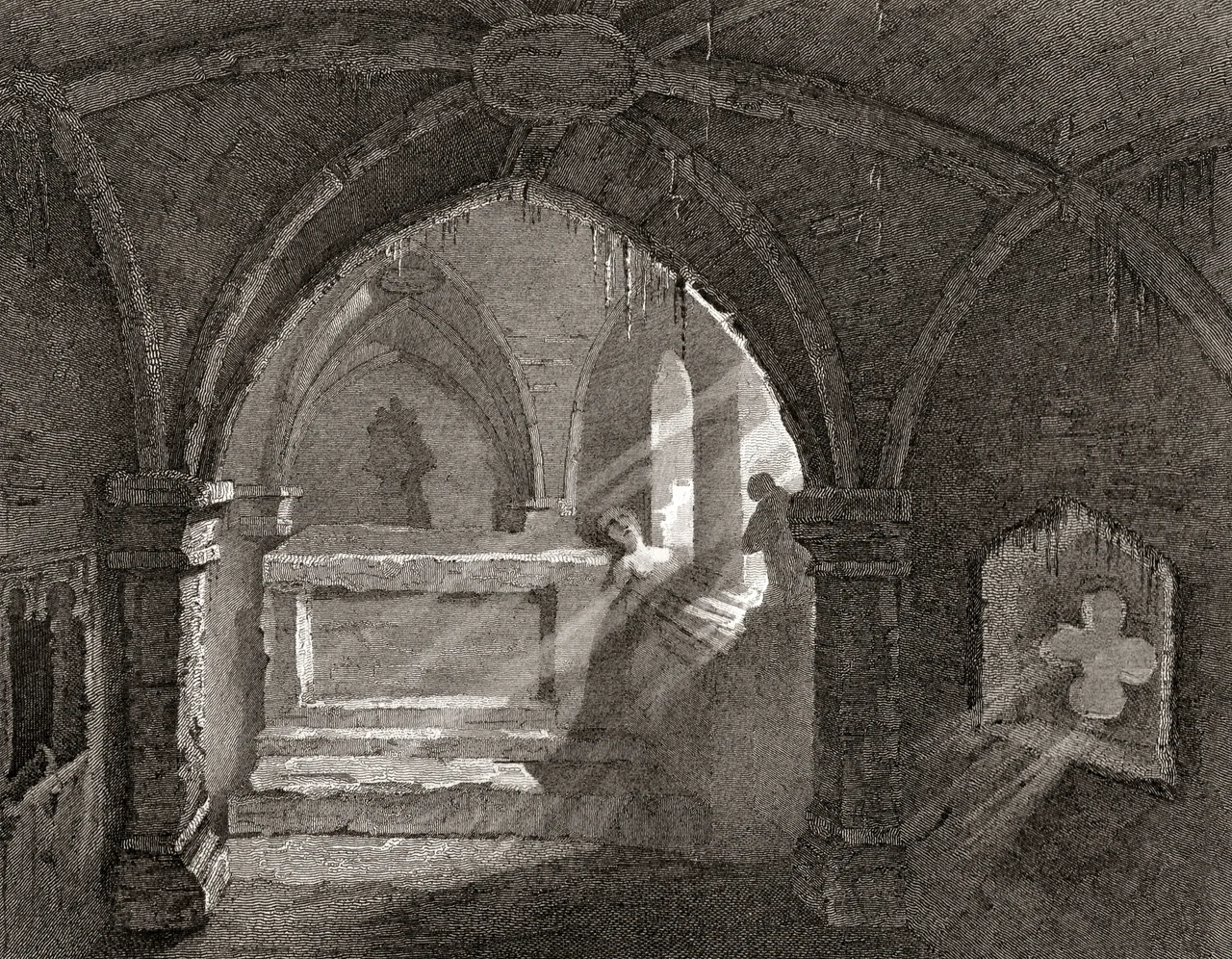

Warkworth Hermitage
To reach Warkworth Hermitage, you take a small boat across the River Coquet. There is no road. The path on the south bank does not lead here. You step off the boat onto a narrow strip of grass beneath a sandstone cliff, climb a short staircase cut into the rock, and walk through a door into a chapel that medieval masons hollowed out of the cliff itself. The altar is still there. So is the tomb effigy of a woman, carved in stone, lying where she has lain for more than six hundred years. The Coquet runs past below.
Carved from the Cliff
The hermitage has two parts. An outer portion is built of conventional stone blocks against the cliff face. The inner portion is hewn directly into the sandstone above the river. That inner space comprises a chapel and a smaller chamber, each with its own altar. The fact that medieval masons cut a chapel from the solid rock - vault, windows, mouldings, and all - rather than building one upward from a foundation tells you something about both the patron's wealth and the practical need for a hidden, river-defended retreat. Stylistic detail in the window between chamber and chapel places the work in the latter part of the fourteenth century. The characteristics are late Decorated Gothic.
The Woman on the Tomb
Inside the chapel is an altar-tomb bearing a female effigy. The tradition recorded by Bishop Thomas Percy in his 1771 ballad The Hermit of Warkworth attributes the hermitage to one of the Bertrams of Bothal Castle, the story being that he retreated here in penitence after a tragedy involving a woman. Bishop Percy's ballad sold well in the eighteenth century and helped fix the romantic version of Warkworth's story in the public imagination. Whether the Bertram tale is true is uncertain - the architectural date and the ballad's narrative do not perfectly align, and Percy himself was working with local folklore as much as documented history. What is certain is that the female effigy is real, the altar is real, and someone in the late fourteenth century thought it was important enough to carve a permanent house of prayer into living rock.
Sketches and Verses
The hermitage has drawn artists and writers for as long as there has been an English picturesque movement. Engravings circulated in the early nineteenth century. The 1814 drawings of the interior and exterior survive in print collections. Letitia Elizabeth Landon, one of the most widely read women poets of the 1830s, wrote a poetical illustration titled Warkworth Hermitage to accompany an engraving of a painting by Thomas Allom in Fisher's Drawing Room Scrap Book for 1836. The site has lent itself to verse partly because it looks like the kind of place poets describe - inaccessible, riverside, brooding - and partly because the underlying ballad supplied a ready-made story of love and loss for anyone who needed one.
Open in the Summer
English Heritage now manages Warkworth Hermitage together with the much larger Warkworth Castle a short distance away on the north bank of the Coquet. The hermitage opens to the public during the summer season. Access is, as it has always been, by water: a boatman carries visitors across the river and back. The chapel interior is small enough that you can stand in the middle and touch nearly anything you can see. The acoustics are odd because you are inside a cliff. Light enters through the same window that helped scholars date the work, and falls in summer afternoons on stone the colour of honey, on an altar carved with the assumption that a single hermit would use it forever, and on the silent woman lying on her tomb.
From the Air
Located at 55.35°N, 1.62°W on the north bank of the River Coquet, just upstream of Warkworth village and castle. Nearest commercial airport is Newcastle (EGNT) about 27 nm south. The hermitage is impossible to see from the air directly - it is set into a cliff face below the level of the surrounding ground - but the sharp meander of the Coquet about 1 nm west of Warkworth Castle marks its location. The castle itself is unmistakable on its hilltop above the village. Best viewed VFR at 2,000-3,000 ft following the Coquet upstream from the coast at Amble.
Nearby Stories
- Beadnell 3.5 km away
- Great North Museum: Hancock 4.8 km away
- Battle of Otterburn 7.5 km away
- Battle of Flodden 10 km away
- Housesteads Roman Fort 14 km away
- Saltburn Pier 49 km away
- German submarine U-2367 74 km away
- Alexander L. Kielland (Platform) 278 km away