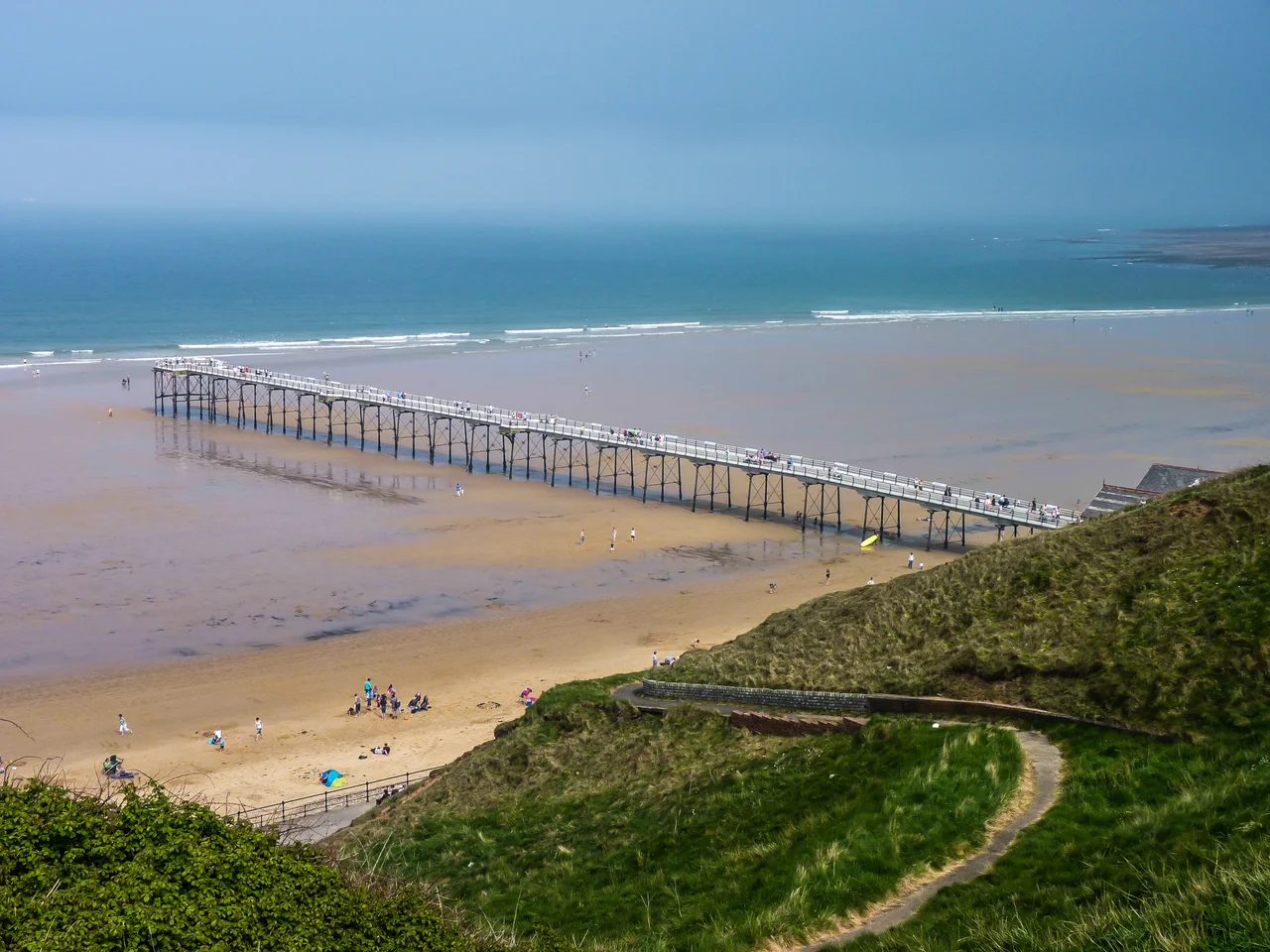

Saltburn Pier
On the night of 21 October 1875, the Saltburn Pier Company believed it owned the future. Subscriptions had sold out, shareholders had collected dividends, steamers had run summer excursions to Hartlepool and Scarborough. Then a gale came up out of the North Sea and tore 300 feet off the seaward end of the new pier - the pier head, the landing stage, the whole eastern deck - and dropped it into the waves. The Pier Company, caught in the middle of an iron-trade slump, looked at the wreckage and made the only practical decision: don't rebuild. The shortened pier reopened in 1877 at 1,250 feet, and it has been shortening, lengthening, burning and being rebuilt ever since. It is the last pleasure pier in Yorkshire.
The Last One Standing
There used to be many piers along the Yorkshire and Northeast coast. Bridlington, Scarborough, Whitby, Hornsea, Redcar - all of them had elegant iron walkways extending out into the North Sea, built in the same Victorian boom that gave Brighton its three piers and Blackpool the same. One by one they were lost: to storms, to fires, to ship collisions, to councils who decided maintenance had become impossible. By the end of the twentieth century, Saltburn was alone. It is now the only pleasure pier remaining on the entire Yorkshire coast, Grade II* listed, run since 1880 by a succession of owners who have somehow managed to keep it open.
Sold in a Hotel Lobby
After the 1875 gale, the company never fully recovered. Debts mounted. In 1880 the pier was put up for auction inside the Alexandra Hotel - the same hotel that John Anderson, the engineer of the local railway line, had built himself on Marine Parade as part of his investment in the new resort. The pier sold for 800 pounds. That was an extraordinarily low figure even for the period, and it reflected what the market thought of pleasure-pier futures in the Cleveland iron slump. The new owners kept it running, but the pier had become something to be saved rather than something to be expanded. Steamer excursions continued for a while. The pier head, the part the storm had taken, was never rebuilt.
Marks and the Cliff Lift
The same engineer who would design the Saltburn Cliff Lift - George Croydon Marks, working for Sir Richard Tangye - looked at the relationship between the pier at the bottom of the cliff and the town on top of it. The walk up the steep zigzag path was discouraging visitors. Marks proposed a water-balanced funicular: two cars connected by a cable, the upper one filled with water, gravity drawing it down and pulling the lower one up. It opened in 1884, 120 feet high, 207 feet of track, a 71 percent incline. With the cliff lift in operation, the pier began to thrive again. Day-trippers could ride up and down between town and pier without exhaustion, and the pier began to add the facilities - tea rooms, slot machines, a theatre at one point - that would keep it commercially viable through the next century.
Lights Underneath
By the late twentieth century, the pier had been damaged again - by storms, by a coal-boat collision in 1924, by a fire in the 1950s - and rebuilt each time, usually shorter than before. It nearly closed in the 1970s. A campaign saved it. In the Queen's Golden Jubilee Heritage awards of 2002, the restored structure took a top placing. In October 2005, lights were installed under the deck so that the pier glows blue and white above the dark sea at night, visible the length of the coast. The National Piers Society named it Pier of the Year in 2009. On 11 May 2019, Saltburn Pier celebrated its 150th anniversary, with new lighting switched on by local dignitaries. It has now outlasted every other pier in Yorkshire by decades.
Walking Out to Sea
The experience of walking a pier - any pier - is something that does not really exist on land. The boards under your feet are not earth and the railing is not a horizon. You are walking out into the sea but you are not on a boat. The wind comes from every direction. The sound of the waves slapping the iron pillars below is constant. When you reach the seaward end, you are surrounded by water on three sides, and the town behind you is a small bright thing on a clifftop. This is what Henry Pease's Quaker resort offered the day-trippers who took the new railway out from Middlesbrough and Darlington in the 1870s: the sensation of going to sea without leaving Yorkshire. Saltburn Pier still offers it. After 150 years and several catastrophes, that has turned out to be a more durable proposition than anyone in 1875 could have guessed.
From the Air
Saltburn Pier sits at 54.5862 degrees N, 0.970725 degrees W, projecting roughly north into the North Sea below the cliffs of Saltburn-by-the-Sea. Nearest aviation reference is Teesside International (EGNV) about 25 km west-southwest. From 2,000 ft AGL the pier reads as a thin black line on the water, 1,250 ft long, running from the base of the cliff out into open sea, with the funicular's diagonal line on the cliffside immediately above it. Hunt Cliff rises to the east at 166 m. Best viewing on a calm afternoon at low tide, when the iron pillars stand fully exposed above the wet sand; in heavy seas the pier head is regularly washed by spray.
Nearby Stories
- Ryedale Folk Museum 3 km away
- 1892 Thirsk Rail Crash 5.5 km away
- Penshaw Monument 6.5 km away
- Darlington 12 km away
- Filey Brigg 12 km away
- German submarine U-2367 28 km away
- Seaham Hall 30 km away
- Battle of Flamborough Head 49 km away