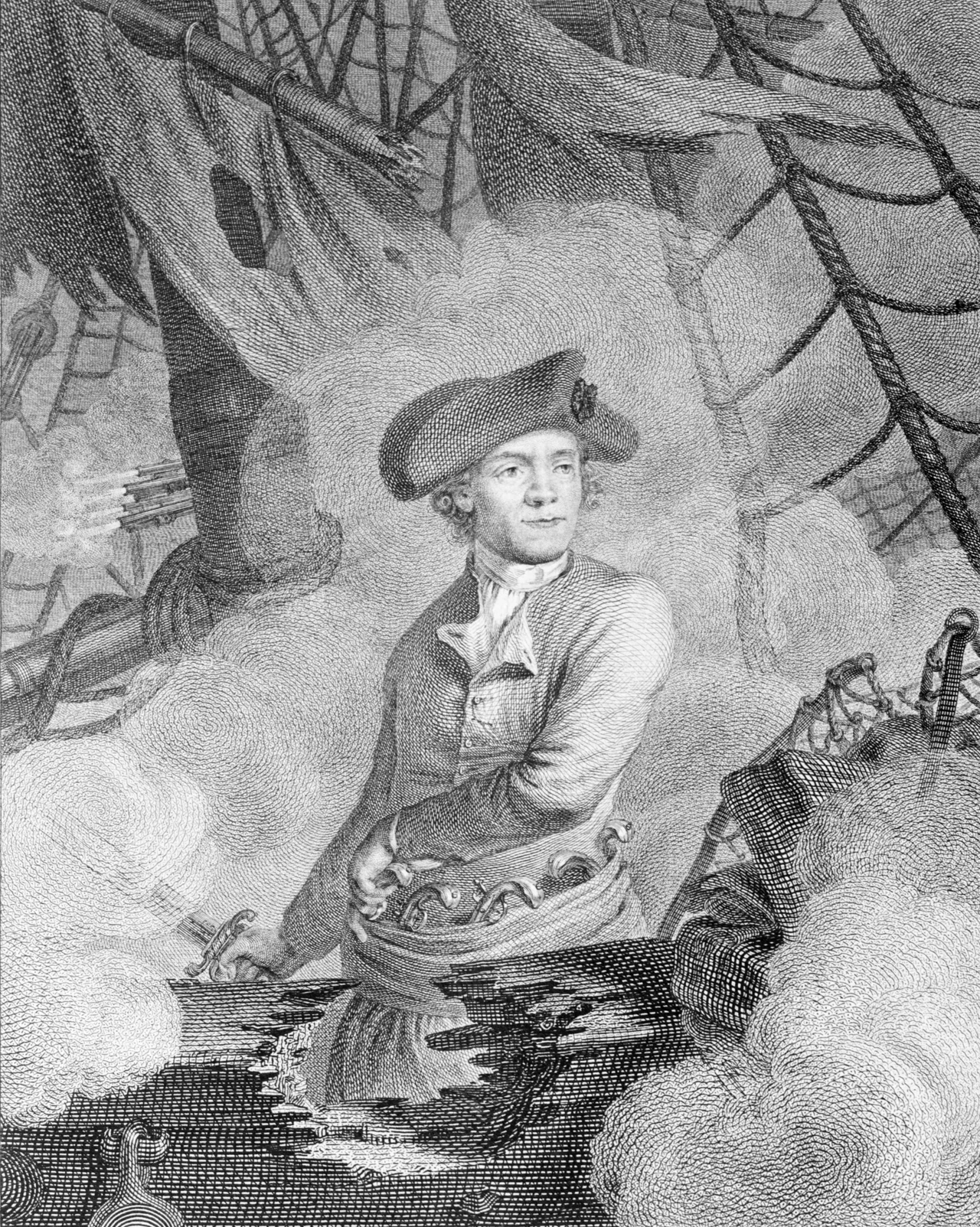
![Photo: Guttenberg, Carl, 1743-1790, engraver. From a drawing by C. J. Notté.[2] | Public domain](https://commons.wikimedia.org/wiki/File:John_Paul_Jones2.jpg)
Battle of Flamborough Head
Just after seven in the evening on 23 September 1779, an obscure American captain named John Paul Jones brought his battered French-built warship within pistol shot of HMS Serapis, a brand-new Royal Navy frigate guarding a convoy of Baltic merchantmen off the Yorkshire coast. The two ships exchanged broadsides. Two of Jones's heaviest guns burst on the first salvo, killing most of the men around them. Serapis - newer, better armed, more manoeuvrable - was clearly going to win. Jones did the only thing left to do: he closed in and lashed his ship to Serapis, hull to hull, so that the British could not use their superior gunnery without blowing themselves up too. He fought the next three hours that way, with thousands of people watching from the cliffs of Flamborough Head in the bright moonlight.
Jones's Squadron
Jones had sailed from Groix off L'Orient in France on 14 August with a seven-ship squadron, most of the vessels loaned or donated by the French government to the American cause. His flagship, the Bonhomme Richard, was a converted French East India Company merchantman that he had reluctantly adapted for war. By September, the squadron had circled north around Scotland, dropped down the east coast of Britain creating havoc, and was hunting near the Humber estuary. The crews were a mixture of Americans, French volunteers, and British prisoners who had been offered the choice between captivity and signing on for prize money. On the morning of 23 September, Jones rejoined two of his frigates - the American-built Alliance under the unreliable Captain Pierre Landais, and the Pallas under Cottineau - just as a fat convoy of forty Baltic merchantmen carrying iron and timber appeared on the horizon.
Pearson's Mission
Captain Richard Pearson of HMS Serapis had only two ships under his command: his own forty-four-gun frigate and the smaller hired armed ship Countess of Scarborough, twenty guns, under Captain Thomas Piercy. Their job was to escort the convoy safely south. When Pearson saw the strangers approaching, he made the choice every escort commander hopes never to make. He turned his ships toward the enemy and signalled the merchantmen to run for the safety of Scarborough harbour. The two British escorts placed themselves between forty defenceless cargo ships and a squadron with nearly twice their firepower. The convoy made it home. That was Pearson's mission, and he achieved it.
Lashed Together in the Moonlight
By the time Bonhomme Richard's heavy guns blew themselves apart, Jones had perhaps an hour to live as a captain unless he changed the game. He drove his ship alongside Serapis and ordered her grappled fast - the anchors hooked, the rigging fouled, the two hulls grinding against each other in the swell. The British eighteen-pounders, designed for fighting at distance, kept firing point-blank into Bonhomme Richard's lower decks, smashing the timbers below the waterline. Jones's marines and sharpshooters poured musket fire and grenades onto Serapis from above. Tradition holds that when Pearson called across in the smoke to ask if Jones had struck his colours, Jones replied with words that became one of the most famous quotations in American naval history: 'I have not yet begun to fight.' Whether he said exactly those words is uncertain. What is certain is that he did not surrender. Bonhomme Richard was sinking, on fire, leaking gunpowder smoke. Jones kept fighting.
The Decision on Serapis
The end came when a grenade, dropped or thrown from Bonhomme Richard's tops, fell through a hatch into Serapis's lower gun deck and ignited loose powder cartridges. The explosion ran the length of the deck, killing many gunners and disabling most of Serapis's heaviest guns. Pearson, with his ship's main battery gone, his rigging shot to pieces, and Captain Landais finally arriving in Alliance to add fresh broadsides - some, confusingly, into Jones's ship by mistake - made his own difficult decision. He struck his colours. Jones boarded and took command. Bonhomme Richard, beyond saving, sank the next day. Jones sailed for Holland in Serapis. Some thousands of spectators on the Yorkshire cliffs had watched the whole engagement by the light of a near-full moon. Pearson was knighted on his return home - the Royal Navy taking the unusual view that an officer who loses a battle while saving his convoy has nevertheless done his job. Jones became a legend. The phrase, real or invented, became immortal.
From the Air
Coordinates 54.1625°N, 0.11944°W. The battle was fought in the North Sea off Flamborough Head, the chalk headland that juts east from the Yorkshire coast between Filey to the north and Bridlington to the south. From the air the head is unmistakable - 400-foot white chalk cliffs forming a distinctive blunt promontory at the eastern edge of the East Riding. The action drifted east-southeast from the headland through the night. Best viewed 2,000-4,000 ft in clear conditions for the cliffs. Nearest airports: Humberside (EGNJ) about 25 nm south-southwest, Durham Tees Valley (EGNV) about 50 nm northwest, Leeds Bradford (EGNM) about 55 nm west.
Nearby Stories
- Mulgrave Castle 0.2 km away
- Pickering Castle 5.3 km away
- Raid on Scarborough, Hartlepool and Whitby 6.3 km away
- Burton Constable Hall 17 km away
- Yorkshire Air Museum 18 km away
- Breagh Gas Field 24 km away
- 2025 North Sea Ship Collision 26 km away
- Runswick Bay 37 km away