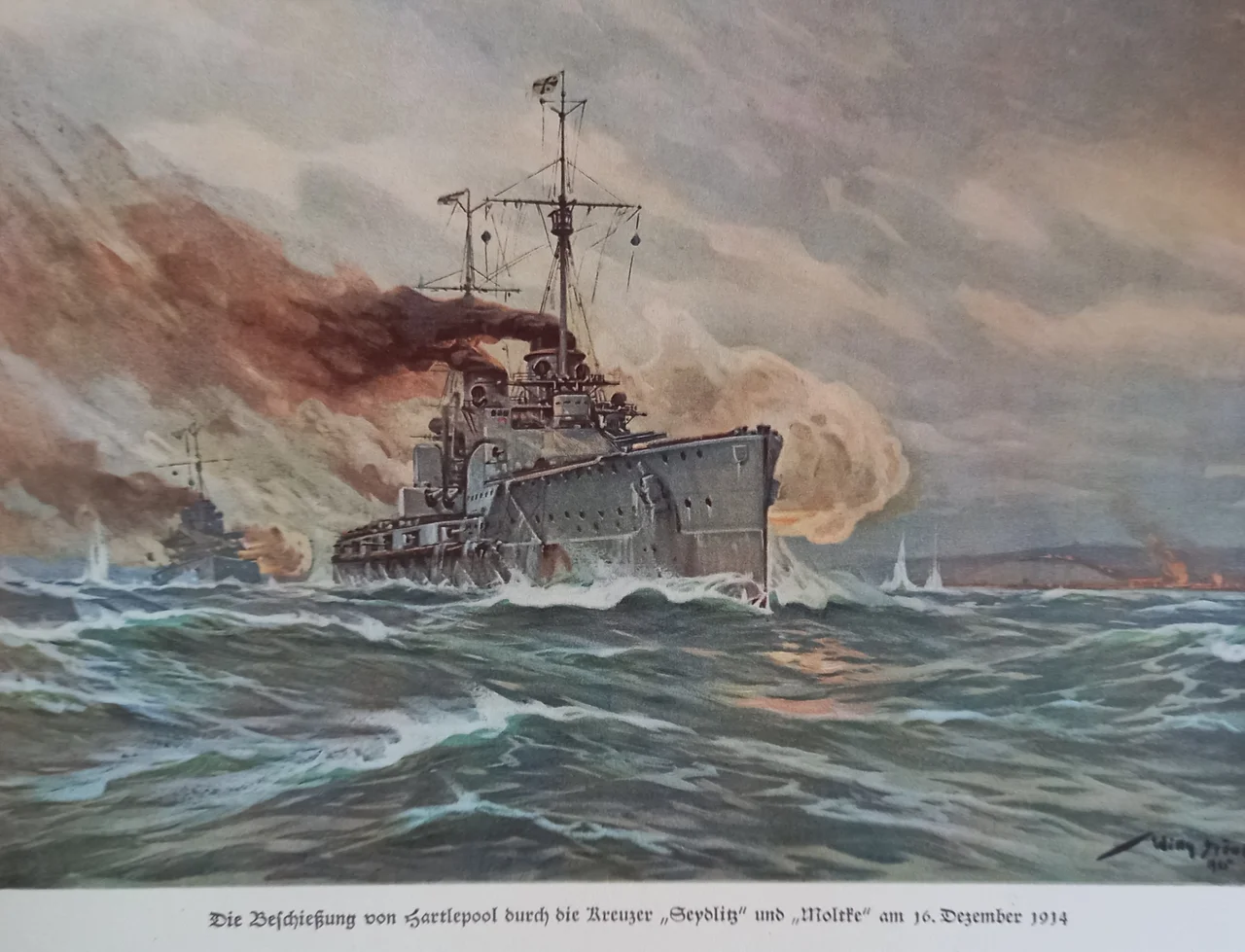

Raid on Scarborough, Hartlepool and Whitby
It was breakfast time in Scarborough on a wet, dark December morning - 8 a.m. on the 16th, 1914 - when the windows began to break. Children pressed faces to glass to see what was happening, and the next shell killed some of them. Out at sea, two German battlecruisers were firing 11-inch and 12-inch shells into a town whose only military assets were a coastguard station, three radio masts, and the medieval ruin of Scarborough Castle. The bombardment lasted about half an hour. Then the ships moved on to Whitby. North of them, three more German battlecruisers were already doing the same to Hartlepool - and there, the casualties would be far worse.
The Bennett Family of Hartlepool
Five members of one Hartlepool family were killed in their own house when a German shell came through the roof. The Bennetts have become one of the small, well-documented details that historians use to make the scale comprehensible - one family, all dead, in seconds. Hartlepool was the bloodiest target of the raid: 86 civilians killed (a later, more careful count by historian Arthur Marder put the figure at 122), 424 wounded. Seven British soldiers also died, including Private Theophilus Jones of the Durham Light Infantry - 29 years old, killed at his post by the Heugh Battery. A plaque in Redheugh Gardens marks the spot where he fell and notes that he was the first British soldier killed by enemy action on British soil for 200 years. The German ships fired 1,150 shells into Hartlepool over about 40 minutes, hitting steelworks, gasworks, railways, seven churches, and around 300 houses. People fled by road and crowded onto the platforms of the railway station, which had not been hit yet but might be at any moment.
Why They Came
Admiral Franz von Hipper, commanding the German High Seas Fleet's battlecruiser squadron, had asked the Kaiser for permission to raid the British coast. A previous attempt at Yarmouth had achieved little, but it had proved that fast battlecruisers could slip across the North Sea, do damage, and slip back before the Royal Navy could intercept. The German strategy was to isolate small pieces of the British Grand Fleet and destroy them, slowly eroding the British advantage. A coastal raid was bait - if it drew out a smaller British force, the High Seas Fleet could pounce. Hipper's squadron sailed from the Jade Bight at 03:00 on 15 December: six big ships and a screen of destroyers and cruisers. Behind them, secretly, the entire main High Seas Fleet of 85 ships moved into a position east of the Dogger Bank, ready to support.
Room 40 Reads the Mail
What the Germans did not know - what they would not learn for a very long time - was that British codebreakers in Room 40 of the Admiralty had recovered German naval codebooks from sunken ships and were reading German signals within hours of their transmission. The Royal Navy knew on the evening of 14 December that Hipper's battlecruisers were coming. What it didn't know was that the entire High Seas Fleet was coming with them. Admiral John Jellicoe was ordered to send Beatty's battlecruisers, Warrender's dreadnoughts, and three cruiser squadrons to a point southeast of the Dogger Bank - to let the raid happen, then ambush Hipper on the way home. It was a careful trap. It missed.
The Battle That Didn't Happen
Through the long foggy morning of the 16th, the Royal Navy intercepting force and the German High Seas Fleet were closer to each other than anyone realised. Admiral Friedrich von Ingenohl, in command of the German fleet, briefly engaged British destroyers in the dark. Fearing he had run into the advance guard of the entire Grand Fleet - and bound by the Kaiser's orders not to risk his battleships - he turned for home at 05:30. Twenty minutes more, and he would have been engaging four British battlecruisers and six battleships with 22 of his own battleships. The numerical advantage Germany had been seeking would have been delivered. Alfred von Tirpitz later commented that Ingenohl had held the fate of Germany in his hand and let it go. The British, on their part, were undone by their own confused signalling - Lieutenant Commander Ralph Seymour's botched flag-orders sent British cruisers turning away from a German cruiser group they had actually sighted. Hipper escaped. Both sides retreated to harbour. Nothing had been settled at sea. But onshore, much had been settled.
What the Towns Looked Like After
Scarborough lost 18 dead and over 80 injured. The Grand Hotel was hit. Three churches were damaged. The lighthouse was wrecked. Civilians had crowded into the railway station, the only place they could think to go, while shells fell around them. Whitby, struck around 9:30 after the German ships moved north, took fewer hits but had its coastguard station shelled and its ancient abbey - the abbey on the cliffs that Bram Stoker had used as a setting for Dracula seventeen years earlier - had further pieces broken from its already ruined fabric. In total, across the three towns, 137 civilians were killed and 592 wounded. The numbers do not include the dead children of Hartlepool by name, though many were named in local newspapers in the weeks that followed. They were schoolchildren going to school, women going to the shops, men opening their shutters.
Remember Scarborough
The British government turned the raid into a recruiting poster. 'Remember Scarborough' appeared on army recruitment posters within weeks, painted with images of dead women and children. Editorials in American newspapers - the United States was still neutral - condemned the attack as 'not warfare, this is murder'. Whether the German captains had aimed at civilians (the towns had radio stations and a castle that counted as defended positions) or whether the dense, foggy morning had simply made accurate gunnery impossible, the political effect was the same: Britain had been attacked at home, civilians had died, and the war had crossed a line. The Royal Navy was blamed for failing to prevent it; the German Navy was branded as butchers; recruiting offices saw a surge in volunteers. Today, plaques in Hartlepool, Scarborough and Whitby mark the houses and spots where people died. The Bennett family is remembered. Private Theophilus Jones is remembered. The 137 dead are remembered by name in town archives. The raid lasted less than two hours. The memory has lasted more than a century.
From the Air
The raid struck the coast between 54.69°N (Hartlepool) and 54.49°N (Whitby) and 54.28°N (Scarborough), all on the North Yorkshire and County Durham coast. The viewing waypoint here at 54.28°N, 0.40°E sits just offshore from Scarborough, where the bombardment began. Cruising altitude FL080-FL120 in good weather offers spectacular views of the chalk and limestone Yorkshire coast - the headlands at Flamborough, the great curving sweep into Filey Bay, Scarborough's twin bays divided by the castle headland, and the ruined Whitby Abbey on its cliff. Nearest airports: Durham Tees Valley (EGNV) inland to the northwest near Hartlepool, Humberside (EGNJ) south of the Humber, and various GA strips along the Yorkshire coast. Watch for low cloud and sea fret typical of this coast in winter - the same conditions that helped the German ships approach unseen in 1914.
Nearby Stories
- Battle of Flamborough Head 11 km away
- Burton Constable Hall 21 km away
- Breagh Gas Field 25 km away
- Cadmus (Ship Name) 25 km away
- West Sole Gas Field 30 km away
- Mulgrave Castle 46 km away
- Pickerill and Juliet Gas Fields 76 km away
- Alexander L. Kielland (Platform) 255 km away