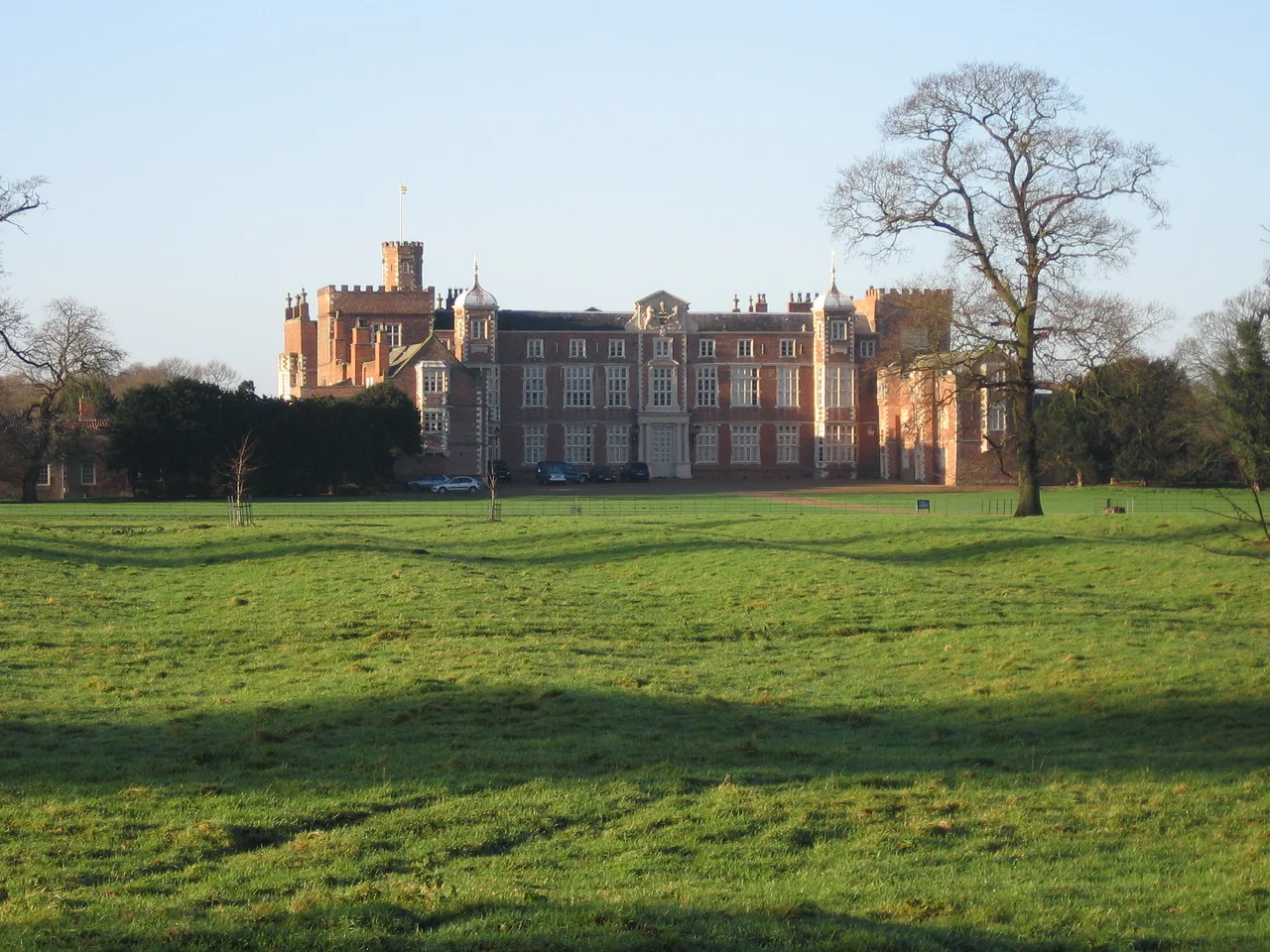

Burton Constable Hall
Herman Melville wrote about Burton Constable Hall without ever setting foot in Yorkshire. In Moby-Dick, published in 1851, he describes a sperm whale skeleton kept at a house in Yorkshire by a certain Sir Clifford Constable, articulated so cleverly that visitors could open and shut him like a great chest of drawers, swing all day from his lower jaw, hear the echo in the hollow of his cerebellum for threepence. That whale was real. It had washed ashore at Tunstall in 1825, eighteen metres of bull sperm whale, dissected by a Hull surgeon and then dragged on ironwork to the lawns of Burton Constable, where the Constables, as Lord Paramount of the Seigniory of Holderness, were legally entitled to anything interesting that washed up on the coast.
A House Built in Layers
Burton Constable looks Elizabethan from a distance and is, mostly, but the building has been growing in fits and starts since the twelfth century. The lower part of the north tower, in limestone, is the oldest surviving piece, a medieval pele tower from the time of King Stephen, raised to defend the village. A brick manor house went up over it in the late fifteenth century, and in the 1560s Sir John Constable swallowed both into a full-blown Elizabethan prodigy house with a Great Hall that rose the full height of the building and a lantern overhead. Stand back from the entrance front and the rhythm of windows and shaped bays reads as a single composition. Step inside and the building's whole long argument with itself becomes visible.
William Constable's Cabinet of Curiosities
The eighteenth-century owner who shaped most of what visitors see today was William Constable, a Catholic baronet's son with money, taste, and an obsessive curiosity about the natural world. He hired Robert Adam, John Carr, Capability Brown, and Timothy Lightoler to redesign rooms and grounds and accepted only some of their plans. He bought a telescope from the York clockmaker Henry Hindley in 1760 for 100 guineas, almost certainly the world's first equatorially mounted telescope, and packed his attics with scientific instruments, mineral samples, dried specimens, and curiosities. Most of that material sat forgotten in storage for a century and a half. In the 1970s it was rediscovered and put on display, and the Museum Rooms now hold the largest cabinet of curiosities in any English country house.
Capability Brown's Eight Visits
Burton Constable is one of the best documented Capability Brown landscapes in England, because the estate steward John Raines wrote down the instructions Brown issued on each of his eight visits between 1772 and 1782. Hints from Mr Brown, the steward called the notes, and they survive. Brown joined the existing fish ponds into two lakes connected by a dam-cum-bridge, planted clumps of trees, dropped in sunk fences and a ha-ha to keep the cattle out without breaking the view, and let the deer park flow up to the windows. The eighteenth-century Orangery still stands at the edge of the formal area with Coade stone ornament, and the Palladian stables Timothy Lightoler raised in 1768 are Grade I listed in their own right, an outbuilding more architecturally important than many entire mansions.
The Chinese Room
In the 1830s, Marianne, Lady Clifford-Constable visited Brighton Pavilion with her sister Eliza and came home determined to recreate a piece of it in Yorkshire. The Chinese Room is the result. Thomas Brooks carved the gilded dragons that swarm the woodwork. Marianne herself designed a dragon chair, which a young apprentice named Thomas Wilkinson Wallis carved in 1841 while still serving his time with Thomas Ward of Hull. It is the kind of room that sounds like kitsch in description and works in person, lit by tall windows looking across Brown's park towards the lakes. Outside in the Great Barn, Moby Dick's whale still waits, jaw open, ribs spread, available for inspection without the threepenny charge Melville imagined.
From the Air
Burton Constable Hall sits at 53.81 degrees north, 0.20 degrees west, in the Holderness plain about nine nautical miles northeast of Hull. From 2,500 to 4,000 feet you can pick out the two Brown lakes, the dam-cum-bridge between them, and the Palladian stable block off the entrance court. The flat Holderness coast runs three miles east, with the Hornsea Mere catching the sun beyond. Humberside Airport (EGNJ) lies about 22 nautical miles southwest across the Humber. Watch for strong westerly winds funnelling off the Wolds and patchy low cloud from the North Sea.
Nearby Stories
- Bempton Cliffs 1.2 km away
- Eden Camp Museum 5.1 km away
- Battle of Hatfield Chase 15 km away
- Humberston Fitties 15 km away
- Raid on Scarborough, Hartlepool and Whitby 16 km away
- 2025 North Sea Ship Collision 16 km away
- Yorkshire Air Museum 18 km away
- Silver Pit 30 km away