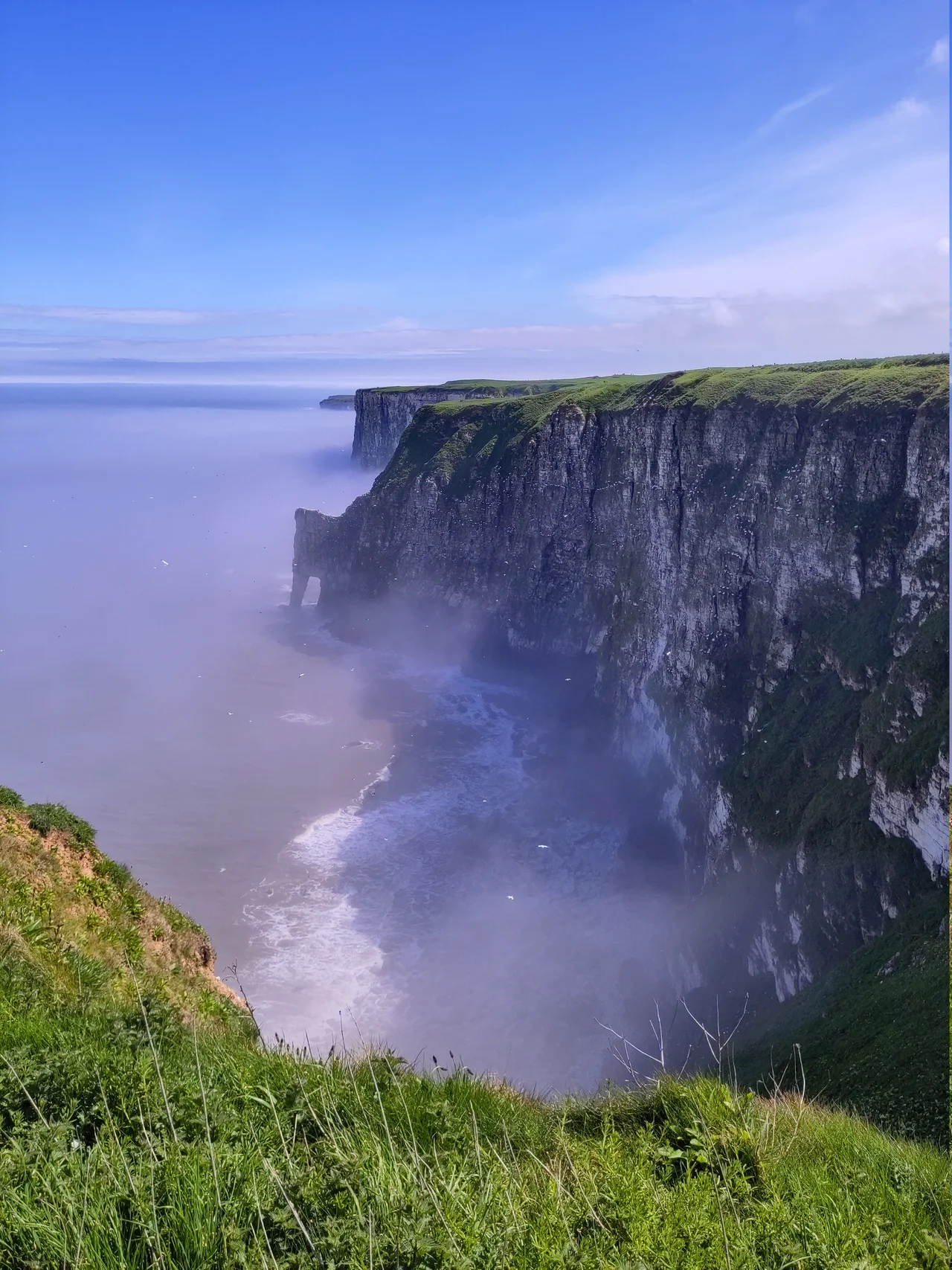

Bempton Cliffs
From a distance the cliffs look as if they have caught fire. The cliff faces, hundreds of feet of white chalk, are smudged grey-white with thousands upon thousands of birds, and what looks like smoke is the constant churning movement of seabirds in flight - gannets, kittiwakes, guillemots, razorbills, fulmars, the occasional puffin. The sound carries for miles. The smell of guano carries almost as far. From January through August every year, this strip of Yorkshire coast becomes one of the largest seabird colonies in mainland Britain, and the only place in England where gannets - the country's largest seabirds, with six-foot wingspans - breed on the mainland.
Why the Birds Come Here
The cliffs at Bempton are made of hard chalk. They run roughly ten kilometres from Flamborough Head north toward Filey, in places over a hundred metres high. The chalk resists erosion well enough to hold the cliff faces upright, but it weathers into a tangle of ledges, shelves, and shallow crevices - perfect real estate for nesting seabirds. Each species has staked out its preferred architecture: kittiwakes glue mud-and-grass nests to narrow ledges that would terrify a goat, guillemots crowd standing-room-only flat shelves where they incubate a single pyriform egg balanced on their feet, gannets claim the wider promontories where they can land into the wind, and puffins squeeze into rock crevices instead of digging the burrows their species typically prefers. Bempton's chalk gives them all what they need.
The Only Mainland Gannet Colony
Northern gannets breed in just a handful of British colonies - mostly remote sea-stacks like Bass Rock and St Kilda, where they are safe from land predators. Bempton is the exception. The cliffs are so high and the chalk so sheer that even foxes cannot reach the ledges, so the gannets nest here on the mainland as if it were an offshore stack. The colony has grown steadily since the 1920s, when there were perhaps a handful of pairs, to thousands today. The birds arrive in January, raise a single chick each through summer, and depart in August and September. Up close, a gannet is an alarming creature - heavy-bodied, blue-eyed, with a sharp dagger of a bill - and watching one fold itself into a dive from a hundred feet above the water is one of the best free entertainments in England.
Puffins Under Pressure
Atlantic puffins are the colony's celebrities, the birds people drive hours to see. Bempton's population - around 958 birds, 450 breeding pairs at the latest count - is harder to spot than at most UK sites, because they nest deep in rock crevices rather than in the more visible burrows they dig elsewhere. The puffins along the Yorkshire coast are now classed as endangered. The Bempton birds fly forty kilometres east to feed at the Dogger Bank, and their numbers are tied to the abundance of sand eels - small silver fish whose populations have been crashing as warming North Sea temperatures push the plankton they feed on further north. The two-degree rise in local sea temperature is, in effect, pulling the food chain out from underneath the puffins. The RSPB monitors them closely. The trend line is not reassuring.
What the RSPB Built
The cliffs have been an RSPB reserve since 1969, and the organisation has built fenced walkways and several observation points right at the cliff edge - close enough to look down into the nests, far enough back from the unfenced sections to stop visitors testing the geology with their own bodies. The visitor centre, comprehensively rebuilt in 2015, sits on top of the cliffs with a cafe, telescopes, and information about what is in season. In 2017 the RSPB installed twenty-two panels of phonetic birdsong by the artist Adrian Riley along the cliff path; each one transcribes the call of a different species into letters you can attempt to read aloud, then hear answered from a nearby cliff. In 2025 the cliffs played a role in Belinda Bauer's novel The Impossible Thing, about a hunt for a rare red guillemot egg robbed from the colony. The cliffs themselves are indifferent. The birds keep coming back.
From the Air
Coordinates 54.1461°N, 0.1603°W. Bempton Cliffs run roughly east-west along the Yorkshire coast about 2 nm north of Flamborough Head, with the cliffs rising to over 100 metres. From the air the white chalk faces are unmistakable, especially in spring and summer when streaked with seabird droppings and surrounded by clouds of birds. The cliffs extend roughly 10 km between Flamborough Head and Filey Brigg. Filey town and Filey Brigg are about 6 nm to the northwest. Best viewed 1,500-3,000 ft in clear conditions; lower altitudes risk disturbing the colony - keep a respectful distance, especially in the breeding season. Nearest airports: Humberside (EGNJ) about 25 nm south-southwest, Durham Tees Valley (EGNV) about 50 nm northwest, Leeds Bradford (EGNM) about 55 nm west.
Nearby Stories
- Mulgrave Castle 0.2 km away
- Pickering Castle 5.3 km away
- Raid on Scarborough, Hartlepool and Whitby 6.3 km away
- Burton Constable Hall 17 km away
- Yorkshire Air Museum 18 km away
- Breagh Gas Field 24 km away
- 2025 North Sea Ship Collision 26 km away
- Runswick Bay 37 km away