
Yorkshire Air Museum
In 1980, Rachel Semlyen looked at an abandoned, derelict wartime airfield outside Elvington and saw a museum. The buildings had been empty for years. The hangars were full of weeds. The control tower the Americans had built in the 1950s was a hollow shell. The RAF was still using the runway for landing practice from Linton-on-Ouse and Church Fenton, but nobody seemed interested in saving the rest. Semlyen approached the landowners with her idea. In 1983, a small group started clearing undergrowth. By 1986 the Yorkshire Air Museum was open. Today it holds more than fifty aircraft, 500,000 documents, and the only Allied Air Forces Memorial in Europe.
The Memorial Mission
The museum's purpose was never purely aviation history. From the start it was conceived as a memorial to Allied air forces personnel, especially those who flew with the RAF and the Free French squadrons in the Second World War. RAF Elvington had been home to No. 77 Squadron, which lost over 500 aircrew during its bombing campaigns against the Ruhr and Berlin. From May 1944 to October 1945 the base was the only British airfield used by Free French heavy bombers, with No. 346 "Guyenne" and No. 347 "Tunisie" Squadrons flying Halifaxes against German targets. The annual Allied Air Forces Memorial Day in September honours those who flew from Elvington and similar bases across northern Europe. The site is the only memorial of its kind in Europe, accredited under the Arts Council's museum scheme and a registered charity (No. 516766).
Friday the 13th
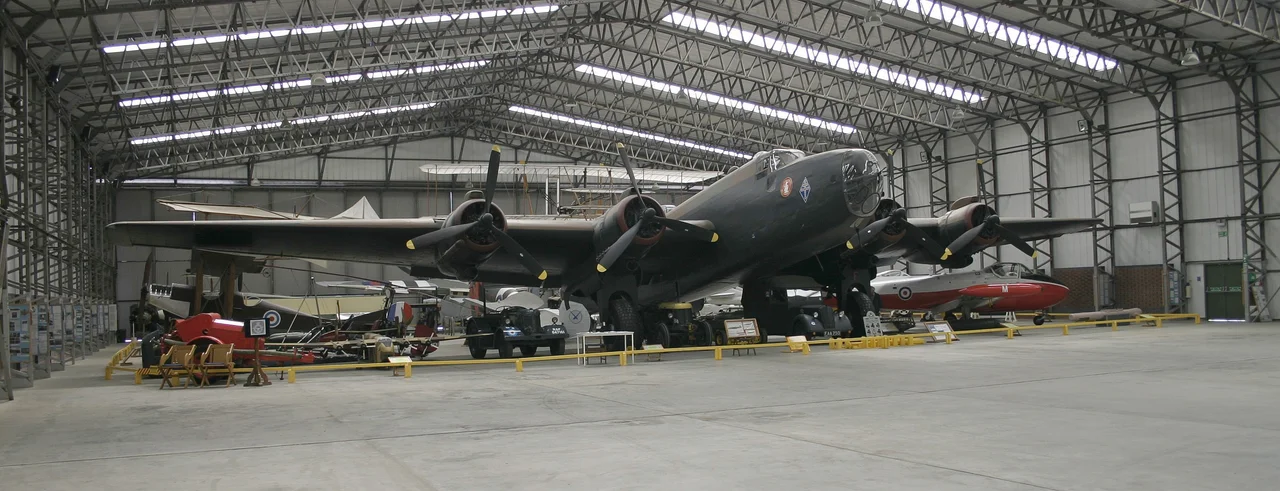
The museum's most celebrated aircraft is a complete Handley Page Halifax III, painstakingly rebuilt and painted in the markings of "Friday the 13th," an Elvington-based Halifax that survived 128 operational sorties, an extraordinary number for a four-engine bomber in the European theatre. The original Friday the 13th flew with No. 158 Squadron from RAF Lissett, not Elvington, but the markings honour the kind of survival the Yorkshire bomber crews lived and died by. The replica is one of only a handful of complete Halifaxes anywhere in the world. The aircraft was assembled from parts of multiple wrecks and donated components, painted in the original camouflage, and given operational livery accurate to the night of the squadron's final mission. Standing under its wings, you can sense the cramped interior where seven men flew through flak at night.
Aircraft Across Eras
Beyond the Halifax, the collection spans aviation from 1853 to the present. A Cayley glider replica honours Sir George Cayley, the Yorkshire baronet who first articulated the principles of fixed-wing flight. Pre-WWII aircraft include replicas of the Wright Flyer, the Avro 504K, and the Mignet Flying Flea. Wartime exhibits include a Douglas Dakota IV, an Avro Anson, a Gloster Meteor F.8, and replicas of the Hawker Hurricane and Supermarine Spitfire. Cold War aircraft fill the apron: a Handley Page Victor K.2, an English Electric Lightning F.6, a British Aerospace Nimrod MR.2, a pair of Blackburn Buccaneers built in Brough nearby, two Panavia Tornados (a GR.1 and a GR.4), and two Dassault Mirages (IIIE and IVA) commemorating the French connection. Several aircraft are kept in running condition and start their engines on Thunder Days through the year.
Pioneers of Aviation
In 2010 the museum opened the Pioneers of Aviation exhibition, funded by the Heritage Lottery Fund, devoted to the people who shaped flight from Yorkshire and beyond. Sir George Cayley, born at Scarborough in 1773, was the first to identify lift, drag, and thrust as the forces governing flight and built a glider that briefly carried his coachman across a Yorkshire valley in 1853. Sir Barnes Wallis, born at Ripley near Derby but educated at Christ's Hospital, designed the Wellington bomber's geodetic airframe and the bouncing bomb of the Dambusters raid. Robert Blackburn, born in Leeds, founded Blackburn Aircraft and helped build Britain's naval aviation industry. Amy Johnson, born in Hull, flew solo from England to Australia in 1930 and disappeared over the Thames Estuary in 1941 while ferrying an RAF aircraft. Nevil Shute Norway, who as Nevil Shute wrote A Town Like Alice and On the Beach, was an aircraft engineer before he was a novelist.
Living History
The museum sits across twenty acres including a seven-acre managed environment area for the "Nature of Flight" sustainability project. Surviving wartime buildings still stand: the airmen's billet, the French Officers' Mess, the original control tower, the Signal Square, the Royal Observer Corps post. The archive, accredited through DCMS and Arts Council England, holds more than 500,000 documents and serves as the official archive of the National Aircrew Association and the National Air Gunners Association. The site has been used by TV and film crews looking for authentic period locations. Annual events include corporate tie-ins with Bentley and Porsche, alongside the educational programmes and the September memorial day. Volunteers keep the engines running. Visitors find themselves, often unexpectedly, deeply moved by a museum built from nothing because Rachel Semlyen looked at a derelict airfield and refused to let its history disappear.
From the Air
The Yorkshire Air Museum sits at 53.92°N, 0.97°W on the site of RAF Elvington, five miles south-east of York. Recommended viewing altitude 1,500-2,500 feet to read the museum hangars and the adjoining 3,094-metre runway. Nearest active airports: Leeds Bradford (EGNM) 25nm west and Humberside (EGNJ) 28nm south-east. The museum's distinctive aircraft on outdoor display (Victor, Nimrod, Buccaneer, Tornado, Lightning) are visible from altitude in good weather, arrayed along the apron beside the surviving wartime hangars.
Nearby Stories
- Battle of Hatfield Chase 4.4 km away
- Eden Camp Museum 6.6 km away
- Roundhay Park 6.9 km away
- Oaks Explosion 7.3 km away
- Filey Brigg 10 km away
- Burton Constable Hall 12 km away
- 1892 Thirsk Rail Crash 14 km away
- RAF Binbrook 21 km away