
Roundhay Park
On 14 October 1888, in the south-east corner of a garden on Oakwood Grange Lane on the edge of Roundhay Park, the French inventor Louis Le Prince mounted his single-lens camera on a tripod and filmed two seconds of his family walking in a circle. His son Adolphe, his mother-in-law Sarah Whitley, his father-in-law Joseph Whitley, and their friend Annie Hartley appear briefly in the frame, dressed in late-Victorian clothes, sunlit. They walk three times around a patch of lawn and the film ends. Sarah Whitley died ten days later, aged 72; the film is also her only surviving moving image. Le Prince himself vanished from a train at Dijon in September 1890. The Roundhay Garden Scene is the oldest motion picture surviving anywhere in the world. The lawn on which it was filmed is still there, in a residential corner of Leeds' grandest park - a park older than the film, older than the camera, older than the nation that hosted the technology.
From Norman Knights to Lake Builders
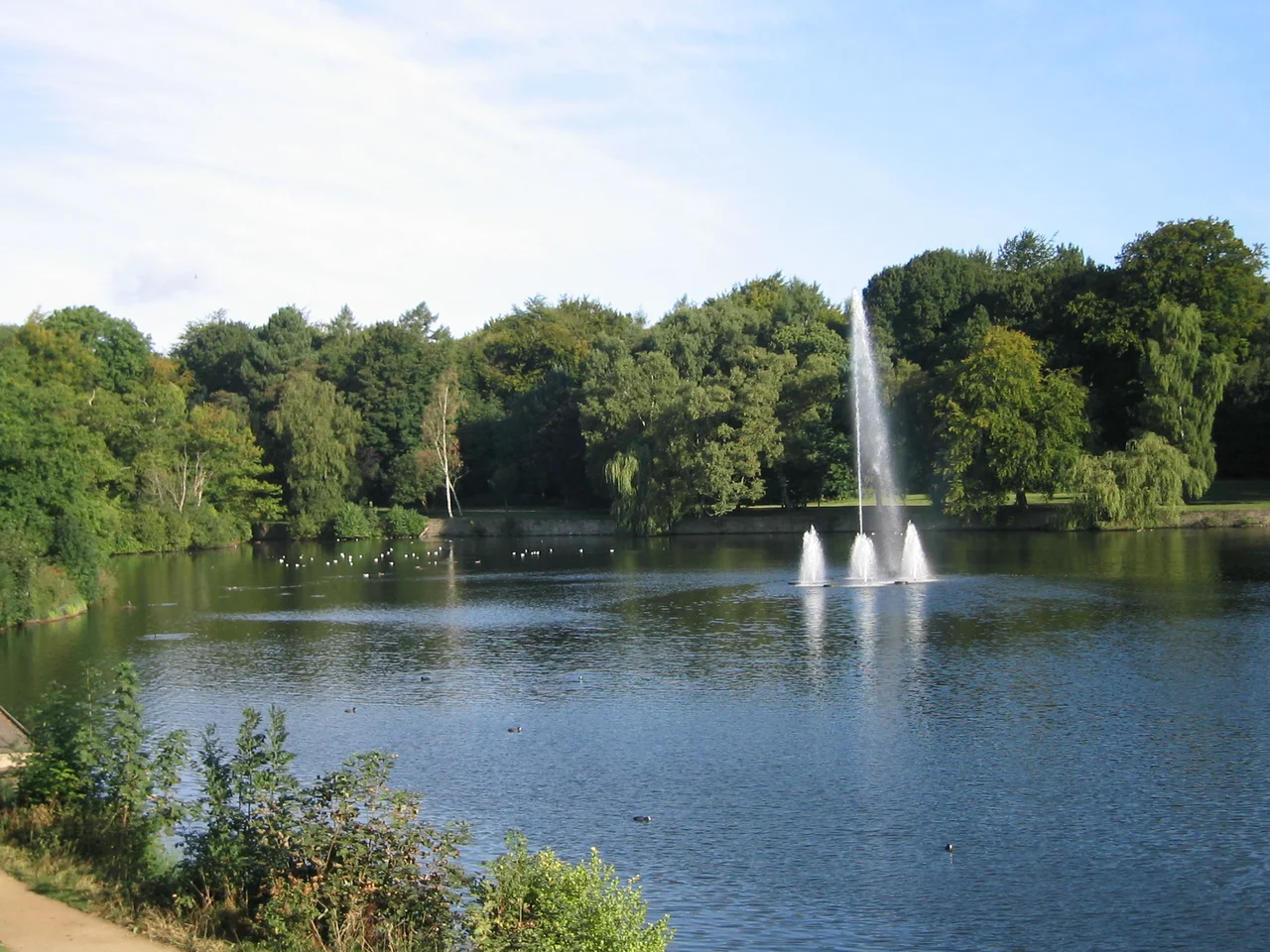
William the Conqueror granted these lands to Ilbert de Lacy, the Norman knight who would build Pontefract Castle, as a reward for his role in the Harrying of the North in 1069-70. For the next two centuries the de Lacys hunted here. Ownership passed through John of Gaunt and his son Henry IV, then to Thomas Darcy under Henry VIII, then by marriage to the Stourton barons. In 1803 the seventeenth Baron Stourton sold the estate to Thomas Nicholson and Samuel Elam. Nicholson took the northern half - the park we now know - and inherited the remains of disused quarries and small coal mines. He decided to disguise them. Over ten years and at a cost of £15,000, he flooded the worked-out ground to create the Upper Lake and the great Waterloo Lake, named for the recent victory in 1815.
The Mansion and the Folly
Nicholson built the Mansion House between 1811 and 1826, a stone two- and three-storey Greek Revival house with views over the Upper Lake, three carriage houses, and stabling for seventeen horses. By 1816 he and his wife Elizabeth had moved in. He commissioned a small castle folly the same year - George Nettleton, a local master builder, raised it in 1811 to look like a medieval gate. Its upper room was used over the years as a summerhouse, a sewing room for the Nicholson daughters, and as a venue for dinners. By 1871, with Nicholson long dead, the city of Leeds bought the estate. The mayor John Barran had argued the case strongly. Because the council was not legally permitted to spend more than £40,000 on so much land, Barran and other private buyers fronted the £139,000 price themselves - the council reimbursing them once an Act of Parliament had cleared a House of Lords committee in 1872. Prince Arthur formally re-opened the park to the people of Leeds that year, before a crowd of one hundred thousand.
Lakes, Beach, and the Arena
Waterloo Lake is the larger of the two, fed by Great Heads Beck and drained at its southern end by Wyke Beck. Below the dam at the south end, an open-air swimming lido was constructed in 1907 and stayed popular through the 1950s before closing in the 1980s. The Upper Lake, only three to five acres and shallow, held an electric launch called the Mary Gordon from 1900 until 1923. Boating has stopped; fishing continues. The Arena, where Nicholson had planned a third lake before his death, was converted to a sports ground in 1894 with a cycle track - a public works project providing employment in a downturn. It holds over a hundred thousand people. The Rolling Stones played here. So did Michael Jackson, Madonna, Bruce Springsteen and the E Street Band, U2, Genesis, Robbie Williams. In summer the Arena is a cricket pitch.
Gardens of the World
The Canal Gardens, separated from the main park by Street Lane, contain three centuries of horticultural layers. The rectangular Canal pond, 350 feet by 34 feet, dates from 1833 and uses the historical garden meaning of canal - a long ornamental water feature. The walled garden was built around 1816 as the kitchen garden for the Mansion. A secluded Friends Garden, named for the Friends of Roundhay Park, sits off the rose garden. Across Mansion Lane to the north, the Gardens of the World include an Alhambra Garden whose central pond and horizontally aligned fountains echo the Generalife at the Alhambra in Granada, and a Monet Garden planted in 1999 in tribute to Claude Monet's garden at Giverny. Leeds City Council's prize-winning Chelsea Flower Show entries from 2008 through 2011 were permanently relocated here, including the 2010 HESCO Garden based on the Leeds and Liverpool Canal locks - which earned Leeds the first ever Chelsea gold medal won by a local authority in the large outdoor category.
Names and Memory
Tropical World occupies a 1939 glasshouse on the Canal Gardens side - the largest collection of tropical plants in the UK after Kew, with a butterfly house, aquariums, free-flying birds, meerkats, and a nocturnal house of bats. Barran's Fountain, a classical rotunda presented by John Barran in 1882 with sculpture by John Wormald Appleyard, stands without its water outlets but otherwise intact. Hill 60, the popular winter sledging slope, takes its name from the World War I battle south of Ypres in spring 1915, a memorial to Leeds soldiers killed there. Soldiers' Field served as the gathering point for First World War troops; the aviation pioneer Robert Blackburn ran test flights from it in 1909 and established a small airport here in 1919, with flights to London and Amsterdam. Nearly a million people visit the park each year. The grass on Le Prince's lawn is still cut, and somewhere in the corner of the property the world's first surviving motion picture is invisibly anchored to a patch of ground.
From the Air
Roundhay Park covers 700 acres at 53.842°N, 1.493°W, on the north-east edge of Leeds. The park is bordered by the suburb of Roundhay to the west, Oakwood to the south, and the A6120 outer ring road to the north. Leeds Bradford Airport (EGNM) is 6 nm to the north-west. From altitude the two lakes are the most distinctive features - the larger crescent-shaped Waterloo Lake and the smaller Upper Lake just north of it. The Mansion sits at the western edge of the Upper Lake. Soldiers' Field forms a large open green to the south-west. Best viewing altitude 2,000-3,500 ft AGL. Concerts at the Arena occasionally affect lower-altitude operations - check NOTAMs during summer event season.
Nearby Stories
- Hovingham Hall 6 km away
- RAF Elvington 7.6 km away
- Battle of Hatfield Chase 9.1 km away
- Wentworth Castle 11 km away
- Murder of Suzanne Capper 12 km away
- Pendle Hill 13 km away
- RAF Topcliffe 15 km away
- Hawes Junction Rail Crash 26 km away