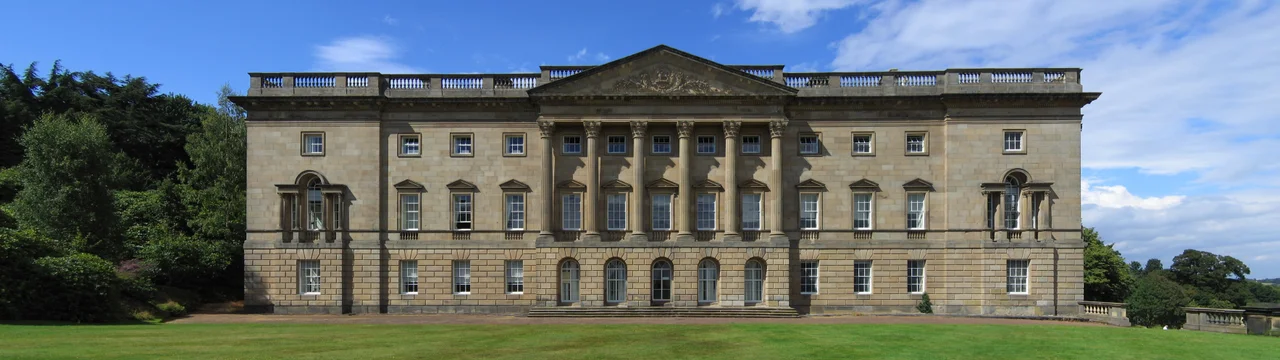

Wentworth Castle
Thomas Wentworth bought Stainborough in the summer of 1708 out of pure spite. The grand Wentworth estate at Wentworth Woodhouse, six miles down the road, was what he believed should have come to him by birthright; instead it had passed to a nephew on his cousin's wife's side, while he had been left with only the barony of Raby. So he bought the neighbouring estate and set out to build something better. Jonathan Swift called him 'proud as Hell.' Within thirty years his house had a 180-foot gallery hung with paintings he had personally chosen in Italy, a Franco-Prussian Baroque front almost unique in England, and a sham ruined castle on the highest ridge of the park. He was not finished losing the family argument. He had simply made the argument harder to win.
The Spite Estate
The site he bought was an older house called Stainborough, built for Sir Gervase Cutler in 1670. Wentworth, by then ambassador to Prussia for Queen Anne, broke his tour of duty in Berlin to close the purchase and returned armed with measurements of the site. He hired Johann von Bodt, a military architect who had spent time in England, to design the east front. From Italy in 1709 he bought paintings, writing back to Yorkshire with satisfaction that he would have 'a better collection there than Mr. Watson,' the Watson at Wentworth Woodhouse being the man who had inherited what Wentworth believed was his. James Gibbs designed the gallery to display the paintings. By 1714 construction was advanced enough that Wentworth and his foreman were arguing by letter about window glass: large plate or small crown. He chose plate. The result, Pevsner wrote two centuries later, was 'of a palatial splendour uncommon in England.'
A Sham Castle for an Earldom
Wentworth had been ennobled in 1711 as Viscount Wentworth and Earl of Strafford, a revival of the title held by his great-grandfather, the doomed minister of Charles I beheaded in 1641. The fall of the Tories at Queen Anne's death in 1714 ended his political career, but his landscape ambitions kept going. From 1726 he built a mock medieval castle on the highest point of the park, the first sham castle in any English landscape garden missed by only a few years. Its four towers were named for his four children. He commissioned his own portrait statue in 1730 from Michael Rysbrack, then erected an obelisk to Queen Anne in 1734. The estate, renamed Wentworth Castle in 1731, eventually contained twenty-six listed structures. He never recovered his political standing, but he had built a place that demanded to be looked at.
The Second Earl's Reply
When the first earl died in 1739, his son William inherited and continued the campaign in a wholly different register. Where his father had built Continental Baroque, the second earl chose neo-Palladian restraint, the cool English style of Burlington and Kent. Between 1759 and 1764 he built a new south front, with John Platt as master mason and Charles Ross drafting the final designs. He had spent a year on the Grand Tour to improve his taste, and at home he was, as a visitor noted in 1768, 'his own architect and contriver in everything.' Horace Walpole, the supreme arbiter of eighteenth-century English taste, gave Wentworth Castle the highest possible verdict: 'If a model is sought of the most perfect taste in architecture... the virtuoso should be directed to the new front of Wentworth-castle.' Walpole was not given to lavish praise. He meant it.
Hailstorms, Heirs and Decline
The Strafford earldom died with the third earl in 1799 and the estate was divided three ways among the daughters of the first. Wentworth Castle passed eventually to Frederick Vernon, who added the family name and took charge in 1816. In July 1838 a freak hailstorm shattered the cupola and the greenhouses, but worse was happening nearby: at Huskar Colliery in the same storm, twenty-six child miners drowned when floodwater rushed into the pit, an event that scandalised Victorian Britain and contributed to the prohibition of underground child labour. A May snowstorm in 1853 destroyed mature trees, some of them rare American species planted by the first two earls. The Vernon-Wentworths added a Victorian wing in the 1880s and entertained Prince Albert Victor, but in 1948 the last heir sold the house to Barnsley Corporation. It became a teacher training college, then Northern College in 1978.
The Restoration That Almost Failed
By 1986 the great Walpole landscape was described as 'disturbed and ruinous,' with multiple structures on English Heritage's at-risk register. The second earl's sinuous river, excavated in the 1730s, had silted into a chain of muddy ponds. The Wentworth Castle Heritage Trust formed in 2002 and spent the next fifteen years and roughly twenty million pounds bringing the estate back. The Rotunda was restored in 2010. The Victorian glasshouse, featured on the BBC's Restoration in 2003 and supported with scaffolding from 2005, was fully rebuilt in 2013 with grants from the Heritage Lottery Fund, the Country Houses Foundation and the European Regional Development Fund. Then in 2017 a funding crisis closed the gardens. The National Trust stepped in alongside Northern College and Barnsley Council, and the parkland reopened on 8 June 2019. The only Grade I listed parkland in South Yorkshire is open again.
From the Air
Located at 53.524 N, 1.519 W at Stainborough, near Barnsley in South Yorkshire. The estate is conspicuous from the air: the Palladian south front, the Baroque east front, Stainborough Castle folly on the high ridge, and the open parkland make a clear pattern from 3,000-5,000 ft AGL. Nearest airports are Doncaster Sheffield (EGCN, since reopened as a regional facility) about 18 nm east and Leeds Bradford (EGNM) about 20 nm north. The M1 runs 2 nm east of the estate. Best viewing in good visibility; the Pennine edge to the west can hold low cloud.
Nearby Stories
- Armley Asbestos Disaster 1.2 km away
- Macclesfield 1.4 km away
- Pottery Cottage Murders 3.5 km away
- Murder of Suzanne Capper 5.1 km away
- RAF Finningley 5.8 km away
- Nottinghamshire 11 km away
- Pendle Hill 15 km away
- RAF Elvington 16 km away