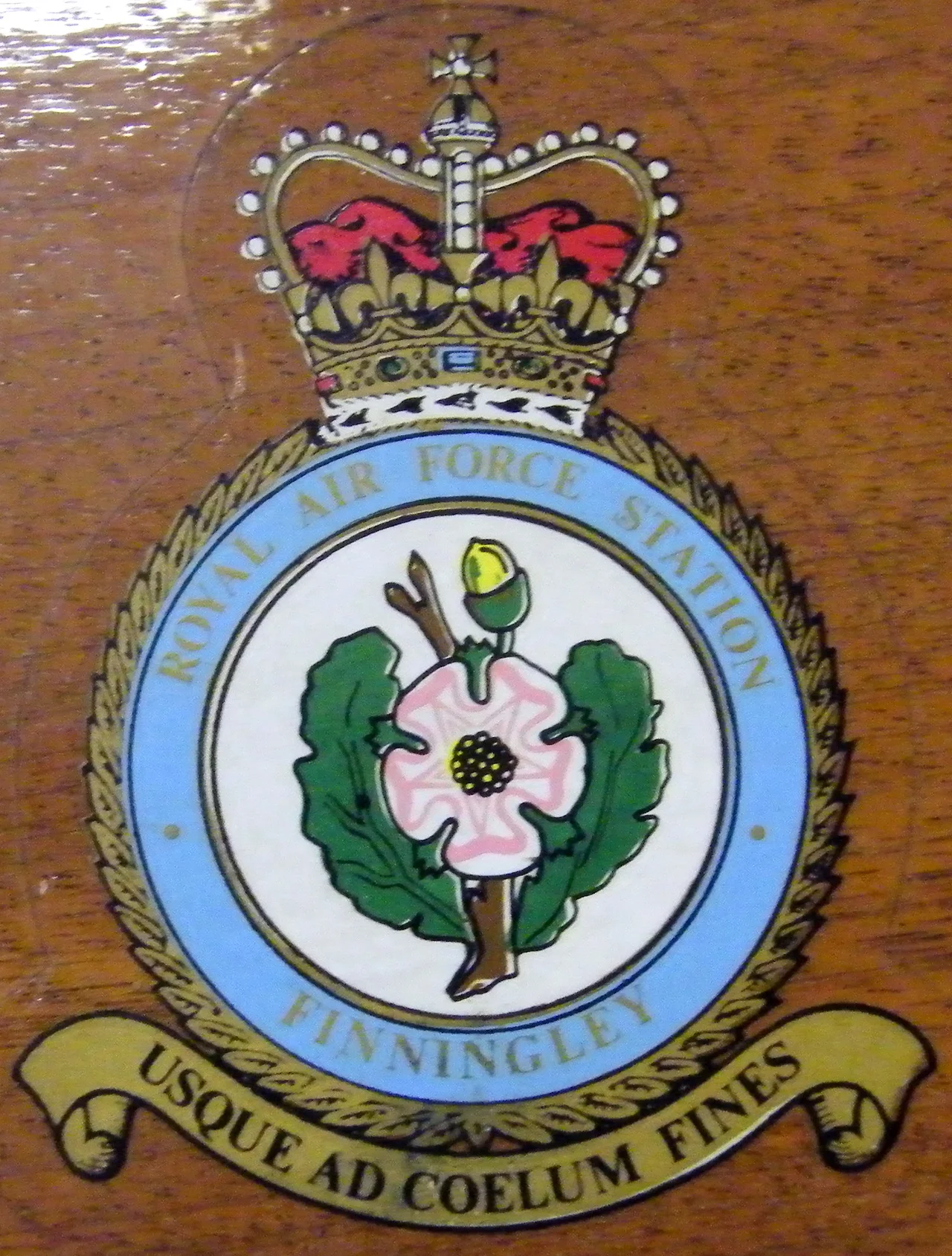

RAF Finningley
The first time a Vulcan B.2 entered RAF service, it landed at Finningley. The date was 1 July 1960, the aircraft was XH558, and the squadron was No. 230 Operational Conversion Unit, the V-bomber school. XH558 went on to outlive every other Vulcan that ever flew - restored, returned to the air in 2007, the last Vulcan in flying condition until October 2015, when the technical authorities withdrew their support and the Civil Aviation Authority grounded her for good. She came home to Finningley in 2011, where she sat in the open beside an English Electric Canberra. They are still there, weathering, while the airfield around them returns slowly to grass.
From Zeppelin Hunters to Hampdens
Finningley's military history began in 1916, when an emergency airstrip at Brancroft Farm, just south of the present site, took on Royal Aircraft Factory BE.2c biplanes from No. 33 Squadron RFC. Their job was to intercept Zeppelins approaching Sheffield's steel mills from the East Coast. Brancroft became a permanent Royal Flying Corps landing ground later that year, but the modern station dates from 1936. The Air Ministry bought 250 acres of farmland four miles southeast of Doncaster, built five Type C hangars in the standard pre-war crescent layout for 430,000 pounds, and opened the station on 30 July 1936. Nos. 7 and 102 Squadrons moved in with Handley Page Heyford biplane bombers, an aircraft already obsolete by the time it arrived. Within three years the squadrons were converting to Handley Page Hampdens, and by the outbreak of war in September 1939 Finningley was a Bomber Command training station.
Operational Training Units
Through the Second World War, Finningley's role was to finish bomber crews before they joined the night offensive. No. 106 Squadron arrived from RAF Cottesmore in October 1939, lost six Hampdens on minelaying sorties off the French Channel ports in 1940, and was reorganised into No. 25 Operational Training Unit in March 1941. Manchesters and Wellingtons came in. Nine Wellingtons were lost when 25 OTU was called upon for operational bombing missions in 1942. The unit was disbanded in February 1943 and replaced by No. 18 OTU, with satellites at RAF Bircotes and RAF Worksop. Hard runways were laid during the winter of 1943-44 - the main 03/21 strip stretching 2,000 yards - and the station could accommodate 2,416 men and 435 women, with the bomb store hidden in Finningley Big Wood. Bomber Command Instructors School took over in December 1944 and saw the war out.
V-Force
After a decade of training squadrons and an occasional reformed fighter unit - including No. 616 Squadron RAF flying de Havilland Mosquitoes, then Gloster Meteors - Finningley got its second life as a V-bomber base. Between 1955 and 1957 the runway was extended to 3,000 yards, and weapons stores were built for Yellow Sun, Violet Club and Blue Steel nuclear weapons. No. 101 Squadron reformed at Finningley with Vulcans in October 1957. No. 18 Squadron arrived with Vickers Valiants in electronic countermeasures configuration the following year. From 1961 the Vulcan Operational Conversion Unit was based here, training the crews who would fly the airborne deterrent during the most dangerous decade of the Cold War. The Battle of Britain Air Display, held at Finningley every September, became the largest one-day airshow in the country. A Vulcan scramble - four bombers airborne in under two minutes - became its signature spectacle.
Search and Rescue, and After
When V-force units left for other bases in the late 1960s, Finningley moved to RAF Support Command and concentrated on training. All RAF navigators passed through the Air Navigation School of No. 6 Flying Training School, flying BAe Dominies and Jet Provosts and later British Aerospace Hawks. In 1976 RAF Finningley also became the administrative home of the RAF Search and Rescue Wing - Nos. 22 and 202 Squadrons, with their bright yellow Westland Whirlwind, Sea King and Wessex helicopters. By 1978 the Wing had recorded over 4,500 human rescues and 93 peacetime gallantry awards. The Front Line First defence cuts of 1994 sealed Finningley's fate. The station closed in 1996. Peel Holdings bought the site, and in April 2005 it reopened as Doncaster Sheffield Airport. Then in September 2022 Peel announced the airport's closure too; the last scheduled passenger flight arrived on 4 November 2022. As of October 2025 the Vulcan to the Sky Trust was fundraising again, hoping to keep XH558 at Doncaster as a static exhibit even as the site's ownership remains uncertain.
From the Air
RAF Finningley / Doncaster Sheffield Airport sits at 53.48 degrees north, 1.01 degrees west, on flat South Yorkshire ground straddling the historic Nottinghamshire-Yorkshire border, four miles southeast of Doncaster town centre. The 3,000-yard 02/20 runway is unmistakable from altitude, as is the V-bomber dispersal architecture around the southern apron. As of late 2022 the airport (ICAO EGCN) closed to scheduled passenger traffic, though the runway and infrastructure remain. Recommended viewing altitude: 3,000 to 5,000 feet AGL. Humberside (EGNJ) is 25 nm to the east-northeast and Leeds Bradford (EGNM) 25 nm northwest. The M18/M180 motorway interchange just south of the site is a useful waypoint, as is the prominent loop of the River Idle to the east. Check current NOTAMs - the site's operational status has been in flux.
Nearby Stories
- Oaks Explosion 4.3 km away
- Murder of Ann Maguire 5.2 km away
- Laxton, Nottinghamshire 7.8 km away
- Pottery Cottage Murders 9.7 km away
- Burton Constable Hall 11 km away
- RAF Binbrook 13 km away
- Yorkshire Air Museum 16 km away
- Battle of Winceby 22 km away