.JPG)
Pottery Cottage Murders
Sarah Moran was ten years old, the adopted only child of Richard and Gillian Moran, raised in a quiet stone cottage on the edge of Beeley Moor with her grandparents living through a sliding door at the other end of the house. She slept with a grey elephant teddy and a comfort towel she had carried since babyhood. On the afternoon of 12 January 1977, a man named William Hughes broke through the cottage door with a stolen kitchen knife, and over the next two and a half days Sarah, her father, her grandfather Arthur Minton, and her grandmother Amy Minton lost their lives. Gillian Moran survived. The events at Pottery Cottage exposed serial failures in British prison security and led to a fifty-seven-page government report. What they cannot do is explain why a family doing nothing more than spending a winter afternoon at home became the victims of someone else's escape.
The Family at the Cottage
Arthur Minton had been born in Solihull in 1904 and had run a grocery shop in School Lane, Acocks Green, with his wife Doris Amy, until his retirement. They had sold up and moved out to Eastmoor in Derbyshire to be near their younger daughter Gillian. Richard Moran, Gillian's husband, had been born to a single mother in Kilmoganny, Ireland, in 1935; fostered by a Catholic family, he had served in the Irish Army, moved to Birmingham, and worked his way up to sales director for Brett Plastics in Chesterfield. Gillian had been raised in Acocks Green and trained as a typist. After discovering they could not have biological children, she and Richard adopted Sarah Bridget in 1967, when the baby was six months old. By 1977 the household was settled and ordinary. Arthur was seventy-two, Amy sixty-seven, Richard forty-one, Gillian thirty-eight, Sarah ten. They had a sliding door between the two halves of the cottage so the generations could share a roof while keeping their own evenings.
An Escape That Should Not Have Happened
William Hughes had been in and out of trouble since the age of fourteen. By 1976 he was on remand at HMP Leicester awaiting trial for rape and grievous bodily harm. In December 1976 he stole a seven-and-a-half-inch boning knife from the prison kitchen and hid it in a cut he made in his mattress. Searches missed it. On 12 January 1977, Hughes was put in a taxi with two prison officers, Donald Sprintall and Kenneth Simmonds, for transport to Chesterfield Magistrates Court. He was handcuffed to Simmonds in a way that left one of his own hands free. At a service station on the M1 he retrieved the hidden knife from his clothing, then attacked both officers in the moving car. He stabbed Sprintall in the back of the neck, slashed Simmonds across the jaw and hand, forced the taxi driver to keep going, then dumped all three at the roadside and drove off. He crashed near Chatsworth, abandoned the car, and walked across Beeley Moor in heavy snow. Pottery Cottage was the first isolated house he came to.
Three Days
Sarah was alone at home from school when Hughes broke in. He tied her up. Her grandfather Arthur, the next to come home, was beaten and bound. When Amy arrived, then Richard, then Gillian, each was bound and isolated in a separate room of the cottage. The first night Sarah was placed in her grandparents' bedroom; Arthur was bound in the downstairs lounge. Evidence later showed that Sarah and Arthur were almost certainly killed during that first night or in the early hours of 13 January. Hughes spent the next thirty-six hours deceiving Gillian, Amy and Richard that the other two were still alive: carrying plates of food to the closed bedroom doors, claiming Sarah was pleased to receive her elephant teddy and comfort towel when Gillian asked, refusing to let her mother see her daughter. He sexually assaulted Gillian. He drove Richard and Gillian to Brett Plastics in the small hours to steal cash from the company safe. The snow kept falling and the roads were treacherous. He stayed a second night.
Help, Too Late
On the evening of 14 January, Hughes packed the family's Chrysler 180 to leave, intending to take Gillian as a hostage. He went back into the house alone, ostensibly for a forgotten map, and stabbed Richard and Amy. The Chrysler then failed to start. Outside, Amy - mortally wounded - climbed through a window and staggered into the snow toward the car, where Gillian watched her collapse. Hughes forced Gillian to ask the neighbours, Leonard and Joyce Newman, for help. Recognising her terror, the Newmans drove at high speed to the nearest phone box and called the police. Hughes then took Gillian to another neighbour, the mechanic Ronald Frost; Frost, understanding what was happening, deliberately slowed the work while his wife Madge made her own call. Police were converging from every direction. When the Chrysler finally started, Hughes drove away with Gillian still inside.
The Standoff at Rainow
The pursuit ran across Derbyshire and into Cheshire, ending around 10pm when a Crosville bus was positioned across the road in the village of Rainow. Hughes tried to swerve around it, lost control, hit a drystone wall. After almost an hour of negotiations he raised an axe over Gillian's head and screamed, 'Right! Your time's up!' Chief Inspector Peter Howse, leading the operation, dived through the rear window to parry the blow. Firearms officer Frank Pell fired one shot that deflected off Hughes's skull. Hughes bit deeply into Howse's arm. Three more shots followed. The last, fired by Officer Alan Nicholls, passed through Hughes's aorta and killed him. It was the first time Derbyshire Constabulary had shot anyone dead, and the first time in modern British policing that an escaped armed prisoner had been killed by police. Howse received the Queen's Commendation for Brave Conduct. Gillian, virtually catatonic, was lifted from the car. She was not told what had happened to her family until after she had been treated in hospital.
After
Arthur Minton, Amy Minton, Richard Moran and Sarah Moran were buried together in a joint funeral at Brimington Cemetery, Chesterfield, on 21 January 1977. More than a hundred mourners attended. The Fowler Report of 10 March 1977 catalogued the prison system's failures: the unsearched mattress, the inadequate categorisation of Hughes as a Category B prisoner despite his record of violence, the handcuffs that left one hand free, the broken communications between police and prison staff. Seventeen of Fowler's recommendations were accepted immediately by the Home Secretary, Merlyn Rees. No individual officer was disciplined; the failure was deemed systemic. Local residents in Chesterfield refused to allow Hughes to be buried in their cemetery and chained the gates shut; in the end he was cremated. Gillian Moran later remarried and had another daughter. She gave one interview to the Daily Mail and has spoken to no journalist since. The cottage itself was eventually sold, renamed, and the road sign for it removed. There is no plaque. There are five names to remember: Arthur, Amy, Richard, Sarah, and Gillian, who survived.
From the Air
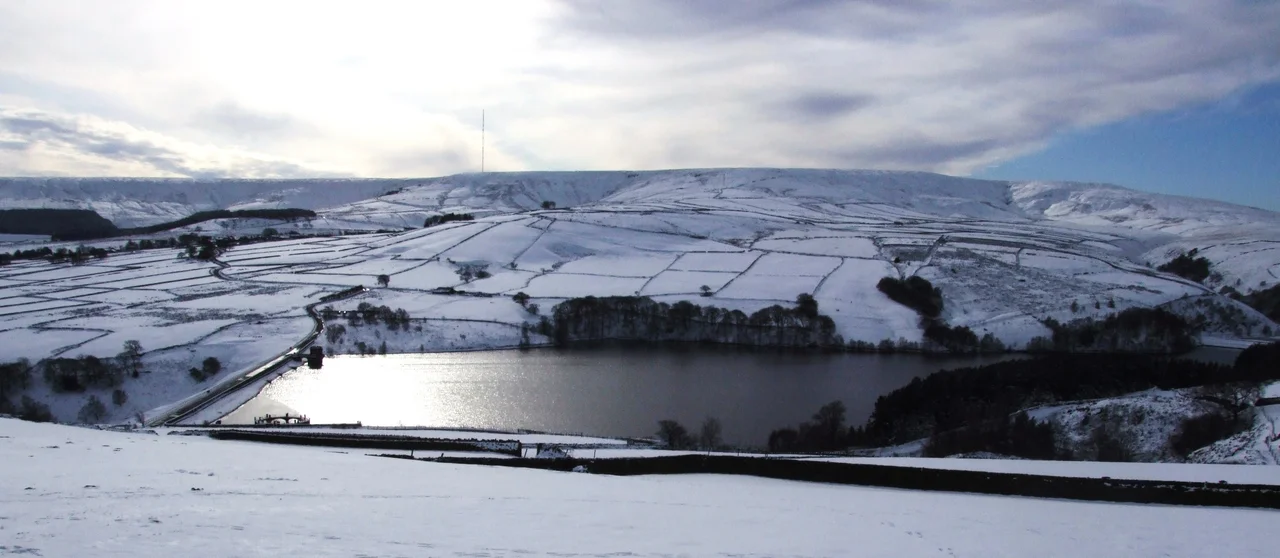
Pottery Cottage stood at 53.238°N, 1.5465°W in Eastmoor, on the open moorland between Chesterfield and Chatsworth in Derbyshire. From the air, this is heather and rough pasture country on the eastern edge of the Peak District, with scattered isolated cottages along narrow lanes. Recommended viewing altitude is 2,500 to 3,500 feet AGL; the moors rise to around 1,000 feet AMSL. Beeley Moor and Chatsworth Park lie immediately west. East Midlands Airport (EGNX) lies about 25 nautical miles south-southeast, Sheffield City Heliport (EGSY) about 13 nautical miles north-northeast, Manchester (EGCC) about 33 nautical miles west-northwest. Weather here can shift rapidly: in January 1977 the moors were under heavy snow that hampered the police search. This is a place to remember rather than to sightsee.
Nearby Stories
- Nottinghamshire 3.7 km away
- RAF Finningley 5.5 km away
- Grantham Canal 7.2 km away
- Repton Abbey 7.9 km away
- Manchester 8.8 km away
- Macclesfield 9.7 km away
- Wentworth Castle 11 km away
- Broad Eye Windmill 12 km away