
Murder of Suzanne Capper
She was sixteen. Her name was Suzanne Jane Capper, she lived with her stepfather and her older sister Michelle in Moston, north Manchester, and the people who killed her in December 1992 had been part of her life since she was a small child — her neighbour Jean Powell had babysat her from the age of six. The court papers describe Suzanne as 'a gentle and easily influenced girl.' Friends remembered a teenager who trusted the wrong people too easily. In the days before Christmas 1992, she was kidnapped and held captive at a house on Langworthy Road. She died in Withington Hospital on 18 December, conscious long enough to name her attackers to the police. She was buried by her mother Elizabeth in the week before what should have been her seventeenth Christmas.
Suzanne
What the case files don't capture, and what news coverage in 1993 largely failed to centre, is the person Suzanne actually was. She had grown up in north Manchester through a difficult adolescence — her mother and stepfather had separated when she was a young teenager, and she had spent time in local authority care in 1990. She and her sister Michelle stayed with their stepfather afterwards. She was a regular at the house of Jean Powell, the woman who had babysat her years earlier — a connection that ought to have meant safety. Friends who spoke later remembered a quiet girl who liked her clothes and her music, who could be led, who hadn't learned yet how to walk away from people who didn't deserve her loyalty. She was sixteen years old. She had a family who loved her. That should be the first thing anyone reading her name remembers.
Moston, December 1992
Moston in the early 1990s was a working-class neighbourhood in the north-east of Manchester — terraced streets, corner shops, the Rochdale Canal a few miles east. Number 97 Langworthy Road was an ordinary house on an ordinary street. The events that took place there over a week in mid-December 1992 do not belong in a travelogue, and this story will not recount them. The Crown's case, presented to the jury at Manchester Crown Court the following year, was that Suzanne was held captive by people she had counted as friends, including Jean Powell, Powell's ex-husband Glyn Powell, Bernadette McNeilly, Anthony Dudson and others. She escaped early on the morning of 14 December after being abandoned in a lane at Werneth Low, near Romiley on the edge of Stockport. She was found at 06:10 by Barry Sutcliffe and two colleagues on their way to work. They got her to hospital. She lived for four more days.
Naming Her Attackers
Suzanne Capper's last act was an act of courage. Before she lost consciousness at Withington Hospital, she gave the police the names of the people who had hurt her. She told them where the house was. Detective Inspector Peter Wall of Greater Manchester Police instructed officers to attend 97 Langworthy Road by 07:30 that same morning and arrest everyone present. Without that statement, the prosecution would have been far harder. Because of it, six people were charged. At the inquest on 8 January 1993, the coroner addressed Suzanne's mother and stepfather directly: 'I offer you, not just on my behalf, but on behalf of the whole nation, my very deepest sympathy and condolences at this tragic happening to your young daughter.' Mr Justice Potts, sentencing the convicted at Manchester Crown Court a year later, called it 'as appalling a murder as it is possible to imagine.'
What the Verdicts Looked Like
On 17 December 1993, almost exactly a year after Suzanne died, Jean Powell (then 26), Glyn Powell (29) and Bernadette McNeilly (24) were sentenced to life imprisonment for murder with a minimum tariff of 25 years each. Anthony Dudson, who was 16 at the time of the offence — the same age as Suzanne — was detained at Her Majesty's pleasure under the Children and Young Persons Act 1933, with a minimum term of 18 years (later reduced to 16). Jeffrey Leigh received twelve years for false imprisonment. Jean Powell's brother Clifford Pook was sentenced to fifteen years in a Young Offenders' Institution. None of the killers are in prison now: Leigh and Pook were released in the late 1990s and early 2000s, Dudson in 2013, McNeilly in 2015 and Jean Powell in 2017. The arguments about parole, and about whether tariffs were ever long enough, have continued for thirty years.
Remembered
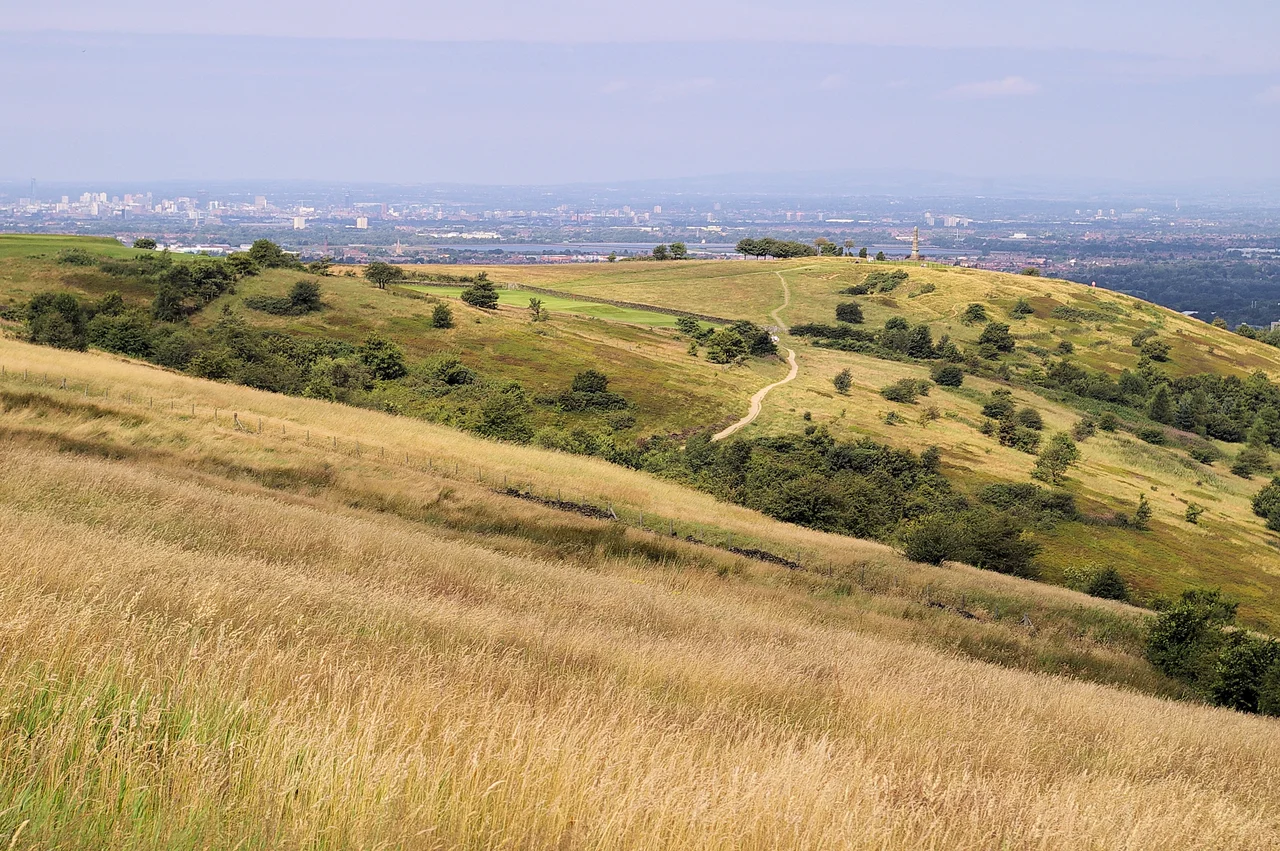
Werneth Low Country Park, where Suzanne was left, is a scrap of open countryside on the edge of the Pennines south-east of Manchester — gorse, grazing, a war memorial on the high ground, views across the Cheshire Plain. It is a place locals walk in for the air. Suzanne's family never spoke much in public; they did not turn her into a campaign. What survives, alongside the legal record, is the brief outline of who she was: a Manchester teenager whose family loved her, whose courage at the very end of her life put the people who had hurt her behind bars, and whose name belongs to her — not to the people who killed her. That is the right way to remember her.
From the Air
Located in Moston, north-east Manchester, at 53.516°N, 2.185°W, with a connected site at Werneth Low Country Park about 14 km south-east on the edge of Stockport. The area sits inside the M60 ring road, roughly 5 km north-east of Manchester city centre. Manchester Airport (EGCC) is about 20 km south; Manchester Barton (EGCB) lies about 10 km west. From low cruising altitude the Werneth Low ridge stands as the first rise of the Peak District foothills above the Mersey valley.
Nearby Stories
- National Science and Media Museum 0.2 km away
- Jodrell Bank Observatory 3.2 km away
- Siege of Lathom House 5.6 km away
- Chester Zoo 6.2 km away
- Whalley Abbey 8.9 km away
- Haddon Hall 10 km away
- Wentworth Castle 16 km away
- Blackpool 16 km away