
Jodrell Bank Observatory
The trams on Oxford Road in Manchester crackled with so much electrical noise that Bernard Lovell could not hear the universe through them. So on 10 December 1945, with a war-surplus GL II gun-laying radar mounted on a hut and a wavelength of 4.2 metres dialled in, he hauled his equipment twenty-five miles south to a flat stretch of land the University of Manchester's Department of Botany had bought from a farming family called Leigh. Four days later, on the night of the Geminids meteor shower, Lovell switched the radar on. The streaks his instruments traced through the air were the first observations ever made at Jodrell Bank.
An Archer's Land
The site takes its name from a low rise on the property, Jodrell Bank, itself named after William Jauderell, a medieval English archer whose descendants lived in the mansion that is now Terra Nova School. In 1939 the botany department bought three fields from the Leighs to study how cosmic rays affected plants, and in 1952 the site was extended with a farm purchased from George Massey, on which a far more ambitious instrument would rise. The fields had been chosen for their separation from urban interference, and that quality turned out to matter for reasons no one had anticipated. By October 1946 Lovell was confirming that his transient radio echoes really did come from ionized meteor trails, swivelling a new broadside array ninety degrees during the peak of the Giacobinids shower and watching the detection rate collapse. The skies above this corner of Cheshire had become a laboratory.
From the Transit to the World Heritage Bowl
In 1947 Lovell strung a wire-mesh dish 218 feet across between wooden scaffolding poles, with a focal mast 126 feet above the ground. The Transit Telescope, as it became known, could only look more or less straight up, but it was briefly the largest radio telescope in the world. It picked up signals from the Great Nebula in Andromeda, the first definite radio detection of a source outside our own galaxy, and caught the radio remnants of Tycho's Supernova of 1572 before optical astronomers had even found it. The Transit pointed only one way, however, and the next instrument would point everywhere. The 250-foot steerable dish that became the Lovell Telescope went operational in 1957 and, with successive Mark II, Mark III, 42-foot and 7-metre antennas, made Jodrell Bank one of the most productive radio observatories on Earth. On 7 July 2019, at the 43rd Session of the UNESCO World Heritage Committee in Baku, the observatory was inscribed as a World Heritage Site under four criteria, including its role as a masterpiece of human creative genius.
The Range of the Science
Few observatories have spanned such a wide range of discoveries. Astronomers at Jodrell Bank have used the dishes to measure radar echoes off the Moon and Venus, to study astrophysical masers around star-forming regions and giant stars, and to discover millisecond pulsars and the first pulsar in a globular cluster. The first gravitational lens ever found was confirmed here in 1979, after observers caught two faint blue stars that turned out to be one quasar split in two by the bending of light around a foreground galaxy, and in 1998 the site contributed to the detection of the first Einstein ring. SETI searches for evidence of other civilizations have run here too. Through MERLIN, the Multi-Element Radio Linked Interferometer Network, the Lovell dish links up with sister telescopes across England and the Welsh borders to form an array with a longest baseline of 217 kilometres, capable of teasing out details around 0.001 arcseconds across the sky.
The Threat and the Reprieve
Great instruments are also expensive ones. In March 2008 the Science and Technology Facilities Council, facing an 80 million pound shortfall, considered withdrawing 2.7 million pounds a year from Jodrell Bank's e-MERLIN project, which would replace microwave links with fibre-optic cables and dramatically increase the sensitivity of the entire array. Bernard Lovell, then in his nineties, said the establishment could not survive if e-MERLIN funding was cut. After an independent review the council reversed its position in July, guaranteeing 2.5 million pounds a year for three years. In April 2011 Jodrell Bank was named the location of the Project Office for the Square Kilometre Array, an even more ambitious international radio telescope, and in April 2015 it was confirmed as the SKA's permanent headquarters for the half-century or more that the instrument was expected to operate.
Music, Maze and a Spaced-Out Solar System
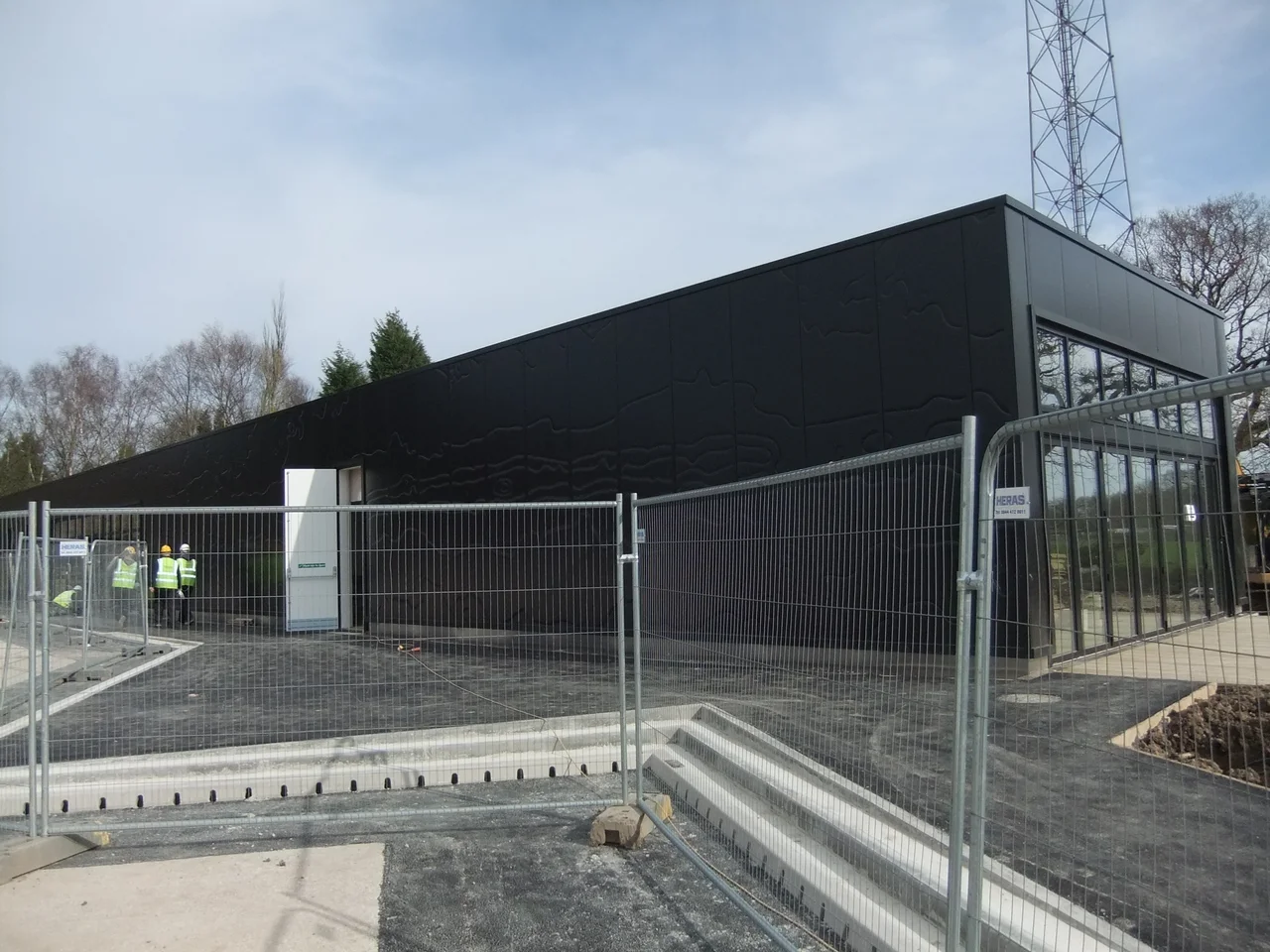
Beyond the science, the site has become an unlikely cultural venue. The Jodrell Bank Discovery Centre opened in April 2011, with a Planet Pavilion, Space Pavilion, a cafe with a view of the Lovell dish and a 35-acre arboretum holding the UK's national collections of crab apple Malus and mountain ash Sorbus, plus the Heather Society's Calluna collection. On 31 August 2013, what would have been Lovell's hundredth birthday, the Halle Orchestra played a concert with the great dish turned to face the audience and used as a screen for projected planetary animations. The Bluedot music and science festival has been held on the grounds since 2016, and BBC's Stargazing Live broadcast from the control room from 2011 to 2016. A 1:5,000,000,000 scale model of the Solar System sits in the arboretum, and the site holds the Sun for a separate 1:15,000,000 scale model spread across all of Britain.
From the Air
Jodrell Bank Observatory sits at 53.24N, 2.31W in rural Cheshire, near Lower Withington and Goostrey, at around 75 metres elevation. The Lovell Telescope's 76.2 metre steerable dish, rising up to 89 metres above the ground, is one of the most recognizable man-made objects in northwest England and visible from cruising altitudes on a clear day. Nearest airports: Manchester (EGCC) 22 km north, Hawarden (EGNR) 50 km southwest, and Liverpool (EGGP) 50 km west. The site is radio-sensitive; pilots flying GA aircraft with onboard transmitters should avoid loitering directly overhead.
Nearby Stories
- Battle of Rowton Heath 1.1 km away
- Knowsley Hall 1.7 km away
- Old Trafford 2.9 km away
- Tutbury Castle 7.2 km away
- Haddon Hall 7.5 km away
- Whittington Castle 14 km away
- Stafford Castle 16 km away
- Wentworth Castle 19 km away