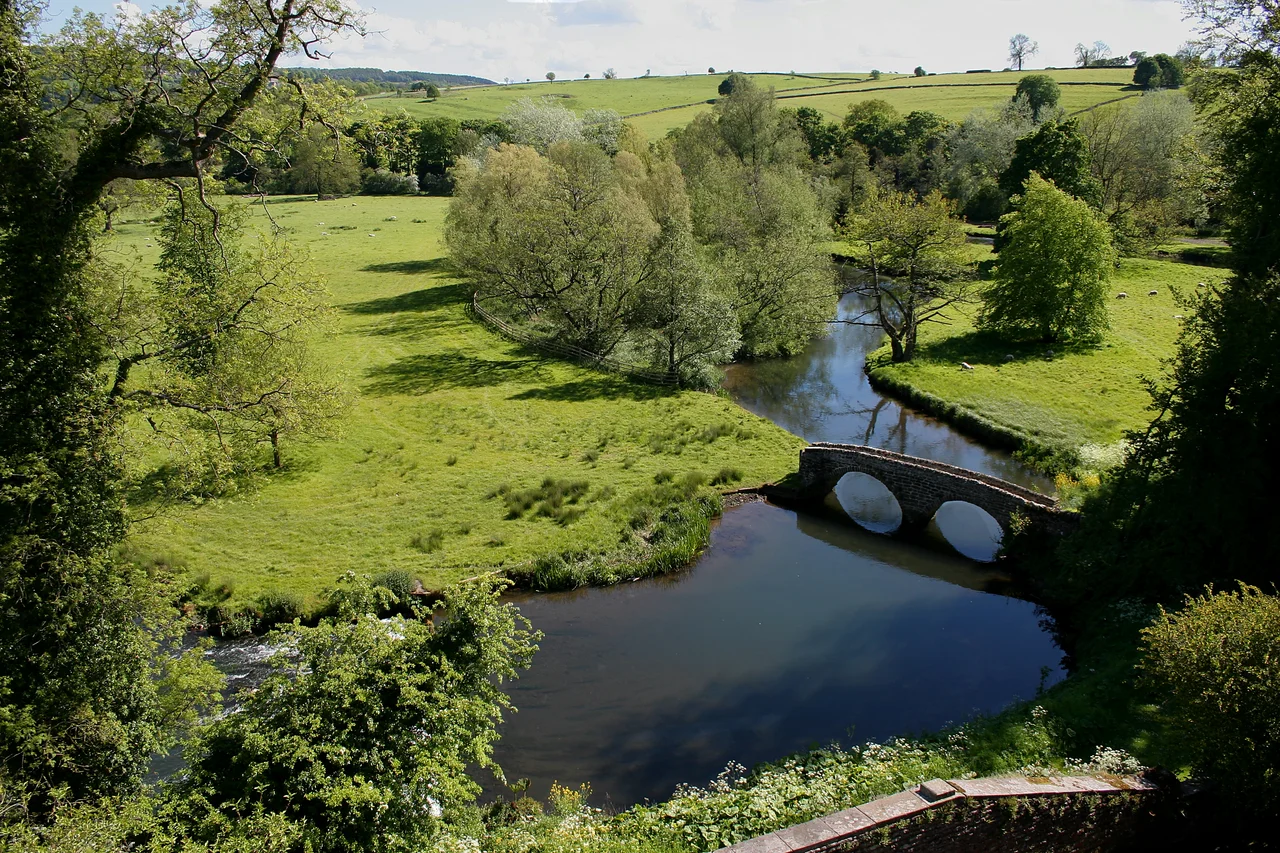

Haddon Hall
Haddon Hall survived by being left alone. When the 1st Duke of Rutland moved to grander Belvoir Castle in 1703, he simply locked the doors of his Derbyshire seat and walked away. For more than two hundred years the place stood empty, its tapestries undisturbed, its banqueting hall used by nobody, its frescoes safe under generations of whitewash. By the time the 9th Duke arrived in the 1920s and began an obsessive restoration, Haddon was something almost no other English country house could claim: a complete medieval and Tudor manor that had skipped the eighteenth and nineteenth centuries entirely. When Hollywood needs the real Middle Ages, they come here.
Domesday to Vernon
William Peverel held the manor of Haddon in 1087, the year of the Domesday survey. The estate passed through the Avenell family before Sir Richard de Vernon picked it up by marrying Alice Avenell around 1170. The Vernons would hold Haddon for nearly four centuries. They built almost everything you now see except the Peveril Tower, parts of St Nicholas's chapel, and the Long Gallery. The chapel was finished by 1427 with painted frescoes covering its walls, the banqueting hall and parlour go back to 1370, and the kitchens still have their medieval bread ovens and salting troughs. Sir Richard Vernon, who died in 1451, was Speaker of the House of Commons and a High Sheriff. The hall was never a castle, but in 1194 a royal licence allowed the family to wall it for defence, and the walls are still there.
The Elopement Story
In 1563 the heiress Dorothy Vernon married John Manners, second son of the Earl of Rutland. By the nineteenth century a legend had grown up that her father, Sir George Vernon, opposed the match - perhaps because the Manners were Protestants and the Vernons Catholic, perhaps because a younger son had thin financial prospects - and that Dorothy slipped away during a ball, ran down a flight of stone steps, crossed a footbridge over the River Wye, and rode off to marry her young man. Historians find no contemporary evidence for any of this. What they find is that the couple did marry, did inherit the hall when Sir George died two years later, and that the bridge and the steps both exist. The story was retold as a novel by the American writer Charles Major in 1902, as a Mary Pickford film in 1924, and as a 1892 light opera with music by Arthur Sullivan. The bridge is still called Dorothy Vernon's Bridge.
Two Centuries of Sleep
Dorothy and John's grandson John Manners inherited the Earldom of Rutland in 1641 from a distant cousin, bringing with it the much grander Belvoir Castle in Leicestershire. His son was made 1st Duke of Rutland in 1703, and the family decisively moved out. Haddon was kept up just enough to remain weatherproof. The whitewash that had been slapped over the chapel frescoes during the Reformation protected them from later vandalism. The Long Gallery's oak panelling went unpolished but unburnt. The medieval kitchen survived because no one updated it. The result, when the 9th Duke John Manners began his work in the 1920s with the architect Harold Brakspear, was a building that had to be revealed rather than reconstructed. They scraped, repaired, replanted, and uncovered the frescoes inch by inch. The walled topiary garden with its clipped peacocks and boar's heads, the heraldic emblems of the Manners and Vernon families, was the 9th Duke's own creation.
A House on Film
If Haddon Hall looks familiar even on a first visit, it is because you have probably seen it. The Princess Bride filmed scenes here in 1987; both 1996 and 2006 adaptations of Jane Eyre used it as Thornfield; Pride and Prejudice in 2005 used it as the Lambton inn where Elizabeth learns of Lydia's elopement; Elizabeth in 1998 used the courtyards; the 2019 Netflix film The King filmed there; and Jude Law's 2023 Firebrand was made there in its entirety, reportedly bringing three million pounds into the Peak District economy. Painters got here earlier. Joseph Nash painted the banqueting hall in 1838, and his image was later adapted for the cover of Jethro Tull's 1975 album Minstrel in the Gallery. The watercolourist Frederick Booty painted the gardens with their peacocks repeatedly. The Long Gallery, with its bay window flooding light onto oak floors that ripple like water, is one of the most photographed rooms in English domestic architecture.
Still Lived In
Haddon is still a home. Lord Edward Manners, brother of the 11th Duke of Rutland, moved into the hall with his family in 2016 - the first time anyone in the family has lived there for nearly two hundred years. A 2021 grant from Historic England, topped up by the Historic Houses Foundation, funded the restoration of the Norman and medieval chapel's chancel window and two critical chimneys serving the medieval kitchens. The hall is Grade I listed and has been since 1951. It opens to visitors most of the year. Walk through it slowly: the air smells of woodsmoke and old wax, the peacocks call across the topiary, and in the chapel the frescoes that the whitewash saved still show the dim outlines of saints and dragons painted six hundred years ago. The 9th Duke's restoration is now a century old. The medieval walls are eight hundred.
From the Air
Haddon Hall sits at 53.1939°N, 1.6498°W on a low limestone bluff above the River Wye, about two miles southeast of Bakewell in the Derbyshire Peak District. From the air, look for the cluster of grey stone buildings with crenellated walls on the wooded west bank of the Wye, with formal terraced gardens stepping down to the river. Recommended viewing altitude is 2,500 to 3,500 feet AGL; the surrounding hills rise to around 1,000 feet AMSL. East Midlands Airport (EGNX) lies about 28 nautical miles south-southeast, Sheffield City Heliport (EGSY) about 16 nautical miles north-northeast, Manchester (EGCC) about 32 nautical miles west-northwest. The Peak District is prone to low cloud and orographic precipitation; valleys often fill with mist on still mornings. Chatsworth House lies about 3 nautical miles north along the Wye/Derwent line and makes an obvious navigational landmark.
Nearby Stories
- Nottinghamshire 3.7 km away
- RAF Finningley 5.5 km away
- Grantham Canal 7.2 km away
- Repton Abbey 7.9 km away
- Manchester 8.8 km away
- Macclesfield 9.7 km away
- Wentworth Castle 11 km away
- Broad Eye Windmill 12 km away