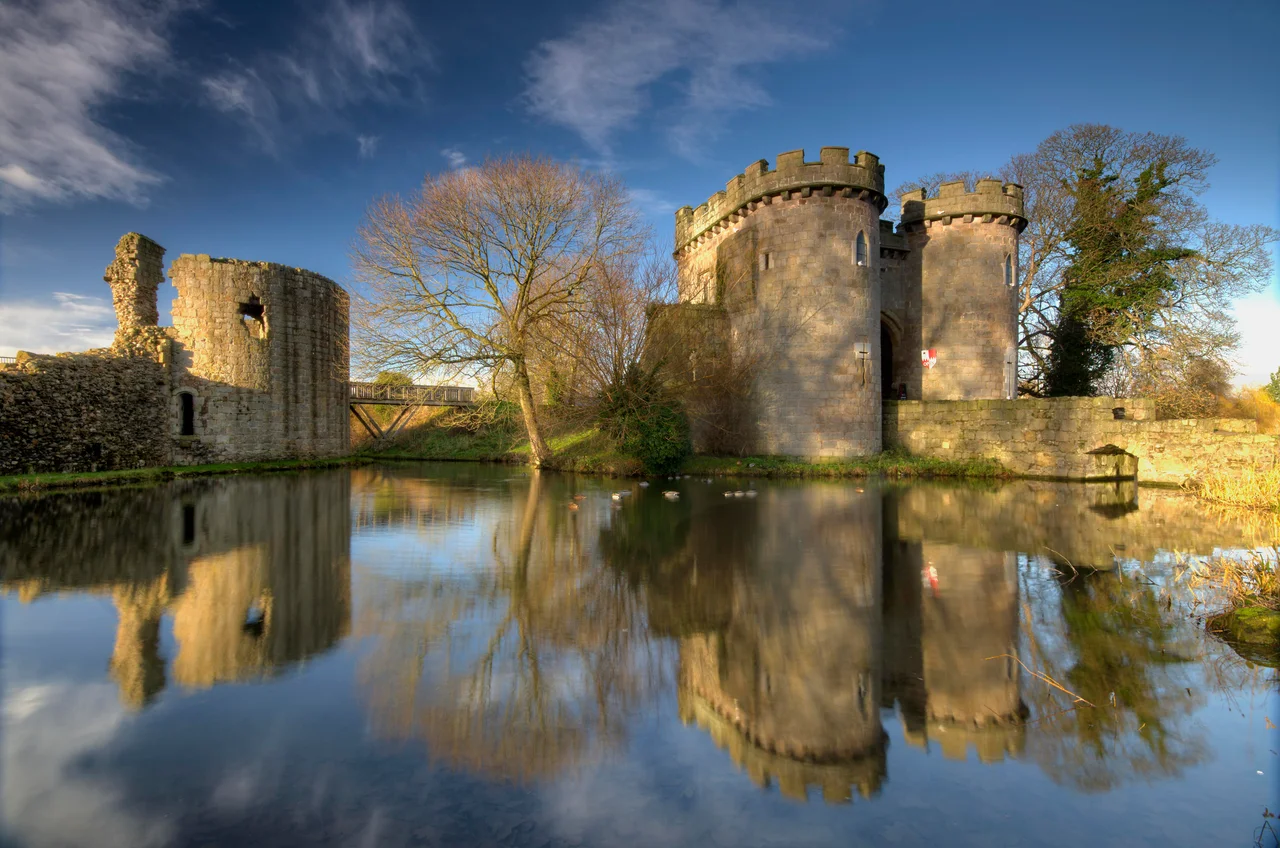

Whittington Castle
Most of the great castles of the Welsh Marches are in the hands of English Heritage or Cadw. Whittington Castle is different. In 2002, the local community took out a 99-year lease and has been running it ever since. They had to: nobody else would. The castle had been a working farmhouse converted from the gatehouse, occupied as a private dwelling into the 1990s. Two of the towers had collapsed into the moat over the centuries; stone had been carted away to build the turnpike road to Ellesmere in 1776. What the Whittington Castle Preservation Trust inherited in 1998 was a ruin with a moat full of ducks - and a story that runs from Empress Matilda to the Holy Grail.
Built for a Civil War
The castle was first fortified in 1138, during the civil war between Empress Matilda and her cousin Stephen of England known as the Anarchy. William Peverel held it for Matilda, the daughter of Henry I, against Stephen's nominal lordship. In 1149 Madog ap Maredudd, the last king of a united Powys, annexed Whittington along with Oswestry, and the castle remained Welsh until his death in 1160. Henry II then gave it to Roger de Powys in 1165, funded its repairs in 1173, and the lordship passed to Roger's son Meurig and grandson Werennoc. A rival claim from Fulk III FitzWarin - who said the castle was rightfully his under the Peverels - led him to rebel against King John when his claim was refused. He was eventually pardoned in 1204 and given the castle. Ten generations of FitzWarins, all named Fulk, held it until the line died out in 1420.
Llywelyn's Stones
In 1223 Llywelyn ab Iorwerth of Gwynedd - 'Llywelyn the Great,' who united most of Wales under his rule - captured Whittington and destroyed it. Under the peace treaty that followed, it was returned to its English owners, but the rebuild took it from a wooden motte-and-bailey to a much more serious stone castle. The new layout had buildings ranged along a curtain wall around an inner bailey, five towers on a raised platform, a wide moat, and an outer gatehouse with a barbican beyond. For forty years it stayed in English hands, then was ceded to Llywelyn ap Gruffudd - Llywelyn the Last - under another treaty. After Llywelyn was killed in 1282 and Wales was conquered by Edward I, the castle settled into a long peaceful career as a lordly residence rather than a frontline fortress. Owain Glyndwr laid waste the surrounding lordship in 1404, but the castle itself was not captured.
Inheritance and Decay
When the FitzWarin line ended with Fulk XI in 1420, Whittington passed by marriage to Elizabeth FitzWarin and her husband Richard Hankeford. Their daughter married into the Bourchier family, carrying the FitzWarin peerage with them. Their grandson became the Earl of Bath. In 1545 the second Earl of Bath swapped Whittington with Henry VIII for former monastic estates closer to his main family seat in Devon. A detailed survey taken at the exchange described several buildings as 'in decay.' The castle was probably never properly lived in again. From 1750 the Lloyd family of Aston, near Oswestry, owned it - and still do - but they lived elsewhere. About 1760, one of the towers fell into the moat. Between 1776 and 1808, much of the stonework was carted off for road-building and other local works. By the time William Lloyd restored the gatehouse around 1808 and let it as a farmhouse, the inner castle was a romantic ruin.
The Grail and the Romance
Whittington has one of the more elaborate legends in the Marches. Sir Fulk FitzWarin - the rebel who fought King John - is named in a 13th-century French romance, Fouke le Fitz Waryn, that mixes his real political career with chivalric adventure. A later tradition holds that the Marian Chalice, identified by some with the Holy Grail, was kept in a private chapel within the castle when Fulk was in residence. The FitzWarins were, in this telling, hereditary guardians of the Grail in the line descending from Payne Peveril. The coat of arms of Fulk FitzWarin still hangs above the castle archway. Most of this is medieval romance rather than history. But the 13th-century romance is one of the earliest surviving Anglo-Norman prose narratives in Britain, which makes the castle - and the family it celebrates - a fixture of medieval literary history regardless of how literally one takes the Grail story.
Owned by the Village
By the late 1990s, the gatehouse-farmhouse had been empty for years and the rest of the site was in advanced ruin. The owners, the Lloyd family, no longer had a use for it. In December 1998 a group of local residents formed the Whittington Castle Preservation Trust, a rural community trust. In 2002 the Trust took out a 99-year lease on the site, and a £1.5 million renovation programme followed. The gatehouse was stabilised. The moat was cleared. Outbuildings were converted to a cafe and a small museum. The grounds opened to the public, free of charge, and stay open year-round. Volunteers run the tearoom and the events programme. School visits, ghost tours - Whittington was featured on Most Haunted in 2016 - and medieval reenactments help fund the maintenance. It is the only community-owned castle of its scale in England: a marcher fortress that survived nine centuries of inheritance and decay, finally rescued by the village that grew up around it.
From the Air
Whittington Castle sits at 52.87 degrees north, 3.00 degrees west, in the village of Whittington about three miles east of Oswestry. From the air the castle's moat - a clean rectangle of water around the stone gatehouse and ruined inner bailey - stands out against the surrounding farmland. Offa's Dyke runs nearby. The Iron Age fort of Old Oswestry is the other major aerial landmark, three miles to the west. Cruise at 2,500-4,000 feet for the best view of the moated ruin and the surrounding marches. Shawbury (EGOS) lies about 17 nautical miles south-east.
Nearby Stories
- Crewe Works 1.6 km away
- Dudmaston Hall 9 km away
- Battle of Blore Heath 10 km away
- King's School, Chester 11 km away
- Caratacus' last battle 15 km away
- Llanrwst 19 km away
- Battle of Mynydd Hyddgen 20 km away
- Ysbyty Ifan 26 km away