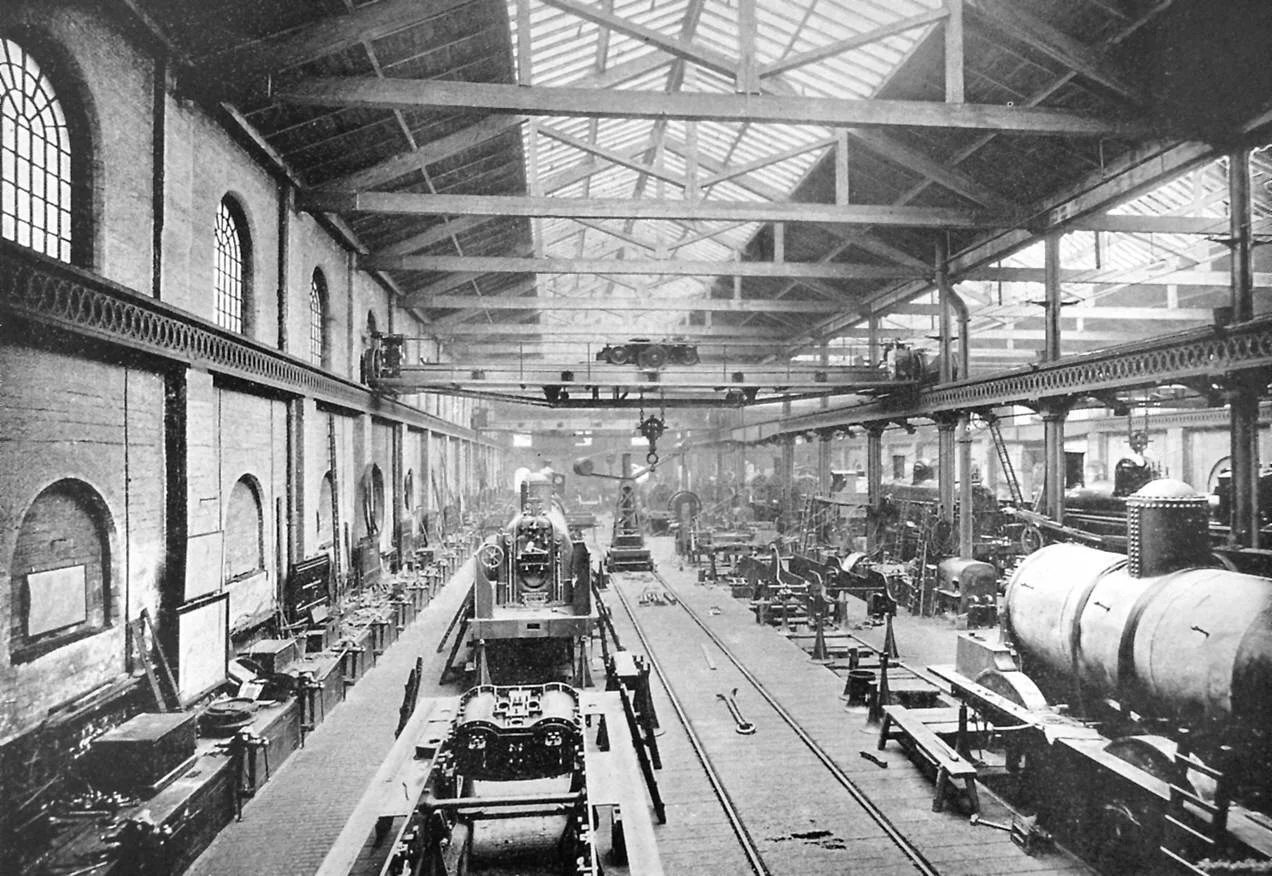

Crewe Works
Tamerlane was the first one. October 1843, a Grand Junction Railway engine built on a three-acre site beside the new station at Crewe, the first locomotive of seven thousand three hundred and thirty-one that would be turned out of this works before steam ended. The last was Class 9F number 92250, completed in December 1958, a hundred and fifteen years and four reorganisations later. In between, Crewe Works built the Webb Jumbos, the Whale Precursors, the Bowen-Cooke Claughtons, the Stanier Black Fives, the Princess Royals, the Coronations, the Britannias. The names alone, to the right kind of listener, are a roll-call of British railway history. Around them grew a town, a workforce of eight thousand men at its peak, a self-contained world of foundries and forges and erecting shops. Some of that world is still here. Most of it is housing now.
The First Concentration
When the Grand Junction Railway bought farmland at Crewe in 1840 to put a workshop, the surrounding country was not much more than fields. The first works opened in March 1843 on three acres. Within five years it employed over a thousand men and was producing one locomotive a week. In 1845 the Grand Junction merged with the Liverpool and Manchester Railway, then with the London and Birmingham and the Manchester and Birmingham in 1846 to form the London and North Western Railway. Each of those constituents had its own workshops. Crewe, gradually, absorbed them all. John Ramsbottom took over as Locomotive Superintendent in 1857 and brought with him two inventions that the railway industry quickly took for granted: the first reliable safety valve, and the water-pickup scoop that let express engines refill their tenders at speed from troughs laid between the rails. Ramsbottom drove a programme of interchangeable parts and precision tooling that turned Crewe into a model of industrial standardisation.
A Town That Made Its Own Steel
By 1853 Crewe was making its own wrought iron and rolling its own rails. In 1864 it installed a Bessemer converter to make steel. In 1868 it became the first place in Britain to use open-hearth furnaces on an industrial scale. It built its own brickworks. It later added two electric arc furnaces. The point of all this is that Crewe was not merely a place where locomotives were assembled from bought-in parts. It was a place where the metal itself was made, then forged, then machined, then assembled. Private locomotive builders did not like the competition. In 1876 they obtained a court injunction restricting the LNWR to building locomotives only for its own needs, after the railway sold engines to the Lancashire and Yorkshire Railway. That injunction stood until British Rail Engineering Limited was created in 1969, almost a century later.
The Stanier Era and the World Wars
When the LNWR became part of the London, Midland and Scottish Railway in 1923, the new organisation found that its express passenger locomotives were overshadowed by the lighter, faster engines of the absorbed Midland Railway. William Stanier became Chief Mechanical Engineer of the LMS in 1932 and chose Crewe as his principal production location, partly because of its size and partly because it could make its own steel. The Stanier era produced some of the most successful British steam locomotives ever built: the Princess Royal class 4-6-2s, the Princess Coronation 4-6-2s (the Duchesses), the Jubilee 4-6-0s, and the Black Five 4-6-0s, the all-purpose locomotive that Driver Hope on the Winwick local would have recognised by 1934. During the Second World War, Crewe also produced more than 150 Covenanter tanks for the Army. The 1935 documentary No. 6207; A Study in Steel, filmed inside the works during the construction of a Princess Royal class engine, survives as a remarkable record of heavy industrial craft.
After the Steam Age
After British Railways was formed in 1948, Robert Riddles introduced the BR Standard classes and Crewe built Britannia and Clan mixed-traffic engines along with some of the Class 9F freight locomotives. When the last steam locomotive left the works in December 1958, diesel production was already starting. Diesel D5030 emerged in 1959. The Class 56 diesel and the Class 91 electric were the works' last new-build series, ending in 1984 and 1991 respectively. In the mid-1980s much of the site was cleared and sold; British Rail Engineering Limited was privatised in 1989 and passed through ASEA Brown-Boveri, Adtranz, Bombardier, and finally Alstom, which took it over in January 2021. The supermarket and leisure park on Weston Road, the new housing estate, the big health centre on what used to be works land, all sit on ground that used to make locomotives. In December 2021 Alstom and Hitachi Rail won the contract to build the HS2 high-speed trains. The bogies, the steel undercarriages that hold the wheels, will all be assembled at Crewe. The remaining works is smaller. The work that gets done there is still recognisably the same trade that Tamerlane represented in 1843.
From the Air
Crewe Works occupies the railway lands immediately north and west of Crewe railway station, at approximately 53.10N, 2.46W. From the air, the West Coast Main Line is the obvious feature, running north-south through the town with the station as its hinge. The remaining Alstom site sits to the west of the main line; the redeveloped portion is now a mixture of supermarket, leisure park, health centre and housing immediately south and west of the works. The Bentley Pyms Lane factory, separate from but historically connected to the rail town, is about a mile west of the station. Recommended viewing altitude 2,500-4,000 ft for the works layout and its relationship to the WCML. Nearest airports: Manchester (EGCC) 27 nm north, Liverpool John Lennon (EGGP) 25 nm northwest, Hawarden (EGNR) 26 nm west-northwest.
Nearby Stories
- Battle of Rowton Heath 1.1 km away
- Knowsley Hall 1.7 km away
- Old Trafford 2.9 km away
- Tutbury Castle 7.2 km away
- Haddon Hall 7.5 km away
- Whittington Castle 14 km away
- Stafford Castle 16 km away
- Wentworth Castle 19 km away