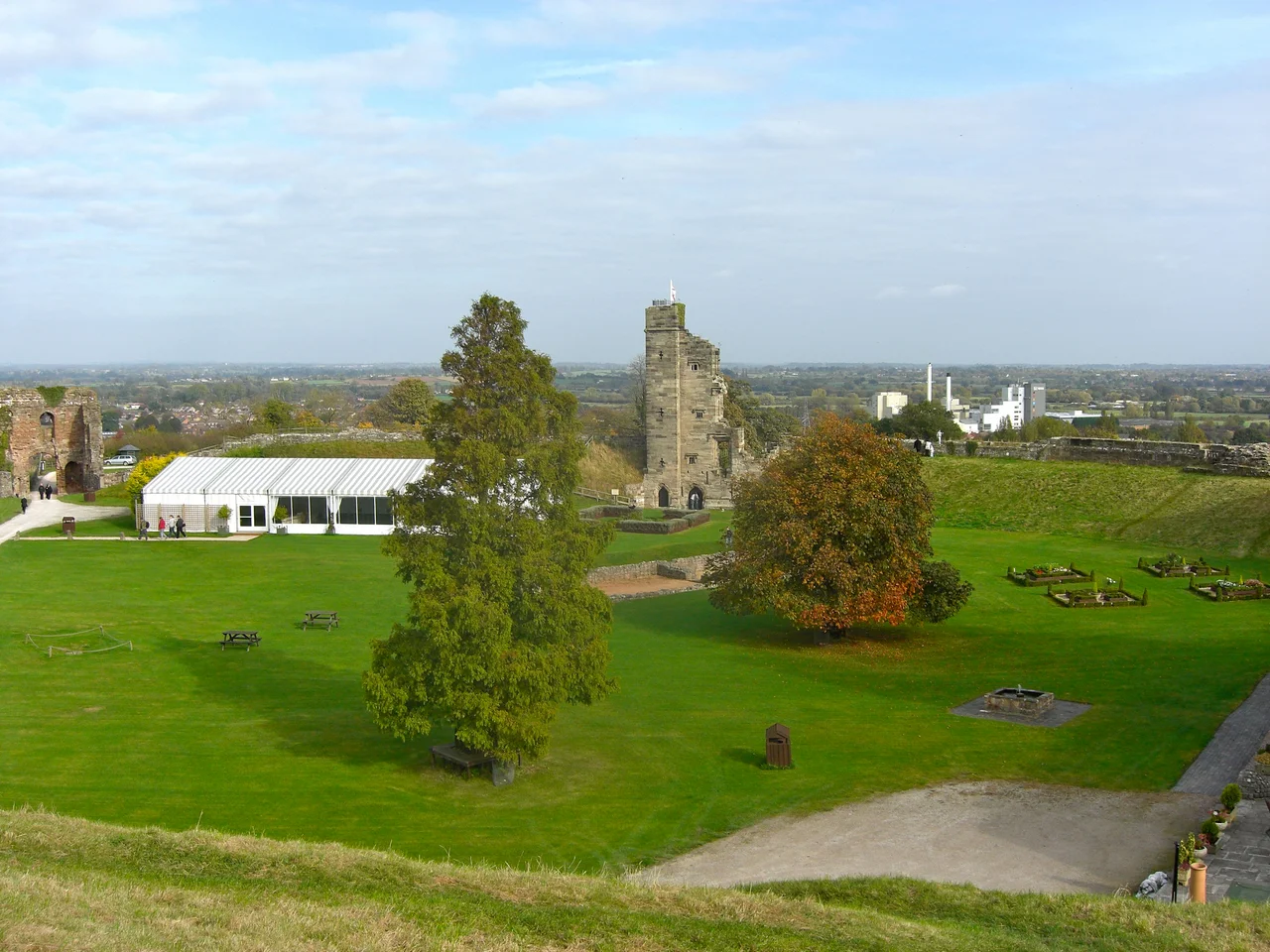

Tutbury Castle
Mary Queen of Scots called herself the "pauvre prisonniere" of Tutbury, and she was not exaggerating for sympathy. The castle she was sent to in 1569, and again in 1585, was a damp and ill-fitting hilltop fortress on the Staffordshire-Derbyshire border, its plaster wet, its carpentry draughty, its garden an enclosure of wooden palings she said was more like a pig run than anything fit for a queen. Today the castle is mostly ruin. A nineteenth-century folly called Julius' Tower stands on the motte where the original Norman keep once rose, and the surviving stretches of curtain wall and the broken stump of John of Gaunt's Gateway look out across the Dove valley toward the village of Tutbury below. The Duchy of Lancaster still owns it, which means, in 2026, it belongs to King Charles III.
Norman Foundations
The first castle at Tutbury was raised by Henry de Ferrers, one of William the Conqueror's most powerful Norman followers, sometime after 1066. Henry made it his headquarters in the wapentake of Appletree, the medieval administrative district that included the hunting forests of Duffield Frith. Around 1080 he and his wife Bertha endowed nearby Tutbury Priory, and for a time the new English priory was a dependency of the Norman abbey of St Pierre-sur-Dives, an act of long-distance feudal piety that linked this corner of Staffordshire to the Calvados hills back home. The de Ferrers family held the castle for a century, until William de Ferrers picked the wrong side in the revolt of 1173 against Henry II and saw Tutbury slighted, that is, deliberately damaged so it could not be used militarily, along with twenty other rebel strongholds.
From Stronghold to Showpiece
The de Ferrers kept rebelling. In 1264, after the family backed Simon de Montfort against the crown, Prince Edward, the future Edward I, nearly destroyed the castle. Five years later Henry III gave the confiscated estates to his second son, Edmund Crouchback, founding the Duchy of Lancaster, the royal estate to which Tutbury still belongs after 756 years. By the early 1300s the castle had been rebuilt as a residence rather than a fortress. Thomas, second Earl of Lancaster, made Tutbury his principal home and lived there in what one contemporary called "more than princely style." In 1313 his household accounts ran to 22,000 pounds, a stupefying sum at a time when food was cheap. Local farmers and craftsmen found a guaranteed market for everything they could produce. For a few decades, Tutbury was less a castle than a small inland court.
The Captive Queen
Mary Stuart arrived at Tutbury on 4 February 1569, after a long winter journey south from Bolton Castle in Yorkshire. The English Privy Council wanted her far from the Scottish border, and Tutbury, with its high enclosure and its remote position, suited Elizabeth's anxieties. Tapestries and bedding were rushed from the Tower of London, but bad weather delayed the wagons, and Bess of Hardwick had to strip her own house at Sheffield to furnish the queen's rooms. Mary noted, with a Frenchwoman's eye, that the castle looked like the hunting lodge at the Bois de Vincennes outside Paris. She complained of the damp, the wet plaster, the rotting carpentry. She passed time embroidering with Lady Livingston and Mary Seton in Bess of Hardwick's chamber. She was moved out in April, brought back in September with a tighter guard, rushed to Coventry that November when northern Catholics rose in her name, and ordered back to Tutbury on Christmas Eve. By May 1570 she was gone, sent on to Chatsworth and a long road that would end on the scaffold at Fotheringhay.
1585: The Last Stay
In January 1585 Mary came back, and this time her treatment hardened. Her keepers, Ralph Sadler and John Somers, struggled to find acceptable hangings for her bedchamber, which sat under the eaves of a timber-built lodging with windows that opened only into the castle courtyard. To keep warm she rigged a tent of tapestry over her bed. The French ambassador Michel de Castelnau wrote to her son James VI describing her early optimism about "Teutbery," but the letters that followed catalogued small humiliations. Sadler took her hawking on the River Dove with a guard of 40 or 50 horsemen, an indulgence that scandalized Elizabeth and got him replaced in April by the puritanical Sir Amyas Paulet. Paulet took down Mary's cloth of estate, the canopy that signaled her queenship, from the room where he ate his meals. He stopped her servants walking on the wall walk. He curtailed her almsgiving in the town and disarmed her Scottish household, many of whom had carried pistols. By Christmas Eve 1585 she was moved on to Chartley, and from Chartley to the Babington plot, and from the Babington plot to her death.
The Civil War and the Folly
The castle's last act as a real military post came in the English Civil War. Held for the king by Sir Andrew Kniveton, it withstood one Parliamentary assault in 1643 and held out until April 1646, when its garrison surrendered after a three-week siege. Parliament, having decided that the place was untenable, ordered the fortifications demolished between 1647 and 1648. The walls came down, the towers were left as picturesque stumps, and in 1780 a romantic-minded landowner crowned the motte with a sham medieval tower, Julius' Tower, named for nothing in particular. Today the castle is a scheduled monument and Grade I listed, open to visitors who climb the hill knowing that a French-speaking queen once shivered in a room here with a tapestry tent over her bed.
From the Air
Tutbury Castle sits at 52.86°N, 1.69°W on a low hill above the River Dove, on the Staffordshire-Derbyshire border about 4 miles northwest of Burton upon Trent. From the air the motte and folly are clearly visible above the village and the river crossing, with the wide farmland of the Dove valley spreading north toward Ashbourne. East Midlands Airport (EGNX) lies 12 nautical miles to the east, the closest controlled airspace. Birmingham (EGBB) is roughly 22 nm to the south-southwest. Recommended viewing altitude is 2,500 to 4,000 feet to read the hilltop fortifications and the river loops below.
Nearby Stories
- Broad Eye Windmill 1.9 km away
- Cromford Mill 3.1 km away
- Murder of Naomi Smith 5.5 km away
- Grantham Canal 6.5 km away
- Round Oak Steelworks 8.1 km away
- Nottinghamshire 9.7 km away
- Battle of Naseby 16 km away
- Sandbach Crosses 18 km away