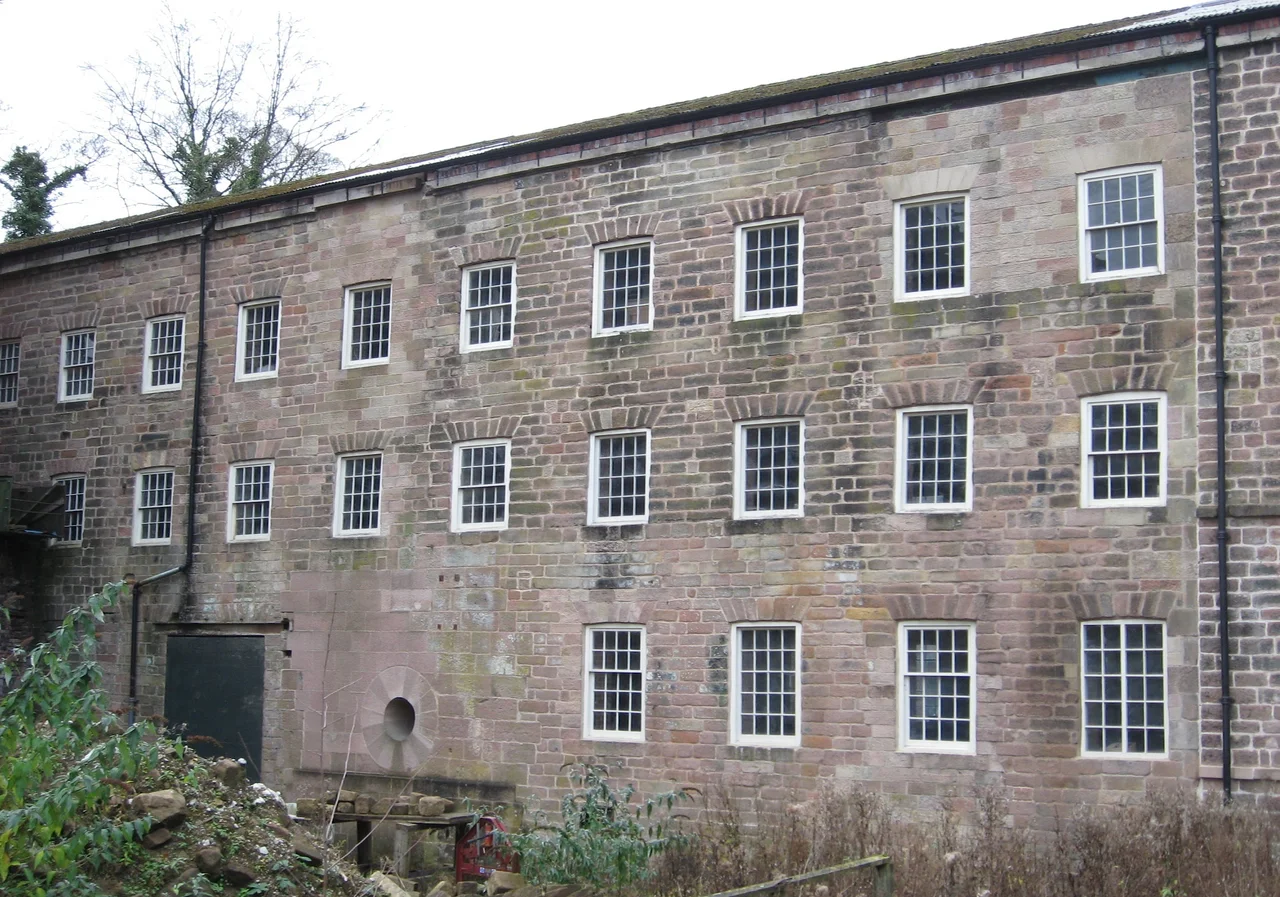

Cromford Mill
Six in the morning, six in the evening: the gate of Cromford Mill closed on the dot, and any worker who missed it lost not one day's pay but two. That detail alone tells you something fundamental about what Richard Arkwright did here in 1771. Before Cromford, work followed daylight and weather and the rhythms of the household. After Cromford, work followed the clock and the wheel. The mill itself sits in a deep cleft of the Derwent valley in Derbyshire, where soft limestone water from the Cromford and Bonsall soughs spilled out into a brook that Arkwright bent to his purpose. The building is small and unromantic, four storeys of grey stone tucked beside a sluice. From this modest hinge, the modern world swung.
Why Cromford, Why 1771
Arkwright was a wig-maker from Preston with a gift for systems. He had patented a water-powered spinning machine, the water frame, in 1769, and he needed a stream powerful and reliable enough to drive it day and night. The Bonsall Brook and the Cromford Sough, an old lead-mine drainage channel, met at a point where a small valley folded into the Derwent. The water never froze; the sough kept flowing in dry summers; the village was poor and short of work. Arkwright bought rights to the water, built his mill, and then did the harder thing. He built the workforce. Because the local farming families would not enter the mill, he constructed cottages on North Street, schools, shops, pubs and a chapel. He invited entire families to settle. The factory was new. The factory town was new. Cromford was the prototype for both.
Six A.M., Six P.M.
The discipline of the closed gate spread faster than the machinery. Within a generation, mills from Lancashire to Saxony to Pawtucket, Rhode Island, were running on Arkwright's pattern. Samuel Slater, who had been apprenticed to Arkwright's partner Jedediah Strutt, emigrated to America with the system carried in his head and founded the United States cotton industry on Cromford lines. Arkwright's water frame patent was eventually overturned for lack of originality, but it didn't matter. The bigger invention was the social one. When Arkwright died in 1792 he was the wealthiest untitled person in Britain. He had not just made a machine. He had made the working day as we still mostly know it, with its bells and shifts and lost pay for being late.
Cromford Dollars
By 1801 the Napoleonic Wars had drained silver coinage from Britain, and small employers struggled to pay wages in legal tender. At Cromford, Arkwright's son ordered Spanish silver dollars to be overstamped with the figures '4s 9d' and circulated to the workforce. The coins, now called Cromford dollars, are extraordinary objects: Spanish reales bearing the head of Charles IV, stamped by an English mill, used to buy bread from a shop owned by the same family who owned the mill that paid for the bread. A few have survived. They sit in display cases at Derby Museum, small silver hieroglyphs of the closed economic loop that early industrial villages depended on.
The Long Sleep
Cotton spinning ended at Cromford around 1847 after Arkwright's son lost a landmark water-rights court case to a competing sough. The mill became a dyeing plant, then a colour-pigment works, then a derelict shell. Some of the buildings were lowered by two storeys. The 1775 mill burnt down in 1890. By the 1990s the site was a chemical waste hazard with a toxic tank covering the original waterwheel chamber. The Arkwright Society bought it in 1979 and began the slow work of cleaning it up. In 2001 the Derwent Valley Mills, including Cromford, were inscribed as a UNESCO World Heritage Site. In 2013 a working replica of an Arkwright water frame was installed. Finding suitable cotton roving for it proved a problem: no one spins cotton in Britain anymore, and the eventual supplier was a Swiss firm with experimental stock.
A Site to Walk
Cromford Mill is now open to the public every day. The eighteenth-century weavers' cottages still line North Street, with their characteristic three-storey loomshop windows on the top floor. The Cromford Canal towpath runs south from the mill yard to High Peak Junction, where you can see the surviving engine houses of one of the world's earliest railway inclines. The canal itself is a Site of Special Scientific Interest, full of dragonflies and herons. In 2024 the BBC filmed Antiques Roadshow in the mill courtyard, which seemed fitting: the building that invented industrial mass production hosting a programme about objects we now value because they were not industrially mass produced. A 20-kilowatt hydro-turbine is being installed in the old wheel chamber, restoring water power to the place where water power industrialised the world.
From the Air
Cromford Mill sits at 53.109°N, 1.556°W in the steep limestone valley of the River Derwent in Derbyshire, on the southern edge of the Peak District. From the air, look for the village of Cromford where the A6 crosses the Derwent; the mill complex is the cluster of stone buildings immediately east of the river. Recommended viewing altitude is 2,500 to 3,500 feet AGL; the valley sides rise to over 1,000 feet AMSL. East Midlands Airport (EGNX) lies about 25 nautical miles southeast, Sheffield City Heliport (EGSY) about 22 nautical miles north-northeast, Manchester (EGCC) about 35 nautical miles northwest. Expect typical Peak District weather: low cloud, drizzle, and rapid changes. The Derwent Valley Mills run as a UNESCO World Heritage corridor from here south to Derby.
Nearby Stories
- Nottinghamshire 3.7 km away
- RAF Finningley 5.5 km away
- Grantham Canal 7.2 km away
- Repton Abbey 7.9 km away
- Manchester 8.8 km away
- Macclesfield 9.7 km away
- Wentworth Castle 11 km away
- Broad Eye Windmill 12 km away