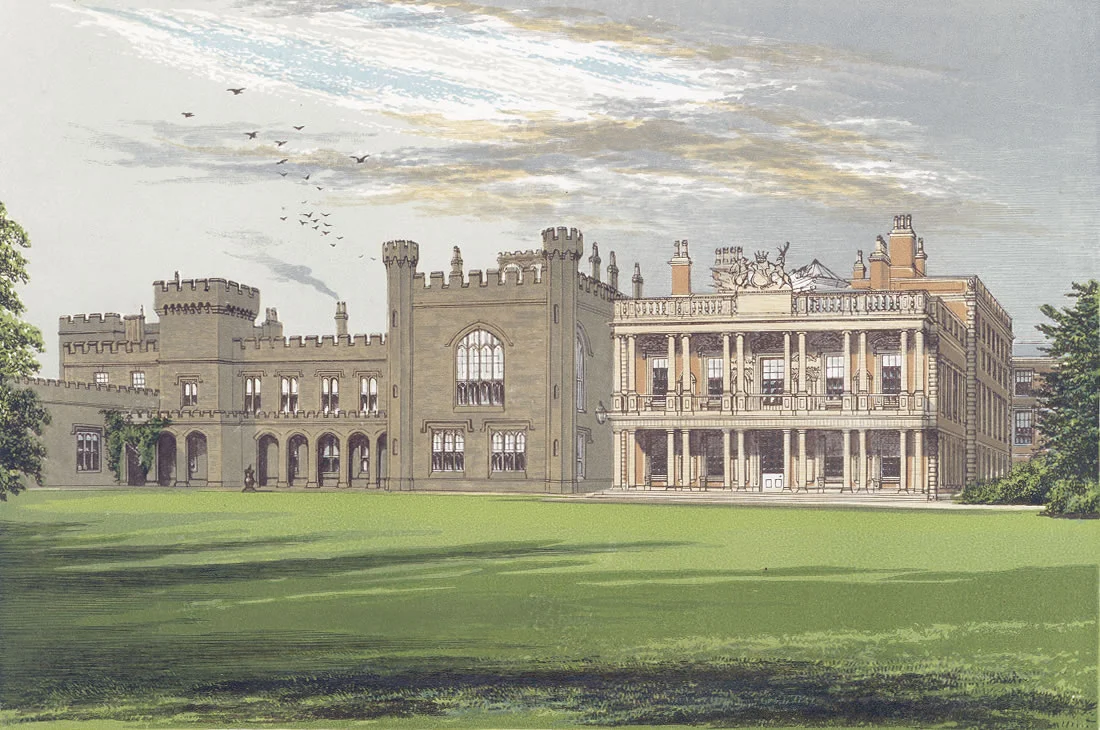

Knowsley Hall
Edward Lear came to Knowsley Hall to draw the animals. The 13th Earl of Derby kept a menagerie - one of the largest private collections of exotic creatures in early-Victorian Britain - and he wanted them documented properly. The young, asthmatic, restless artist Lear arrived in 1832, set up his easel beside enclosures of parrots and tortoises and rare cattle, and produced the lithographs that would make his early reputation. The Earl's children took to him. He began making nonsense verse for them - the kind of verse that eventually filled A Book of Nonsense and made him, alongside Lewis Carroll, the founding figure of English children's literature. The owls and the pussycats started here.
From Hunting Lodge to Great House
Knowsley began as a medieval hunting lodge on the Lathom estate, the property of the Stanley family. In 1702 it passed to James, the tenth Earl of Derby - a man who had married into significant wealth and chose to spend it. He turned the lodge into a country house. Robert Adam designed a dairy in 1776-77 (since demolished); John Foster and William Burn added Gothic castellations and extensions around 1820. In the early twentieth century, W. H. Romaine-Walker 'tidied up' the house for the seventeenth Earl. After the Second World War, the architect Claud Phillimore reduced the buildings considerably, and the family moved into a smaller but still substantial residence elsewhere in the park. Since 1953 the hall has been designated a Grade II* listed building.
The Stanleys, Across Five Centuries
Thomas, the second Earl, rode with Henry VIII at the Battle of the Spurs in 1513. Ferdinando, the fifth Earl, was a poet and patron of writers including William Shakespeare; he held the earldom for a single year before dying of arsenic poisoning in 1594, in circumstances that have intrigued historians ever since. Edward, the 14th Earl - the one who built the Safari Park lay in the future - was three times Prime Minister of Great Britain, the longest-serving leader of the Conservative Party in its history. He steered the Slavery Abolition Act through Parliament, and his third administration passed the Second Reform Bill of 1867, doubling the British electorate. The current incumbent is Edward Richard William, the 19th Earl, who with his wife Caroline (daughter of the 10th Lord Braybrooke) has overseen the hall's most recent restoration.
Capability Brown's Lake
The parkland around Knowsley was reshaped in the 1770s by Lancelot 'Capability' Brown - the most influential landscape designer in English history - who flooded a 62-acre depression to create the lake that feeds the water gardens around the hall. The Octagon, a summer house designed by Robert Adam, dates from 1755. The whole park covers 2,500 acres. Inside the hall, the rooms still open to visitors carry the layered tastes of three centuries: the Entrance Hall panelled in carved oak; the Grand Staircase hung with oil paintings on leather; the Walnut Drawing-Room with a portrait of the actress Elizabeth Farren, who married the 12th Earl; the library full of natural history books gathered by Edward Lear's patron; the Stucco Room, originally Rococo, now a sprung-floor ballroom that links the Royal Lodging to the rest of the house.
The Safari and the Hall Today
In 1971, the 18th Earl founded Knowsley Safari Park on the estate - one of the earliest drive-through safari parks in Britain, where lions and giraffes share an Edwardian landscape with the visitor traffic. The Park remains the most public face of the estate. The hall itself is now a working venue, licensed for weddings, available for conferences and corporate events, with the grounds hosting fundraisers for local charities. In 2025 it doubled as the fictional Fackham Hall - the Davenport family seat - in the parody film of the same name. The estate also contains the highest point in the Knowsley unitary authority. Like a great deal of the surrounding modern Merseyside, this is a place where five hundred years of aristocratic continuity now sit comfortably alongside parkland that anyone can drive a Ford Fiesta through to see a rhinoceros.
Flight Context
Knowsley Hall sits at approximately 53.438 degrees north, 2.838 degrees west, in the Metropolitan Borough of Knowsley about seven miles east-northeast of Liverpool city centre. Liverpool John Lennon Airport (EGGP) is approximately 7 nautical miles south-southwest. The estate's 2,500 acres show up clearly from the air as a green block of parkland and woodland in the otherwise built-up suburban belt between Liverpool and St Helens; the Safari Park enclosures and the lake are the easiest visual references. Best identified from 2,000 to 4,000 feet AGL.
From the Air
Located at 53.438N, 2.838W in the Metropolitan Borough of Knowsley, east of Liverpool. Nearest airport: Liverpool John Lennon (EGGP), approximately 7nm south-southwest. The 2,500-acre estate forms a distinct green block of parkland; the Safari Park enclosures and the 62-acre Capability Brown lake provide strong visual references. Best viewed 2,000-4,000 feet AGL.
Nearby Stories
- Blackpool Pleasure Beach 4.4 km away
- Whalley Abbey 4.8 km away
- Worsley 5.4 km away
- Second Battle of Middlewich 7.7 km away
- Chester Zoo 7.9 km away
- Llanrwst 23 km away
- Abergele Rail Disaster 27 km away
- Sea Lion Rocks railway station 73 km away