
Chester Zoo
Nobody knew, in 1956, whether chimpanzees could swim. When Chester Zoo released its troop onto a cluster of grassy islands separated from visitors by twelve feet of water, the keepers were guessing. It turned out chimps cannot swim, and the islands became one of the most photographed enclosures in British zoo history. That gamble was characteristic of the man who built the place. George Mottershead had returned from the First World War in a wheelchair, and he had decided, against the medical and architectural orthodoxies of his time, to make a zoo without bars.
The Boy and the Lizards
Mottershead's family ran a market garden in Shavington, near Crewe, and exotic plants kept arriving with stowaway lizards and insects tucked into the soil. The boy collected them. A trip to Belle Vue Zoo in Manchester in 1903 lit the rest of the fuse. He read Carl Hagenbeck, the German showman who had reimagined the zoo as a place of moats and ditches rather than iron cages, and he absorbed the ideas of the Swiss ethologist Heini Hediger. When he came back from the trenches, broken in body but not in conviction, he searched for the right piece of England to put his ideas down. He chose Oakfield Manor in Upton-by-Chester, then a country village, and bought the house and nine acres of gardens for three and a half thousand pounds in 1930. The locals objected. He went ahead anyway, and Chester Zoo opened on 10 June 1931.
Moats Instead of Bars
Hagenbeck's moat principle had been used elsewhere, but never as systematically as at Chester. Mottershead extended it to species the German had never tried, including those chimpanzees on their water-ringed islands. The chimps became a centrepiece. The zoo grew, and so did the principle behind it: an animal kept in a space that resembled its world would live longer, breed more reliably, and teach visitors more honestly than one staring out from behind iron. The North of England Zoological Society, founded in 1934 as a registered charity, took over the work. The zoo has never received government funding. It supports itself, and it has grown into the largest zoo in Britain, employing over six hundred and fifty permanent staff and rising past a thousand in the summer.
Two Million Through the Gate
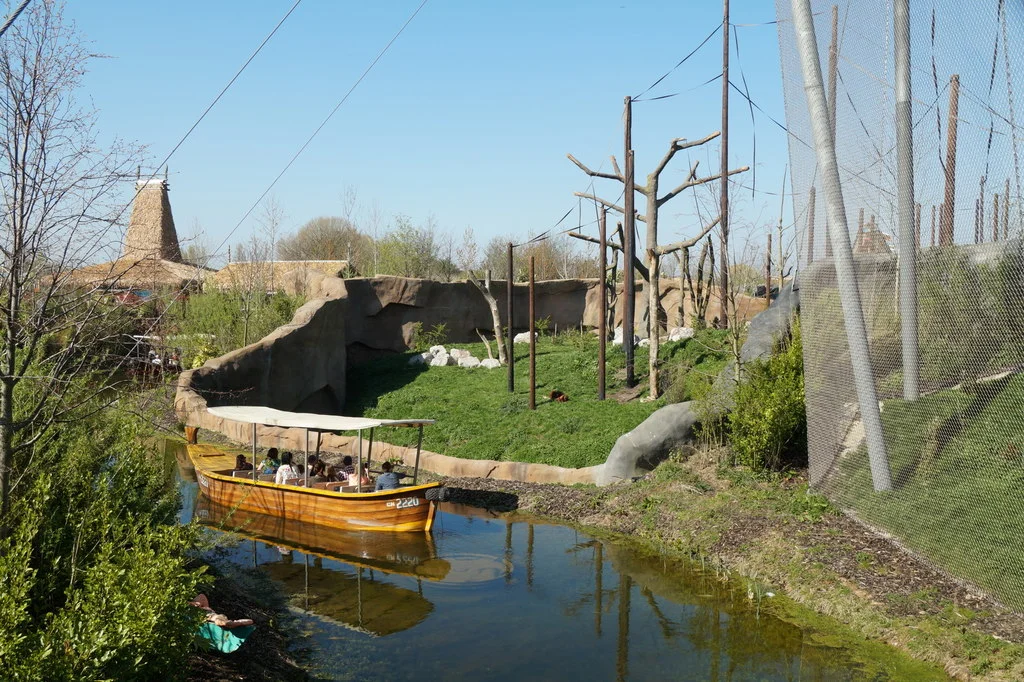
By 2019, Chester Zoo was drawing more than two million visitors a year, making it the most-visited wildlife attraction in Britain. Forbes called it one of the fifteen best zoos in the world. TripAdvisor users have repeatedly named it the best in the UK and among the top three globally. The reasons are partly the moats Mottershead pioneered and partly what has been added since. Islands at Chester Zoo, opened in 2015 at a cost of forty million pounds, recreates six Southeast Asian habitats and lets visitors cross between them on bridges or by boat. The Heart of Africa exhibit opened in April 2025 across twenty-two and a half acres of savannah, housing fifty-seven species including giraffes, zebras, naked mole-rats, and fifteen thousand locusts. The numbers sound preposterous until you remember that ecosystems work that way.
The Quiet Work of Saving Species
Behind the visitor paths, Chester runs one of Europe's most ambitious conservation breeding programmes. At the end of 2007, more than half the species at the zoo appeared on the IUCN Red List, and 155 were classified as threatened. The zoo manages international studbooks for ten species, including the Sumatran tiger, the eastern black rhinoceros, and the Rodrigues flying fox. In 2016 Chester became the first zoo outside New Zealand to breed the tuatara, a lizard-like reptile that is the last surviving sphenodont, a prehistoric lineage older than the dinosaurs. The first snow leopards in the zoo's history arrived in 2024 as part of a global breeding programme; the female cub Bheri was born in June 2025. In the same year, Chester announced a vaccine, developed with the University of Surrey, for the elephant herpesvirus that has killed so many young Asian elephants in zoos and in the wild.
Walking the Bridleway
Flag Lane, the public bridleway, still bisects the zoo. The original Elephants' Bridge carried zoo vehicles between halves, and Bats' Bridge, opened in 2008, lets pedestrians and mobility scooters follow. The land beyond the public area grows food for the herbivores. In 2025 the zoo introduced colour zones to help visitors navigate the expanding site: yellow for elephants and bats, pink for the Islands, orange for the Heart of Africa, green for the chimps and okapis, blue for the Himalayan habitat where the snow leopards live. A man who spent years in a wheelchair built something that millions can now walk, ride, and roll through. The zoo he started in nine acres of garden now covers a hundred and sixty hectares, and the chimps, ninety years on, still cannot swim.
From the Air
Located at 53.227N, 2.884W in Upton-by-Chester, on the northern outskirts of Chester. From altitude the zoo's 160-hectare grounds form a distinctive green oval north of the city, bisected by the Flag Lane bridleway. The new Heart of Africa savannah at the western edge and the Islands lake cluster to the south are recognisable features. Nearest airports: Hawarden (EGNR, 5nm southwest) and Liverpool John Lennon (EGGP, 12nm north). The Mersey estuary is visible to the north.
Nearby Stories
- Goodison Park 1.5 km away
- First Battle of Middlewich 2.4 km away
- Whittington Castle 4.2 km away
- Worsley 9.5 km away
- Gwrych Castle 14 km away
- Lilleshall Abbey 22 km away
- Cymer Abbey 31 km away
- Celtic Array 70 km away