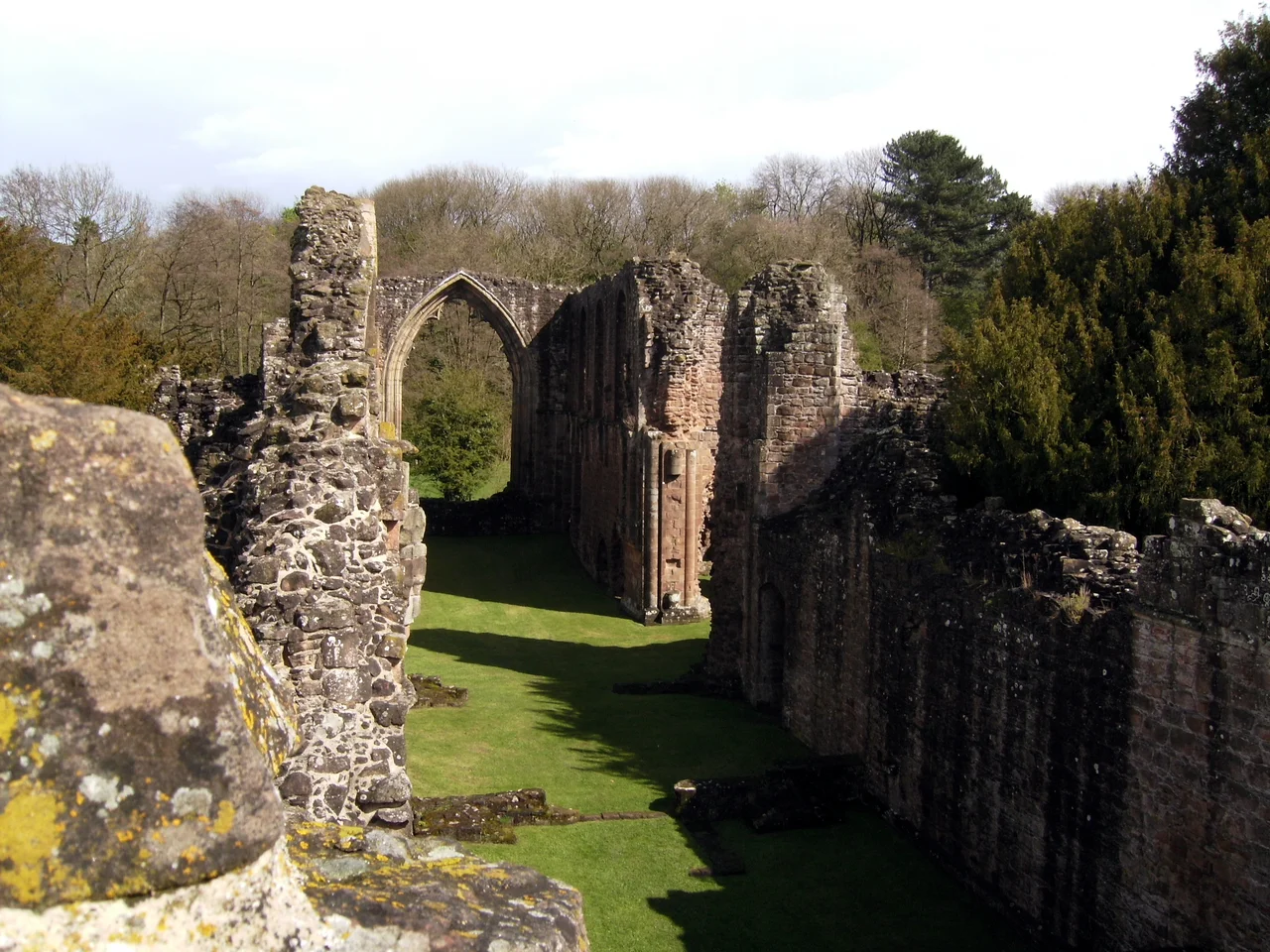

Lilleshall Abbey
Look closely at the lopsided romanesque archway of Lilleshall Abbey's main west portal and you will see, between the masonry pillars that flank it, the sheer mass of stone meant to hold up a great western tower that no longer exists. The tower probably came down during the English Civil War. The Belmeis brothers who founded the abbey in the 1140s could not have imagined a war between Parliament and a king, but they had founded it during another civil war, the Anarchy of King Stephen and Empress Matilda, and they knew enough about violence to take care that the abbey would survive whoever was on the throne. It survived for almost four centuries. The west tower did not survive the cannon.
Two Brothers and a Civil War
Lilleshall was founded between 1145 and 1148 by two Shropshire brothers, Richard and Philip de Belmeis. Richard was Archdeacon of Middlesex and dean of the college of St Alkmund in Shrewsbury. Philip was lord of Tong. They were nephews of a former Bishop of London, and between them they had inherited much of the Belmeis family land in the West Midlands. King Stephen was fighting his cousin Empress Matilda for the throne, and the country was in the long civil instability historians call the Anarchy. To secure the abbey against any possible outcome, the brothers got charters from Stephen, from Matilda, from her son the future Henry II, from the Pope's Legate, from Theobald of Bec the Archbishop of Canterbury, and from a clutch of bishops. The abbey was Augustinian, but of a stricter sort: it followed the customs of the Abbey of Arrouaise in northern France, an austere reform that imitated the Cistercian discipline. The Belmeis brothers funded it by suppressing St Alkmund's, an ancient collegiate church in Shrewsbury, and diverting its rents to the new house in the Shropshire woods.
An Estate Across Five Counties
Within a century Lilleshall had become a major landlord. Its core estate lay in Shropshire and Staffordshire, but the abbey also held land in Leicestershire, Derbyshire, Warwickshire, Northamptonshire, Wiltshire, Norfolk, and even Yorkshire, with houses in Welshpool, Newport, Stafford, Shrewsbury, and a property near the Tower of London. The Lilleshall demesne alone supported four granges, each a working farm with sheep, oxen, ploughs, and tenants. The abbey ran a tannery and a brewery on site. By the mid-15th century it employed more than twenty household servants: two porters, a butler, a chamberlain, two cooks, a baker, a bell-ringer, a cobbler, a washerwoman, a carpenter and his apprentices. John of Gaunt, Duke of Lancaster, came here in the late 14th century and stayed for two days with his wife Katherine Swynford and a vast retinue. Lilleshall was the kind of place that received princes.
The Dissolution and a Stand by Cannon
By the early 14th century the abbey was in financial trouble, criticised by visiting bishops for poor accounting, too many corrodies, and the brewer's incompetence. It survived, just, and by the time of Henry VIII's first wave of dissolutions in 1536, Lilleshall was technically large enough to escape. It bought itself another two years. On 16 October 1538 Abbot Robert Watson and ten remaining canons signed the surrender. Watson received a pension of fifty pounds and the abbey's London house. The contents were sold off and meticulously listed: altars, plate, beds, pots, pans, the small stock of grain, the hay, the livestock. Total receipts: seventy-four pounds, eighteen shillings. The choir stalls were given to a parish church, where they survive today. In 1543 the manor was bought outright by the Leveson family, who turned the abbot's lodging into a country house. A century later, during the Civil War, Royalist forces garrisoned the buildings, and Parliamentary cannon brought down most of what is missing today, including the western tower.
Walking the Ruin
The cruciform church was over sixty metres long and had a stone-vaulted roof. The main walls still stand, restored after the 1960s when mining subsidence forced English Heritage's predecessors to prop them with timber. The west front confronts you first: a wide central doorway under a romanesque round arch, with the great empty space above where a window and tower once rose. The doorway itself was finished comparatively late, in the 13th century, the round arch chosen on purpose to harmonise with the older work visible through it. On the south wall, beside the transept, the processional entrance from the cloister survives almost intact, with a segmental arch surmounted by a three-order round arch and a tympanum entirely carved in detailed zigzag. The chancel and presbytery, the oldest parts of the building, were begun in the later 12th century. A great 14th-century east window was inserted as the rest of the abbey aged, and it still dominates the church even though the glass is long gone. The cloister was a garden surrounded by domestic buildings: chapter house, parlour, refectory, slype. Ancient yew trees, dark and very old, lean over the southern wall.
Why Lilleshall Survives
Most English monastic ruins were quarried for their stone within a generation of dissolution. Lilleshall escaped that fate because the Leveson family bought it and used what they could and left the rest. Their seat moved elsewhere, the abbey site sank back into farmland, and the romanesque walls were left to gather lichen and ivy. The Ministry of Public Building and Works took guardianship in 1950 and English Heritage looks after it today. There is no admission fee. On a wet weekday afternoon in October you can be the only person inside the precinct, and the silence under the great empty east window is profound. The Augustinian canons sang their offices here eight times a day for nearly four hundred years. Whatever you make of monasticism, that is a long human practice to have been pursued in one place, and the ruin keeps the shape of it.
From the Air
Located at 52.72 N, 2.39 W in north-east Shropshire, 6 miles north of Telford. From 2,500 to 4,000 feet, the ruin appears just east of Lilleshall village on the Shropshire plain, with the Wrekin hill rising prominently to the south and Newport visible to the north-east. Nearest airports: RAF Cosford (EGWC) about 6 nm south, RAF Shawbury (EGOS) about 11 nm north-west.
Nearby Stories
- Welshampton Rail Crash 1.4 km away
- Knowle and Dorridge Rail Crash 1.4 km away
- Bewdley 2.3 km away
- Tamworth Castle 4.4 km away
- Battle of Mortimer's Cross 8.1 km away
- Wedgwood 8.8 km away
- Derby Museum and Art Gallery 19 km away
- Powis Castle 24 km away