
Derby Museum and Art Gallery
In one corner of the Derby Museum hangs a painting called The Alchymist in Search of the Philosopher's Stone. A figure in a long robe kneels in front of a flask that is exploding into light. The light is not metaphor: in 1669 a German alchemist named Hennig Brand really did boil down enormous quantities of his own urine in pursuit of a way to make gold, and what he produced instead was phosphorus, which ignites spontaneously in air. The painter, Joseph Wright of Derby, was depicting an actual scientific discovery in a style that made it look like a religious vision. The museum that houses this picture, along with more than 300 other Wright works, is essentially a memorial to the moment when science replaced faith as the central drama of European life, painted by an artist who lived and worked here.
From Mechanics' Institute to Public Museum
The story of the museum starts on 10 February 1836 with the founding of the Derby Town and County Museum and Natural History Society, a typical Victorian gathering of clergymen, doctors, and gentleman collectors. In 1839 the group held a major exhibition at the Mechanics' Institute, which displayed objects from Joseph Strutt's private collection alongside fossils and shells. Many of those Strutt items made their way permanently into the museum. The collection was given to Derby Corporation in 1870, vanished into storage for three years, and finally opened to the public on 28 June 1879 in a new building designed by Richard Knill Freeman. The site was a gift from Michael Thomas Bass, the brewer whose name still hangs over half the public buildings of Burton. The art gallery wing followed in 1882. An extension funded by Alfred E. Goodey's 1945 bequest of 13,000 pounds was finally completed in 1964 and now houses most of the displays.
The Lunar Society in Paint
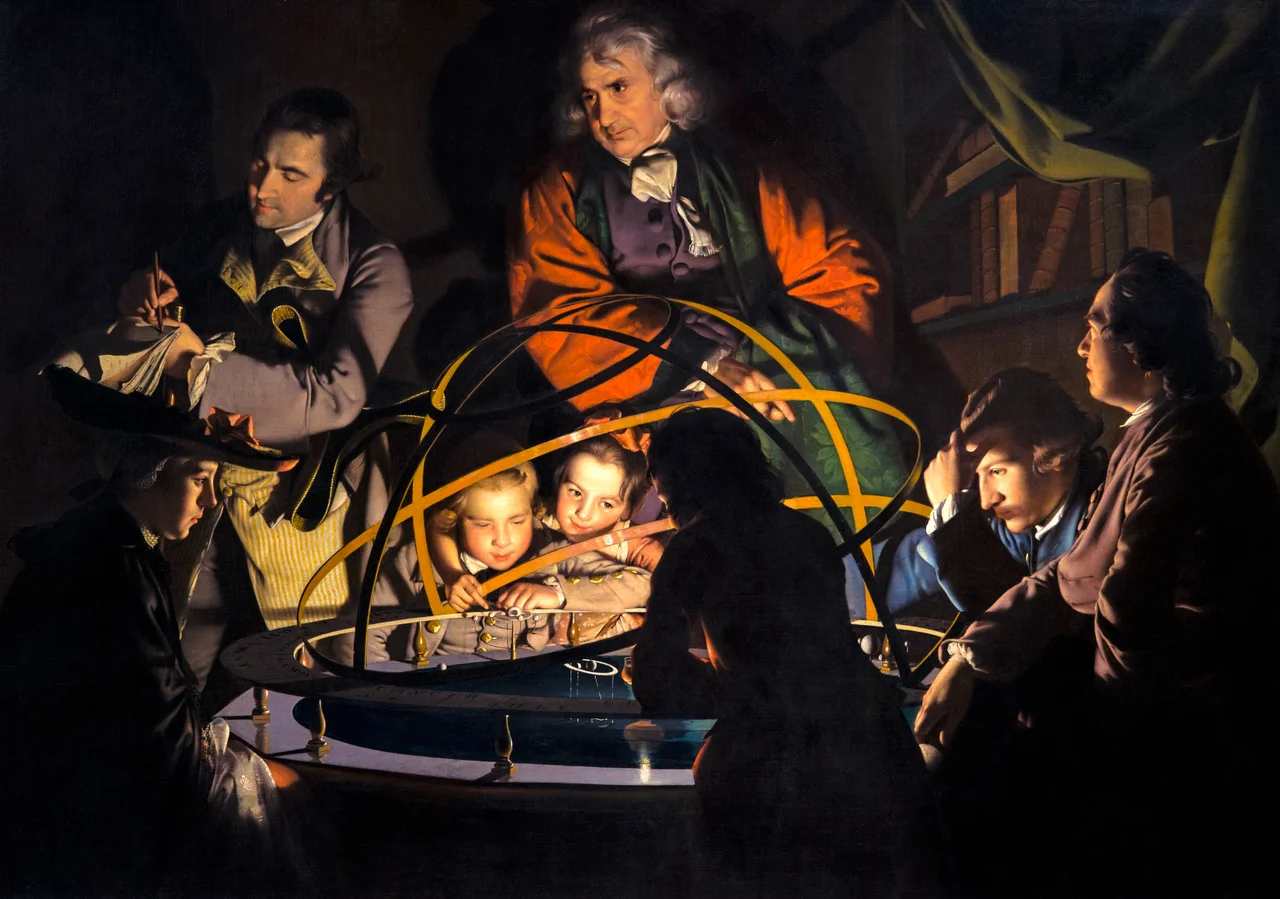
Eighteenth-century Derby sat at the center of a quiet revolution. The Lunar Society, an informal club that met by moonlight in Birmingham so members could ride home safely after dinner, brought together Erasmus Darwin, Matthew Boulton, Joseph Priestley, and Josiah Wedgwood, with Benjamin Franklin sending letters from across the Atlantic. Erasmus Darwin, grandfather of Charles, moved to Derby in 1783 and founded the Derby Philosophical Society. Joseph Wright knew them. His clockmaker neighbour John Whitehurst built scientific instruments for the Lunar circle, and tickets for visiting lectures by the Scottish astronomer James Ferguson in July 1762 were sold from Whitehurst's workshop. Wright almost certainly attended. His most famous paintings, A Philosopher Lecturing on the Orrery (1766) and An Experiment on a Bird in the Air Pump (1768), depict these public demonstrations of natural philosophy by candlelight, the same dramatic chiaroscuro Caravaggio gave to martyrdoms now applied to a tabletop model of the solar system. The Derby Gallery owns 34 of his oil paintings and over 300 sketches, the largest single Wright holding in the world, and in 2011 the city formally adopted him as its civic brand.
The Air Pump and the Guillotine
The paintings are not just charming science demonstrations. Edmund Burke, the political philosopher, wrote in 1790's Reflections on the Revolution in France that British radicals who supported science "considered man in their experiments no more than they do mice in an air pump." Wright's air pump painting, completed more than twenty years earlier, shows a small cockatoo gasping inside a glass globe while a lecturer's hand hovers on the valve. The expressions on the faces of the spectators, two children turn away in tears, a young man stares fascinated, a girl peers anxiously, capture the moral unease of an age learning that knowledge has a cost. Joseph Priestley, one of the Lunar Society members and a friend of the painter's, fled to America after Birmingham mobs burned his house in 1791. His collaborator Antoine Lavoisier, the French chemist who named oxygen, was guillotined in 1794. The Enlightenment did not arrive painlessly. The Derby Gallery is one of the few places in the world where you can see the period painted, with sympathy and dread, by someone who lived through it.
The Bonnie Prince Charlie Room
Tucked into the museum's upper floor is a panelled room reconstructed from the original Exeter House, demolished in 1854, where Charles Edward Stuart held his council of war on 5 December 1745. Bonnie Prince Charlie's Jacobite army had marched as far south as Derby, the closest a Stuart claimant ever came to retaking London. In that room his officers persuaded him to turn back rather than risk the open road. The retreat ended at Culloden the following April. The panelling was rescued, the museum added related objects, and Queen Victoria sent down an original letter of the Prince from her own collection. The room is small and slightly stuffy, lit by lamplight, and it still feels like a place where bad decisions could be made.
Pa-Sheri and the Repton Stone
The wider collection has its share of unexpected residents. A carved fragment of a cross shaft from Repton, known as the Repton Stone, shows a mounted figure in mail armour with a diadem, which some scholars argue is a memorial to King Aethelbald of Mercia, killed in 757 and buried at Repton. If they are right, this small stone is the earliest large-scale pictorial representation of an English monarch. The museum also holds the mummified remains of two ancient Egyptians named Pypyu and Pa-Sheri; in 2025 Pa-Sheri was temporarily moved to the University of Lincoln for conservation work, the kind of long, careful labor on fragile human remains that contemporary museums increasingly do in public. There is a deep Bretby Art Pottery collection, the Soldier's Story gallery dedicated to the 9th/12th Royal Lancers, the Sherwood Foresters, and the Derbyshire Yeomanry, and a not-talked-about 2012 episode in which more than a thousand items, mostly coins, medals and watches, were stolen from the museum's offsite storage facility and only some were recovered. The museum's holdings, like its city, are layered, sometimes unexpectedly compromised, and always worth a slow walk through.
From the Air
Derby Museum and Art Gallery stands at 52.92°N, 1.48°W on the Strand in the centre of Derby, a short walk from the cathedral and the River Derwent. From the air the museum is part of the dense Victorian streetscape between the cathedral tower and the Derwent crossing. East Midlands Airport (EGNX) lies 9 nautical miles to the southeast, the closest controlled airspace. Birmingham (EGBB) is roughly 32 nm to the southwest. Recommended viewing altitude is 1,500 to 3,000 feet to read the central Derby grid, the cathedral, and the curve of the river to the east.
Nearby Stories
- Prestbury, Cheshire 4.2 km away
- Stoke-on-Trent 5 km away
- Bingham, Nottinghamshire 8.6 km away
- Beauchief Abbey 9.6 km away
- Shot at Dawn Memorial 9.6 km away
- White Ladies Priory 13 km away
- Oakham 23 km away
- Battle of Gainsborough 24 km away