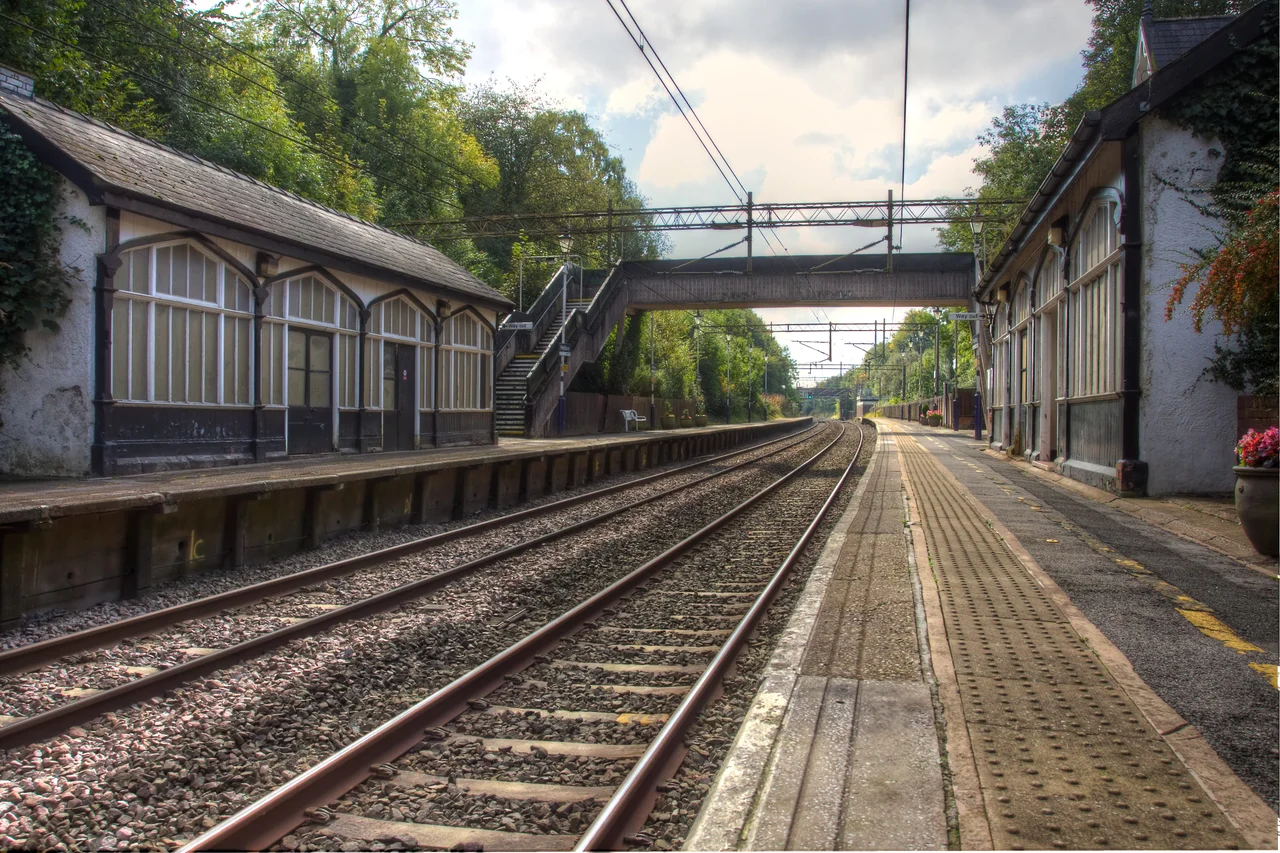

Prestbury, Cheshire
The name Prestbury does not mean priests' town. It means a priest's fortified enclosure, from Old English Preosta burh, and that small distinction tells the story of the village's beginnings. Sometime in the early medieval period, churchmen chose this elbow of high ground on the River Bollin because the river could be crossed easily on both sides, and because the wild forest of Macclesfield to the east promised both shelter and game. Today the same place houses Cheshire's most concentrated footballer enclave and an A.A. Gill nickname, "Smug Central", but a Saxon cross still stands in the churchyard, and the parish church is still surrounded by the medieval village.
A Parish of Thirty-Five Townships
At the time of the Norman Conquest the parish of Prestbury was enormous. Thirty-five townships answered to its church, from Macclesfield itself out to Wildboarclough, Wincle, and Lyme Handley. Curiously, the township of Prestbury was not mentioned in the Domesday Book of 1086, which suggests it was a church without a manor rather than a settlement that had been forgotten. Twelve of its neighbours were recorded. Butley was worth two shillings at Domesday, down from thirty in Edward the Confessor's time. Adlington and Macclesfield were each assessed at twenty. Eight others were simply marked Waste. The church administered both ecclesiastical and civil business until the Local Government Act of 1894 finally separated the two, by which point only three of the old townships, Butley, Fallibroome, and Prestbury itself, made up the modern civil parish.
The Silk Village
Through the 19th century, Prestbury was a centre of the Cheshire silk industry. The parish accounted for roughly a third of all men employed in that trade across England and Wales in the early 1800s, a remarkable concentration for so small a place. Swanwick's factory drew workers from outside, and rows of factory cottages went up, including a terrace nicknamed Irish Row. Weavers' cottages with extra-tall upper storeys lined New Road and the village street, the long windows letting in the light a hand-loom needed. The mill itself burned down in 1940. Around the same time, the village street still ran straight up to a ford across the Bollin where it met Pearl Street in Butley. A two-arched bridge was thrown across in 1825, then replaced in 1855 with the single-arched stone bridge that still carries the road today.
The Saxon Cross
St Peter's Church is a Grade I listed building, and in its churchyard sits a small Norman chapel which in turn shelters a Saxon cross. The chapel was old before England had a single king; the cross is older still, marking a Christian site that predates the Conquest. The parish memorial to the dead of the two World Wars stands in the west porch of the main church. Other listed buildings huddle inside the conservation area: the Bridge Hotel, Prestbury Hall, Horner's, and the Priest's House, all designated focal buildings. Brooks Cottages on the Butley side of the Bollin carries a plaque dated 1686, marking out the year Rodger Brooks and his wife Ellen built their house in the twenty-fourth year of his life. Spittle House, just outside the protected area, was probably raised as a leper hospital between 1300 and 1450, a reminder that medieval villages also looked after their sick.
The Hatter and the Naturalist
Thomas Henshaw, born in Prestbury in 1731, made his money as an English hatter and his name as a benefactor. Brian Houghton Hodgson, born here in 1801, became one of the great pioneer naturalists and ethnologists of the East India Company era, working in India and Nepal and collecting the knowledge that filled museum cases across London. Mike Yarwood, the impressionist who made a national career out of impersonating Harold Wilson, lived here too. So did Sir David Nicholas, who edited ITN's news for years. Noddy Holder of Slade lives nearby, the snooker player Alex Higgins lived on the border of Prestbury and Mottram St Andrew during his peak, and the fantasy author Ian Livingstone was born in the village. It is an unusual mix for somewhere this small.
Footballers' Alley
The defining change of the 21st century in Prestbury has been architectural: substantial Victorian houses replaced by new mansions, often built for Manchester's footballing aristocracy. Wayne Rooney built a house here, and so at one time or another did Michael Carrick, Peter Crouch, Carlos Tevez, Ashley Young, Wes Brown, Owen Hargreaves, Stephen Ireland, and Robbie Savage. Stan Pearson, who played 312 games for Manchester United before the modern era and won eight England caps, retired to a newsagent's and post office in the village in the 1950s. Freddie Flintoff, the former England cricket vice-captain, has also lived locally. Prestbury Golf Club, designed by Harry Colt in 1920, sits at the southern end of the village and is ranked among the country's best parkland courses. The village has been called Smug Central by at least one travel writer, but the priest's fortified enclosure on the Bollin has survived stranger labels than that.
From the Air
Prestbury lies at 53.2928 N, 2.1452 W in Cheshire, two miles north of Macclesfield and on the western edge of the Peak District foothills. Manchester Airport (EGCC) is roughly 11 miles to the north-west. The River Bollin runs through the village from east to west. Prestbury Golf Club's parkland and the railway tunnel south of the village are useful visual cues. Recommended viewing altitude is 2,500 to 4,500 feet AGL, with the dark moorland of Macclesfield Forest rising to the east.
Nearby Stories
- Hope Cement Works 1.5 km away
- Liverpool John Lennon Airport 3 km away
- Diglake Colliery Disaster 3.4 km away
- Holt Castle 4.6 km away
- Bank Hall 6.9 km away
- Rochdale Pioneers Museum 8.3 km away
- National Coal Mining Museum for England 9.6 km away
- Belper North Mill 19 km away