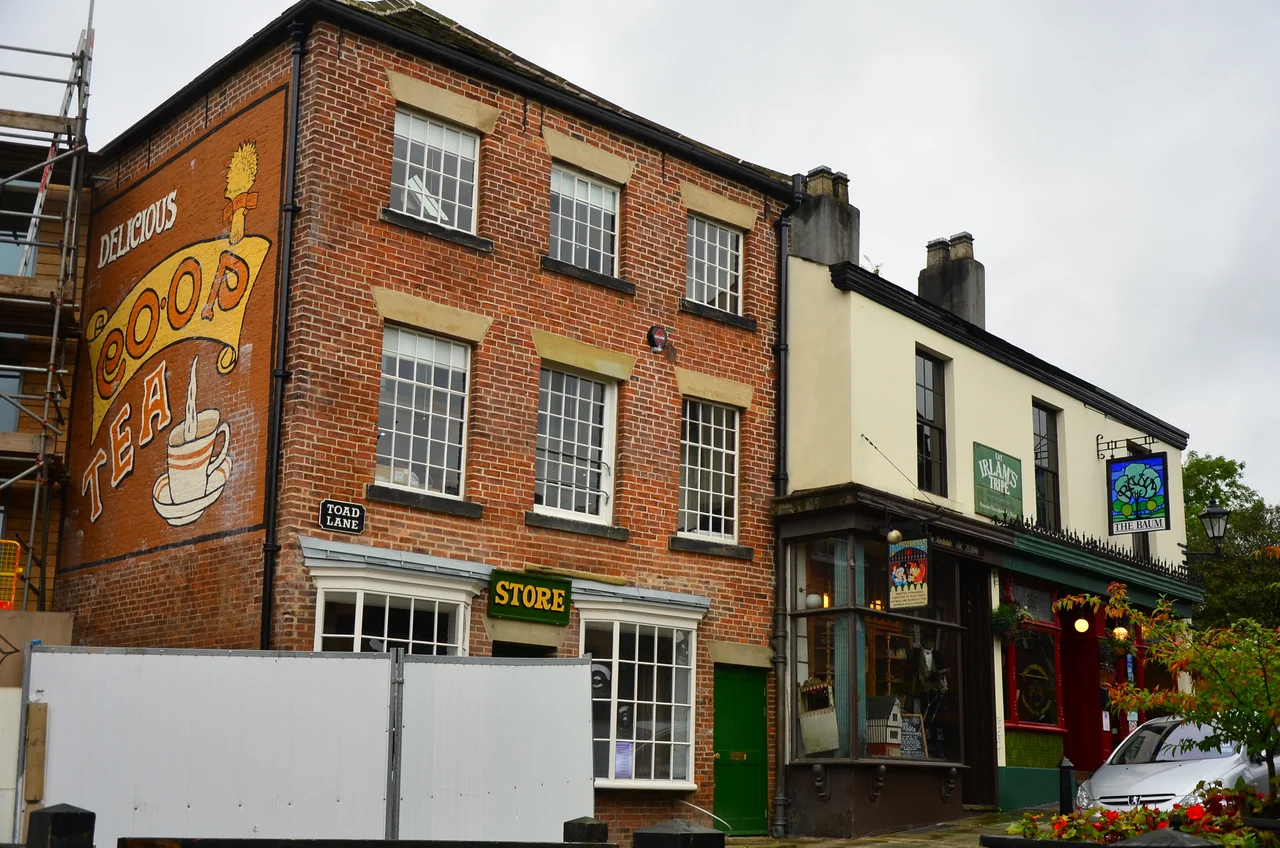

Rochdale Pioneers Museum
The counter was a plank laid across two barrels. The stock, when the shop opened on 21 December 1844, amounted to a small heap of butter, sugar, flour, oatmeal and candles. The proprietors were twenty-eight Rochdale weavers and tradesmen, organised as the Rochdale Society of Equitable Pioneers. They had pooled their money - a pound each - and rented the ground floor of an 18th-century warehouse at 31 Toad Lane. They were not the first people to attempt a cooperative shop. They were, however, the first who made one work in a way that lasted, and the way they did it became known as the Rochdale Principles. Every co-op in the world today, from Italian wineries to American electric cooperatives to the Co-operative Group that still operates British high streets, traces its lineage to this plank on two barrels.
Why 1844
The Rochdale Pioneers did not appear from nowhere. The 1840s were a brutal decade in industrial Lancashire - a long depression, falling wages in the cotton mills, the Chartist agitation, the Plug Plot riots. A failed weavers' strike in Rochdale had left a generation of working men looking for something else. Robert Owen had been preaching cooperation since the 1820s. Earlier attempts at cooperative shops had failed, mostly because they extended credit and went bust. The Pioneers' insight was that they would sell only for cash, at market prices, but pay a dividend to members based on what they had bought. The surplus went back to the membership. They added other principles: democratic control - one member, one vote - regardless of how much capital each had subscribed; political and religious neutrality; education funded from the business. These ideas, taken together, became the Rochdale Principles and have been adopted, with revisions, by cooperative movements worldwide.
The Building
31 Toad Lane began as an 18th-century warehouse on what was then a busy thoroughfare leading into central Rochdale. In December 1844 the Pioneers rented only the ground floor - the Methodist society used the upstairs. By 1849 the Co-op had taken the entire building and added a library, a meeting room, and a boot and shoe department. In the 1860s they expanded into neighbouring buildings, and in 1867 they moved to new purpose-built premises. The original shop became, of all things, a pet shop. The Co-operative Union bought the building back in 1925 specifically to create a museum, which opened in 1931. The building tells its own story of survival - in the 1970s it was discovered to be structurally unsound and by the end of the decade was on the verge of collapse.
Saving Toad Lane
The job of saving 31 Toad Lane fell to a CWS architect named Roy Collins. His solution was bold and unromantic: insert a reinforced concrete cage inside the building, providing all the structural strength, while leaving the original exterior walls 9 inches out of plumb to preserve the lean and character of the period building. From the street, the building looks 18th-century and weathered, because it is. Inside, modern engineering holds everything up. Rochdale Council redeveloped the surrounding street - which had been a cul-de-sac since the 1960s - with cobbled paving, 19th-century gas lamps, and a unique Victorian post box. The work won a Civic Trust Award in 1981 for its great sensitivity. HRH Princess Alexandra attended the reopening that year.
What the Museum Tells
The ground floor contains a recreation of the original shop - the rudimentary furniture, the scales, examples of the goods the Pioneers stocked. The exhibits trace the development of the early cooperative movement, the formulation of the Rochdale Principles, the lives of inspirational cooperators, the history of retail, the 20th-century social history of the movement, and its international spread. The museum is owned and operated by the Co-operative Heritage Trust. A lottery-funded refurbishment in 2010-12 brought it up to current standards. It is a small museum - one building, four floors - in an unremarkable street in a Lancashire mill town. The reason people come from around the world to see it is the same reason it exists: a movement that today has more than a billion members globally started here, in this room, with this counter, in late December 1844.
From the Air
The Rochdale Pioneers Museum sits at 53.6187 degrees north, 2.1594 degrees west, on Toad Lane in central Rochdale. Manchester Airport (EGCC) lies about 26 km south. Manchester Barton (EGCB) is about 24 km south-southwest. Leeds Bradford Airport (EGNM) is about 35 km east-northeast. From altitude Rochdale is the substantial town in the bowl below the Pennines on the M62 corridor, north of the Manchester conurbation.
Nearby Stories
- Bank Hall 2.9 km away
- Huyton 3.7 km away
- Low Moor Explosion 5.1 km away
- Hat Works 8.8 km away
- Heysham Port 10 km away
- Hope Cement Works 11 km away
- Mercer Art Gallery 14 km away
- Malham Cove 14 km away